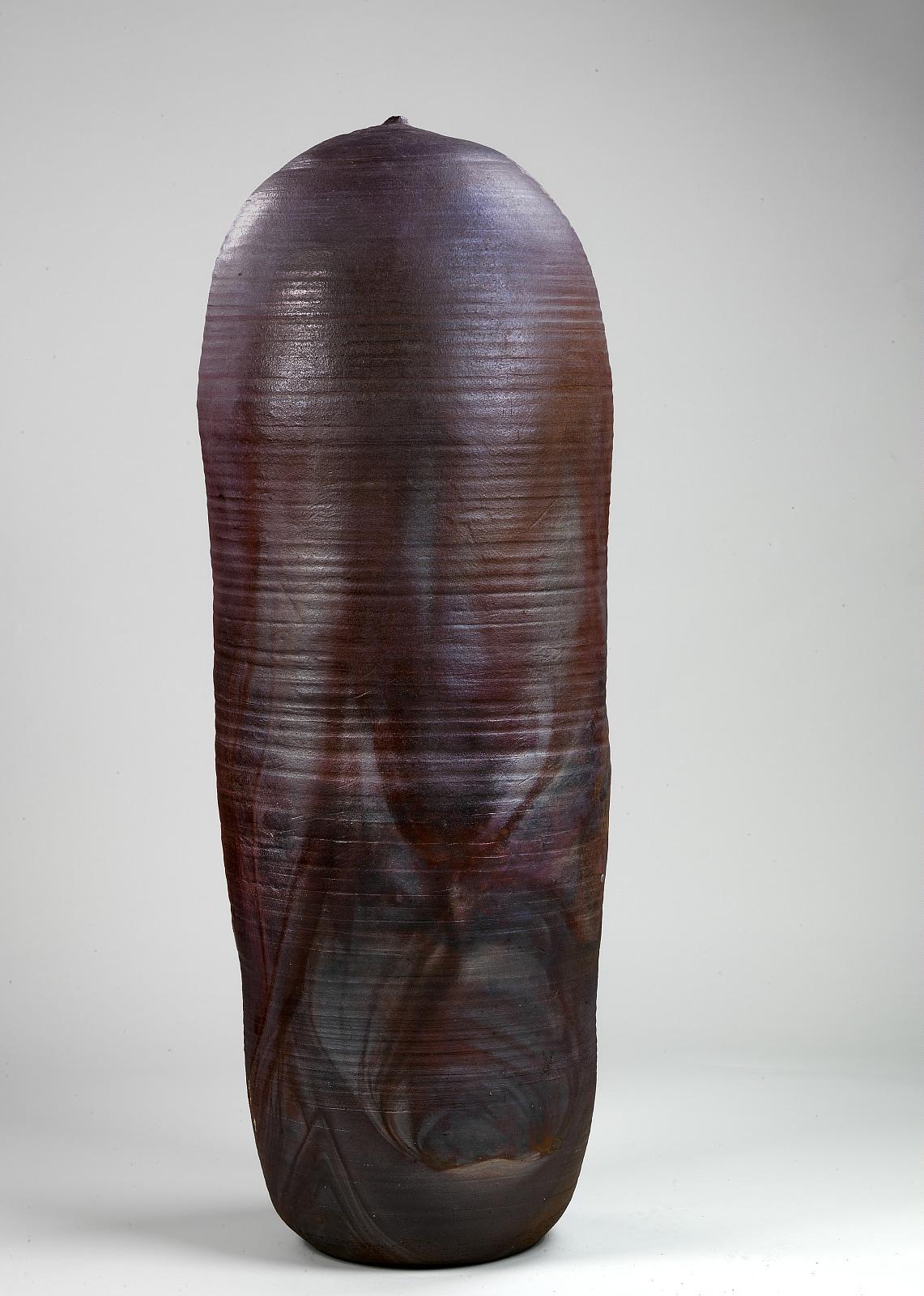
Image context: the photographed work is Takaezu's Anagama, not a generic studio pot. Its long, subtly irregular body is one of her closed forms: the surface is fully available to sight, but the chamber that makes latent sound possible stays inaccessible.[2]
At first, Toshiko Takaezu's Anagama appears to have forgotten what a vessel is for. The glazed stoneware body rises a little over one meter, rounds at the shoulder, and ends without the open mouth that would ordinarily explain a pot's purpose. Nothing can be poured in, stored, served, or readily taken out. Yet the work has not stopped being a vessel. It has made containment more intense. What it holds is an interior the viewer cannot inspect and, potentially, a small ceramic rattle whose movement can turn that hidden volume into sound.[2]
That conversion—from useful opening to sealed presence—is often treated as the instant when Takaezu carried ceramics from craft into sculpture. The formula is tidy but incomplete. Her closed forms do not escape pottery. They depend on a potter's knowledge of centering, throwing, joining, drying, glazing, and firing, then use that knowledge to make utility unavailable without making the vessel irrelevant. Closure is not a rejection of the medium's history. It is the technique that lets shape, skin, chamber, weight, and sound become equally important.
Closing the mouth changes the whole body
Takaezu began with functional ceramics. She worked at the Hawaii Potter's Guild in Honolulu from 1940, studied with Claude Horan at the University of Hawaii, and moved to Cranbrook Academy of Art in 1951 to study with Maija Grotell. After an eight-month trip to Japan in 1955, she taught first at the Cleveland Institute of Art and later, from 1967 to 1992, at Princeton. The closed form emerged from that unusually broad foundation: commercial production, rigorous wheel work, postwar abstraction, Japanese ceramic traditions, and decades of teaching were not separate chapters so much as tools kept active together.[1][3]
The process begins in recognizable pottery. Smithsonian American Art Museum describes Anagama as wheel-thrown at its base, then extended through coils and hand building into a nearly closed spheroid.[2] On other works, the precise sequence and proportion could vary, but the structural problem remained: wet clay had to rise beyond the scale or contour that throwing alone could comfortably provide, and each added section had to become one continuous load-bearing wall.
The top was brought inward until only a vestigial neck or tiny duct remained to vent gases during firing. Museum descriptions sometimes call the result sealed and sometimes nearly closed; the useful distinction is between technical venting and functional access. A pin-sized firing aperture does not restore the mouth of a bowl. Visually and practically, the opening has ceased to organize the object.[1][4]
That small act redistributes attention. On an open pot, the lip announces an inside, the rim frames it, and the exterior often reads in relation to that promised capacity. On a Takaezu closed form, the eye cannot complete that familiar route. It travels around a continuous silhouette instead. Shoulder, flank, foot, glaze run, and minute asymmetry acquire more force because no mouth tells them where the front or purpose should be.
Closure also makes the clay body responsible for its own presence. Takaezu's forms range from objects that sit within the scale of two hands to works as high as six feet that required scaffolding; among her upright variations were the cylinders she called “Trees.”[1] Anagama, at 100.5 centimeters high and only 36.9 centimeters across at its widest irregular diameter, has the upright tension of a figure without becoming figurative.[2] Its scale is bodily, but its rounded continuity withholds the cues—face, gesture, opening—that would turn that bodily impression into a character.
The rattle makes an invisible measurement
The hidden sound began with an accident. While trimming a rim, Takaezu broke off a fragment that fell into a vessel and survived firing without fusing to the wall. The loose shard transformed the finished object into a rattle. She then made the accident repeatable by wrapping small clay pieces in paper before placing them inside. The paper burned away in the kiln; the clay pieces fired into separate beads.[5]
This is a modest intervention with a large consequence. A rattle does not merely add an amusing secret. When a closed form is moved, each impact reports a different part of the chamber that sight cannot reach. A short, sharp knock suggests one trajectory; a cluster of smaller contacts suggests another. Sound becomes a rough measurement of interior diameter, curvature, wall hardness, and the force of the person handling the work. The inaccessible cavity announces its dimensions through duration and resonance.
The sound is also conditional. It exists only when a body lifts, tips, rolls, or carefully rocks the ceramic. That makes the closed form a latent instrument rather than a continuously sounding sculpture. Weight matters: the two-foot form discussed by the Museum of Fine Arts, Boston, requires strenuous engagement, while a smaller work can shift in the hands.[5] The maker composed the chamber and selected the loose pieces, but the eventual rhythm depends on another person's strength and care.
Museums complicate that relationship. Ceramic sculpture is fragile, and visitors ordinarily meet it through sight alone. The rattle can therefore be central to the work while remaining silent in the gallery. The 2024 retrospective Toshiko Takaezu: Worlds Within addressed that contradiction directly: sound artist and co-curator Leilehua Lanzilotti developed recordings and demonstrations that activated selected closed forms, allowing their concealed “soundscapes” to enter the exhibition without turning every object into a handling station.[6] The mediation is not the same as holding one. It does, however, restore a technical fact that a pedestal can suppress.
Glaze becomes a surface without a privileged front
If closure makes the vessel sculptural, glaze prevents it from becoming a mute geometric solid. Takaezu brushed, poured, splashed, and dripped glaze across stoneware and porcelain, sometimes layering applications so that kiln heat would make colors meet in ways she could influence but not fully script.[1]
The method has often invited comparison with Abstract Expressionist painting. The resemblance is real—there are runs, veils, bursts, and gestural passages—but a closed form refuses the fixed viewing position of a canvas. A brush mark disappears around a curve and returns altered by light. A pour gathers speed down one side, thins over a shoulder, or stops where the glaze chemistry and gravity reach a temporary truce. To see the whole painted event, the viewer has to move, and even then it can never be held in one glance.
Takaezu's surface is therefore neither applied decoration nor a picture wrapped around neutral volume. The glaze tells the eye how the form swells, turns, leans, and closes. It can exaggerate a ridge or visually dissolve one; a dark run can pull the body downward while a pale field makes the same clay seem buoyant. Fire fixes these decisions while modifying them. Technique here includes the disciplined admission that chemistry, gravity, atmosphere, and heat are collaborators with different tolerances than the hand.
This helps explain why closure and glaze belong together. Without an open mouth, the exterior becomes an uninterrupted field. Without the glaze's movement, that field could feel hermetic. Color keeps circulating around the object even though access to its cavity has been denied.
A closed form is not a dead end
Takaezu extended the logic rather than repeating one perfect silhouette. Rounded closed forms led to Moons, upright Trees, strong-shouldered bodies, slit-open “Momos,” and eventually bronze bells; painting and weaving also remained active parts of her practice.[1] The variations show that closure was not a signature shape to be branded. It was a question-generating device. How little opening is enough? How large can a chamber become? When does an internal rattle turn volume into an instrument? What happens when a slit lets darkness become visible, or when bronze makes sound the object's public function?
The strongest reading of the closed forms is therefore not that Takaezu made pots useless so museums could call them art. She made one familiar use impossible in order to reveal several less obvious capacities already latent in the vessel. Clay can carry load, register touch, hold darkness, receive color, survive chance, resist sight, and shape sound. Pottery knowledge does not sit behind those effects as preliminary training. It is what makes every one of them credible.
In Anagama, the visible sculpture and the concealed instrument occupy exactly the same wall of clay. The viewer gets the glaze and silhouette immediately; the chamber must be inferred, and the rattle may never be heard. Takaezu's technical achievement was to keep those unequal kinds of access in productive tension. She closed the vessel, but she did not finish the encounter.
Sources
- Toshiko Takaezu Foundation, “Toshiko Takaezu” — biography and practice overview covering her training, 1955 study in Japan, closed-form construction, scale, glaze application, teaching, and work across ceramics, painting, fiber, and bronze.
- Smithsonian American Art Museum, “Toshiko Takaezu, Anagama” — collection record, dimensions, medium, construction description, rattle method, and source page for the article's museum photograph.
- Princeton University Art Museum, “Toshiko Takaezu, artist” — institutional account of the closed vessel, internal rattle, hand-worked surfaces, biography, and Princeton teaching career.
- Cleveland Museum of Art, “Toshiko Takaezu, White Form” — object record explaining the paper-wrapped clay bead, painterly glaze, and development of Takaezu's closed vessels while she taught in Cleveland.
- Museum of Fine Arts, Boston, Jacqueline Yu, “Closed Form” (October 31, 2023) — museum essay on the accidental first rattle, Takaezu's deliberate paper-wrapped clay pieces, and the bodily effort required to sound a large closed form.
- The Noguchi Museum, “The Noguchi Museum Announces Toshiko Takaezu: Worlds Within” (December 2023) — institutional press release on the retrospective, its approximately 200 works, and Leilehua Lanzilotti's sound-focused activation of the closed forms.