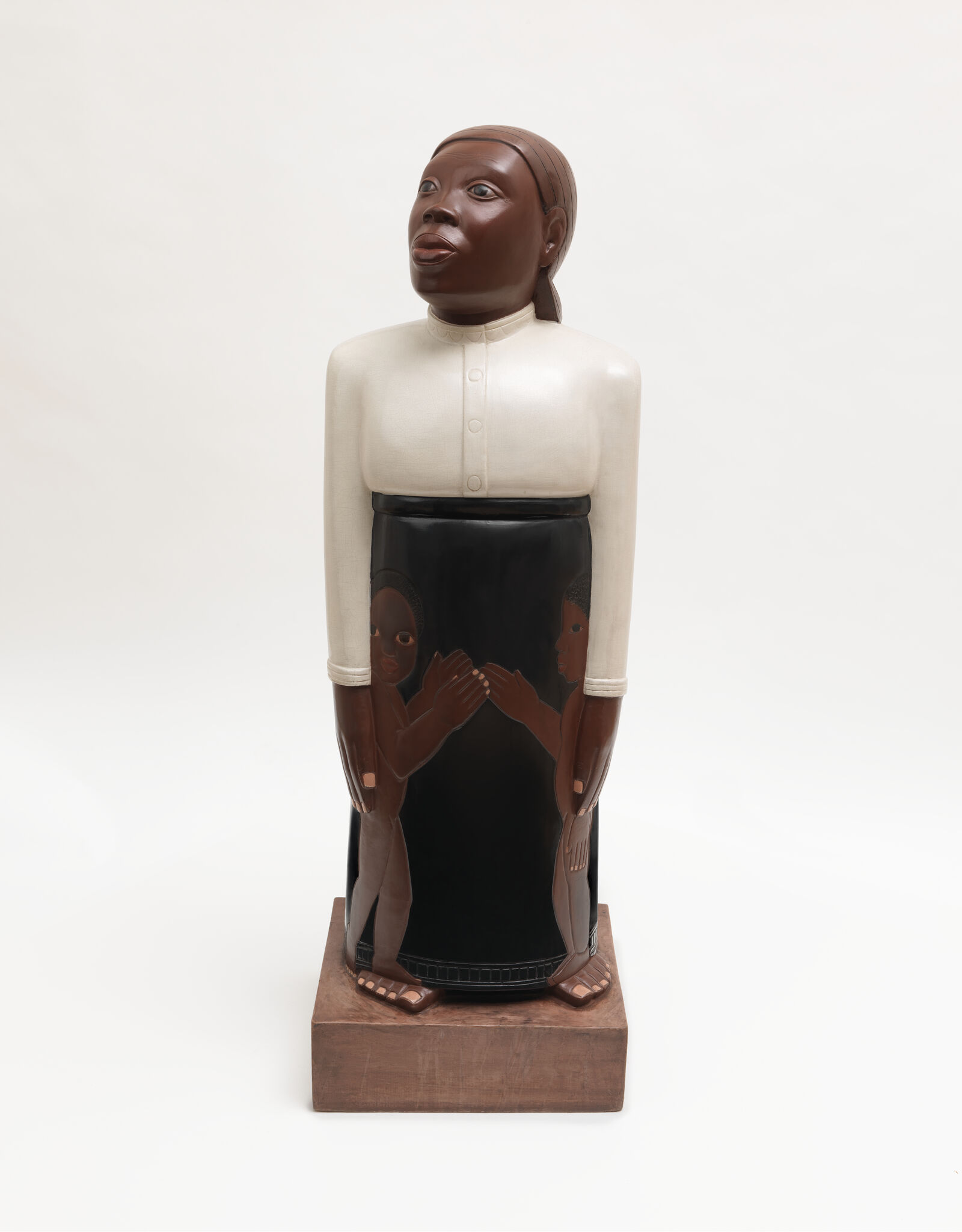
Image context: this is SFMOMA's direct museum photograph of the sculpture discussed below, not a generated reconstruction or a diagram. Its frontal view makes the shared column legible: the children are neither separate statuettes nor painted symbols, but bodies modeled into the mother's form.[1]
Sargent Johnson's Forever Free is only three feet tall, but it behaves like a monument. A Black woman stands upright on a square base, her white blouse fastened to the neck and her long dark skirt descending almost without interruption to her feet. Her chin rises and her face turns slightly away. On either side, two nude children press against her body under the full length of her arms.
Look longer and the family arrangement becomes stranger. The children do not merely stand beside the woman. Johnson cut and modeled them into the same narrow column. Each child stands upon one of her feet; their outer contours barely escape the dark field of her skirt. They face each other and meet hands across its center, while the mother's long arms form the sculpture's edges. Protection is not illustrated by an embrace added to three independent figures. It is built into the object's load-bearing shape.
That shared structure is why the title cannot settle into a simple declaration. Forever Free names emancipation, while the sculpture shows freedom as a condition carried by bodies that cannot be visually disentangled. The mother looks beyond the object; the children remain within her outline. Johnson makes hope visible, but he also gives it weight.
Three figures, one piece of ground
SFMOMA dates Forever Free to 1933 and records its dimensions as 36 by 11½ by 9½ inches. The museum describes a carved redwood core covered with layers of gesso, cloth, and paint; the Huntington's 2024 exhibition materials identify painted plaster over linen and wood.[1][2] Those descriptions matter because the sculpture's apparent simplicity is not the simplicity of an untouched log. Johnson built a new skin over wood, then used that skin to make carving, shallow relief, modeling, and color read as one continuous body.
In a 1964 oral-history interview, Johnson remembered beginning with a straight log and placing a mother and two children in relief upon it.[3] The recollection clarifies what the finished work still lets us see. He did not carve deeply enough to free every limb into open space. Instead, the log's compactness survives inside the human group. The woman's skirt reads as clothing, background, and structural core at once.
The feet make this compression exact. Each child stands on one of the mother's feet rather than on the base. Their footing is literally hers. At first this can look like an economical solution to a narrow block of wood; formally, it turns dependence into balance. Remove the mother's width and the children lose the small platforms beneath them. Remove the children and the flanking arms no longer explain their long, protective descent. No figure is compositionally complete alone.
Yet Johnson keeps their conditions distinct. The mother is formally dressed; the children are unclothed. Her polished blouse and skirt announce adult public presence, while their nudity registers exposure. Her eyes and mouth are carefully colored, while the children's smaller faces and torsos are subordinated to the enclosing silhouette. She is both a person and the ground on which two more vulnerable persons appear.
The work therefore resists a sentimental version of unity. A sentimental family group would dissolve difference into affection. Forever Free does something harder: it makes care architectural. The mother's body must provide boundary, footing, scale, and direction before the sculpture can produce its extraordinary calm.
A title with a horizon in it
The title recalls the Emancipation Proclamation's declaration that enslaved people in the rebelling states would be “then, thenceforward, and forever free.”[8] The Huntington made that historical echo explicit in its 2024 gallery text; its exhibition account also read the woman's erect stance and upward look through pride, hope, and protection.[2][7] The connection is persuasive, but Johnson does not carve a broken chain, a legal document, or a triumphant stride. He gives emancipation the form of a stationary Black mother with children attached to her footing.
That choice shifts freedom from a completed event to an intergenerational problem. The children can be read as the future protected within the present, but the sculpture refuses to send them forward on their own. Their small bodies remain embedded in the adult body that has to secure them. The title speaks in the absolute tense of “forever”; the form answers with daily, bodily maintenance.
The woman's head supplies the only strong release from the column. Her shoulders stay square and frontal, while her gaze travels diagonally beyond the viewer. Because the rest of the group is so compressed, that modest turn feels expansive. The future is not depicted as a place elsewhere in the sculpture. It exists as a direction she can see but cannot yet occupy.
Artist Arnold J. Kemp has written about precisely this friction, admiring the work while questioning how its stiff, controlled, almost frozen form presses against a title that promises freedom.[6] That doubt improves the encounter. If we treat the upward gaze as automatic shorthand for uplift, the sculpture becomes an illustration of an idea we already possess. If we allow rigidity and aspiration to coexist, it becomes an argument about how freedom can be proclaimed before it is fully lived.
Modernism does not arrive from one direction
The columnar compression also places Forever Free inside several histories at once. Johnson was born in Boston in 1888, moved to the Bay Area around 1915, trained in San Francisco, and identified as Black within a multiracial family history. His work circulated nationally through Harmon Foundation exhibitions, even as his adult career remained rooted on the Pacific coast.[2]
Recent scholarship has used the broader phrase “Black Renaissance” to keep that history from collapsing into Harlem alone. Christine Garnier's review of the Huntington retrospective argues that Johnson's sculpture expands American modernism geographically and materially: his work belongs to Black cultural resurgence, Bay Area modernism, and a practice attentive to Africa, Asia, Latin America, and the Pacific.[5] John P. Bowles likewise situates Johnson within both the national New Negro movement and a self-consciously transnational California art world.[4]
Those contexts warn against treating the sculpture's simplified forms as evidence of one borrowed source. Johnson did not need to become more “modern” by making the mother less individualized, nor more “African” by making her more frontal. His compression is an active synthesis. The work uses the authority of the column, the immediacy of polychrome, the intimacy of portrait sculpture, and the public address of a monument without submitting entirely to any one of them.
Its scale is crucial. At 36 inches, Forever Free meets an adult viewer below eye level. It has a monument's frontality without a monument's command over a plaza. The mother looks upward, but we look slightly down. That asymmetry prevents effortless hero worship. To see her as monumental, the viewer has to grant monumentality to a figure still kept physically close—to care work, to motherhood, and to a Black mother, a figure the Huntington notes was often subjected to negative and racist stereotypes.[2]
The polished surface strengthens that doubleness. It suppresses the raw grain of the core and joins the three figures beneath a continuous finish, but it never fully disguises the block beneath them. The sculpture appears tender and resistant at once: skin has been carefully made, while mass remains stubbornly present.
Protection is not the opposite of freedom
A shallow reading of Forever Free would choose between two conclusions. Either the mother is an uncomplicated emblem of emancipation, or the children's dependence exposes the title as false. Johnson's formal decisions make both answers insufficient.
The children do not cancel freedom because they need shelter. The woman does not cease to be a subject because her body protects them. But the sculpture also refuses the fantasy that liberation abolishes dependency. Nobody here occupies separate ground. The future stands on the present's feet, and the present takes its shape around the future.
This is the force of the single column. It turns a family scene into a physical proposition: freedom is not merely the removal of constraint from isolated individuals. It also requires forms strong enough to hold unequal vulnerability without making vulnerability disappear. The mother's long silhouette bears that work, while her turned face keeps its own direction.
From the front, the group seems almost sealed. Then the gaze breaks the seal. Johnson does not show where the woman is looking, and he does not carve the children stepping away. He leaves aspiration and obligation inside the same compact object. Forever Free is powerful because its title opens a horizon that its bodies have not yet crossed.
Sources
- San Francisco Museum of Modern Art, “Sargent Johnson, Forever Free, 1933” — official object record, dimensions, medium, collection status, museum photograph, interpretive transcript, and audio description.
- The Huntington Library, Art Museum, and Botanical Gardens, “The Huntington to Present Major Exhibition on Sargent Claude Johnson” (updated February 13, 2024) — biography, Black Renaissance context, materials, iconography, and 2024 exhibition interpretation of Forever Free.
- Archives of American Art, Smithsonian Institution, “Oral history interview with Sargent Johnson, 1964 July 31” — primary-source recollection of the sculpture's straight-log origin and mother-and-children relief structure.
- John P. Bowles, “New Negro on the Pacific Rim: Sargent Johnson's Afro-Asian Sculptures,” Smithsonian Institution Scholarly Press (2012) — peer-reviewed account of Johnson's Bay Area and New Negro contexts, transnational sources, related 1933 drawings, dating, and lacquer technique.
- Christine Garnier, “Sargent Claude Johnson,” Panorama: Journal of the Association of Historians of American Art 10, no. 2 (Fall 2024) — scholarly review of the Huntington retrospective and its reframing of Johnson within Black Renaissance and Pacific-centered modernism.
- Arnold J. Kemp, “One on One: Arnold J. Kemp on Sargent Johnson's Forever Free,” SFMOMA Open Space (January 31, 2011) — an artist's close response to the sculpture's polished surface and the tension between its controlled form and emancipatory title.
- The Huntington Library, Art Museum, and Botanical Gardens, Sargent Claude Johnson large-print gallery booklet (2024) — official in-gallery text connecting the title Forever Free to the Emancipation Proclamation.
- U.S. National Archives, “Emancipation Proclamation (1863)” — record citation and full transcript of the proclamation, including the “thenceforward, and forever free” passage echoed by Johnson's title.