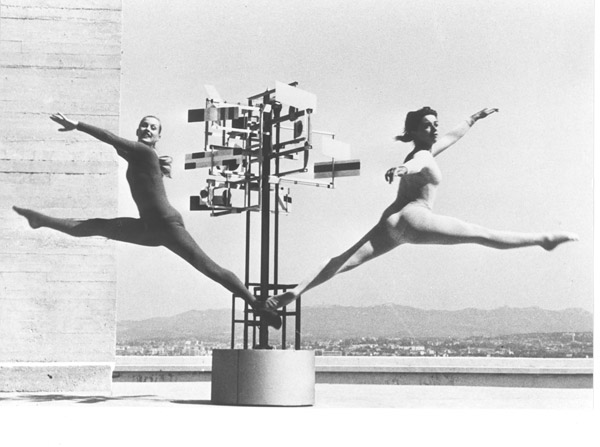
Image context: this period 1956 photograph is catalogued as the rooftop pas de deux, not a later reconstruction. The dancers' opposing leaps suspend CYSP 1 between them, showing the central argument at a glance: the machine's artistic force emerges inside a human choreography.[7]
On August 8, 1956, according to the Centre Pompidou catalogue, dancers crossed the roof terrace of Le Corbusier's Cité Radieuse in Marseille beside a steel construction that could roll, turn, listen, and register light. The archive identifies Tania Bari among Maurice Béjart's dancers and places Nicolas Schöffer's CYSP 1 inside the Festival of Avant-Garde, with the Mediterranean sky where a theater ceiling ought to be.[2]
The machine did not resemble a human. Sixteen polychrome plates branched from an open metal frame; small motors rotated them while a wheeled base moved the whole assembly. A microphone and photoelectric cells supplied an electronic control system with changes in sound, light intensity, and color. The result could accelerate, slow, turn, or alter its moving composition without Schöffer arranging every visible state in advance.[1][3]
This is why CYSP 1 is widely considered the first autonomous sculpture explicitly conceived under the sign of cybernetics. It is also why the familiar nickname “robot dancer” can mislead. The sculpture did not know a dance, recognize a body, or improvise with human understanding. Its achievement was more exact: it made a limited sensing-and-action loop public, then let dancers turn that loop into a relationship. The breakthrough was not a machine performing alone. It was choreography distributed among apparatus, surroundings, operators, and people.
Before cybernetics, space was already part of the work
Schöffer did not begin by trying to imitate life. He began by refusing to treat sculpture as a self-contained mass.
After moving from Hungary to Paris in 1936, he developed what he called spatiodynamisme. Centre Pompidou traces the theory to 1948 and his first sculpture with actual movement to 1950. Open frameworks, projecting arms, reflective or colored planes, gaps, and shadows let the surrounding room enter the composition. A viewer walking around one of these works did not merely discover another side of a stable object; the object's relations appeared to reorganize with every change of position.[6]
The name CYSP joined the opening letters of “cybernetic” and “spatiodynamic.” That sequence matters. The electronics did not replace sculpture with a machine demonstration. They extended a prior question: what if surrounding space could act upon the work, rather than only receive its shadows?[1][4]
The physical answer remained visibly sculptural. Circles and rectangles sat at different heights and angles inside a rectilinear armature. Red, blue, yellow, black, and white planes broke the frame into temporary fronts. When the plates rotated, their colored faces, dull backs, narrow edges, and cast shadows entered and left view. When the base changed direction, the entire hierarchy changed with it. Motion was not an effect added to a finished composition. Motion kept the composition from finishing.
Schöffer would define luminodynamisme in 1957 and later make projected light and duration increasingly explicit materials.[6] CYSP 1 sits at the hinge: still recognizably a constructed sculpture, yet already dependent on signals and time for what anyone actually sees.
A few inputs produced many visible states
The vacuum-tube-based control system was bounded. That limitation is not an embarrassment to hide beneath a futuristic label; it is the source of the work's clarity.
Grand Palais describes sensors for sound, brightness, and color connected to an “electronic brain” developed with Philips engineers. Art historian Thomas Dreher's technical reconstruction adds four rubber wheels, two travel speeds, batteries, small motors for the plates, vacuum-tube electronics, and a random generator that varied self-movement. The control system coordinated the rolling base and the plates rather than operating them as unrelated tricks.[1][3]
Contemporary descriptions assigned different dispositions to different conditions. Blue and darkness could excite the sculpture; red, strong light, or noise could calm parts of its behavior, while silence could provoke activity. Those pairings were designed responses, not meanings discovered by the machine. CYSP 1 did not decide that blue was lively. It routed a measured condition toward a change of speed or direction, with random variation preventing every encounter from resolving into the same short sequence.[3]
That is cybernetic in a historically specific sense. An input alters the system's action; the action changes the situation from which the next input arrives. A turning plate changes reflected color and shadow. A rolling base changes its position relative to lamps, walls, bodies, and sound. People then move, watch, approach, or retreat differently. The loop exceeds the electronics because the environment does not hold still.
It is tempting, in an AI-saturated present, to promote this into early machine intelligence. Doing so makes the work less interesting. There was no trained model, semantic recognition, or accumulating account of a dancer. CYSP 1 shows how little “understanding” a system needs before humans begin treating its output as temperament. A slowing reads as hesitation; a fast turn becomes surprise; a repeated approach begins to feel social. The intelligence is partly an effect of spectatorship.
“Autonomous” had an operator-shaped boundary
The machinery is well documented at the level of sensors, motors, plates, and movement. Its exact control arrangements are less settled.
Dreher records two incompatible accounts. One describes a control desk communicating by radar when self-navigation could not manage an obstacle. Jean-Noël Montagné, who participated in a later restoration, instead recalled autonomous and cable-controlled modes; he said an antenna had been tested as a capacitive sensor but suffered too much interference. The disagreement is not a side note. It warns against turning a changing experimental apparatus into one immaculate specification.[3]
Autonomy here should therefore be understood as a working range, not an absolute state. The sculpture could carry power, receive local conditions, vary its movement, and travel without each motion being manually issued. It could also need a human to recover the performance when that range failed. The operator did not cancel the system's agency any more than a stage manager cancels a theatrical event. The boundary was part of making unstable technology usable in public.
Authorship had the same distributed shape. Schöffer designed the artistic system, while Philips engineering made the control apparatus possible. Sources differ over which individual engineer should be credited, a reminder that even the personnel record is less tidy than the lone-inventor story. The broader practice joined industrial laboratories to artists, composers, choreographers, architects, and performers. Yale University Press's scholarly overview treats precisely these cross-disciplinary alliances as central to Schöffer's work, not as technical assistance outside it.[1][3][4]
That distinction matters because the myth of the lone inventor can make collaboration disappear at the moment technology enters art. CYSP 1 was not less Schöffer's sculpture because an engineer helped it sense and move. It was a different kind of artwork because the artist had to specify relationships that no single craft could realize.
Dance made feedback legible
The work first appeared at the Nuit de la poésie at Paris's Théâtre Sarah-Bernhardt in 1956. Later that year it reached the Cité Radieuse roof with Béjart's dancers and Pierre Henry's musique concrète.[1] The shift from theater presentation to open-air choreography did more than provide a photogenic launch.
A moving sculpture in an exhibition can still be watched as an isolated marvel. Dance supplies comparison and consequence. A metal frame turns near a flexible torso; a motor's steady rotation meets a dancer's change of weight; colored planes divide the air that arms and legs immediately reoccupy. Human performers make the machine's timing visible because their own timing can answer, avoid, echo, or contradict it.
The surviving archive record identifies the event and its participants, but it does not give a step-by-step score.[2] We should not invent a perfect exchange in which every gesture triggered an elegant mechanical reply. The sensing repertoire was limited, the work's control history is contested, and outdoor performance added uncontrolled light and sound. Those facts sharpen the achievement. Co-performance did not require seamless communication. It required both machine and dancers to remain susceptible to a shared situation.
The roof intensified that openness. Cité Radieuse supplied a modernist platform rather than a neutral black box; daylight, concrete, architecture, music, moving bodies, and the skyline entered one composition. LaM places Schöffer's cybernetic turn within a postwar culture that imagined scientific and technological progress as a way to reorganize collective life.[5] On the roof, that ambition became briefly physical. Sculpture was no longer a monument placed in public space. It was a participant that made public space behave differently.
“First” names a category, not a finished future
Grand Palais and the authors of the major 2018 Schöffer study both describe CYSP 1 as the first cybernetic sculpture.[1][4] The priority claim is not uncontested and depends on where the category begins. The useful word in it is sculpture.
Reactive machines existed before 1956. Dreher's history places CYSP 1 after William Grey Walter's self-navigating experimental tortoises and alongside Gordon Pask's early responsive performance system Musicolour.[3] Schöffer's priority rests on bringing explicit cybernetic principles into an object presented and debated as visual art. “First” marks a disciplinary crossing; it does not mean feedback itself began on the Cité Radieuse roof.
The work's later appearances show how quickly that crossing became a field. CYSP 1 was exhibited at London's Institute of Contemporary Arts in 1960 and returned there in 1968 as a twelve-year-old reference point inside Cybernetic Serendipity, the exhibition that gathered computer graphics, generated texts, sound systems, responsive machines, and visitors under one roof.[3] By then, its hardware was no longer the newest. Its changed contract with the viewer remained current.
That contract is CYSP 1's durable technology. Schöffer fixed the armature and the repertoire of possible reactions, but he did not fix a single final appearance. Engineers translated sensory conditions into operations. An environment supplied variables. Operators guarded the edge of failure. Dancers and spectators responded to behavior they could not entirely predict. Form survived, but control became plural.
The archival photograph catches two dancers in opposing leaps with CYSP 1 between them. It cannot prove that a sensor registered those bodies or that a machine motion caused either jump. Yet it records the performance's structural proposition: the machine is no longer scenery behind a dancer but a third timing problem around which bodies arrange themselves.[7]
CYSP 1 did not dance alone, and it did not need to. Its radical claim was that sculpture could stop pretending to be alone in the first place.
Sources
- GrandPalaisRmn, “Cysp de Nicolas Schöffer, une oeuvre ... sensible !” — institutional account of the sensors, sixteen moving plates, Philips collaboration, 1956 presentations, Béjart performance, and Pierre Henry music.
- Centre Pompidou, Bibliothèque Kandinsky, Nicolas Schöffer archive record — catalogue descriptions and credits for photographs of CYSP 1 with Maurice Béjart's dancers, including the August 8, 1956 Cité Radieuse performance and Tania Bari.
- Thomas Dreher, History of Computer Art, “Nicolas Schöffer's CYSP 1” — technical reconstruction of the wheels, motors, sensors, random control, response mappings, disputed remote-control accounts, and later ICA exhibitions.
- Arnauld Pierre, Sébastien Delot, Pauline Mari, and Dominique Trudel, Nicolas Schöffer: Space, Light, Time. Yale University Press, 2018 — scholarly overview of CYSP 1, feedback, and Schöffer's interdisciplinary collaborations.
- LaM, “Nicolas Schöffer. Rétroprospective” — museum framing of Schöffer's cybernetic practice within postwar technological culture and its collaborations across art, science, industry, music, and choreography.
- Centre Pompidou, “Nicolas Schöffer, Lux 1” — collection essay tracing spatiodynamism from 1948, actual movement from 1950, and the 1957 turn to luminodynamism.
- Centre Pompidou, “Danser sa vie: Nicolas Schöffer” — institutional presentation and source page for the 1956 archival photograph of CYSP 1 and Maurice Béjart's dancers on the Cité Radieuse roof.