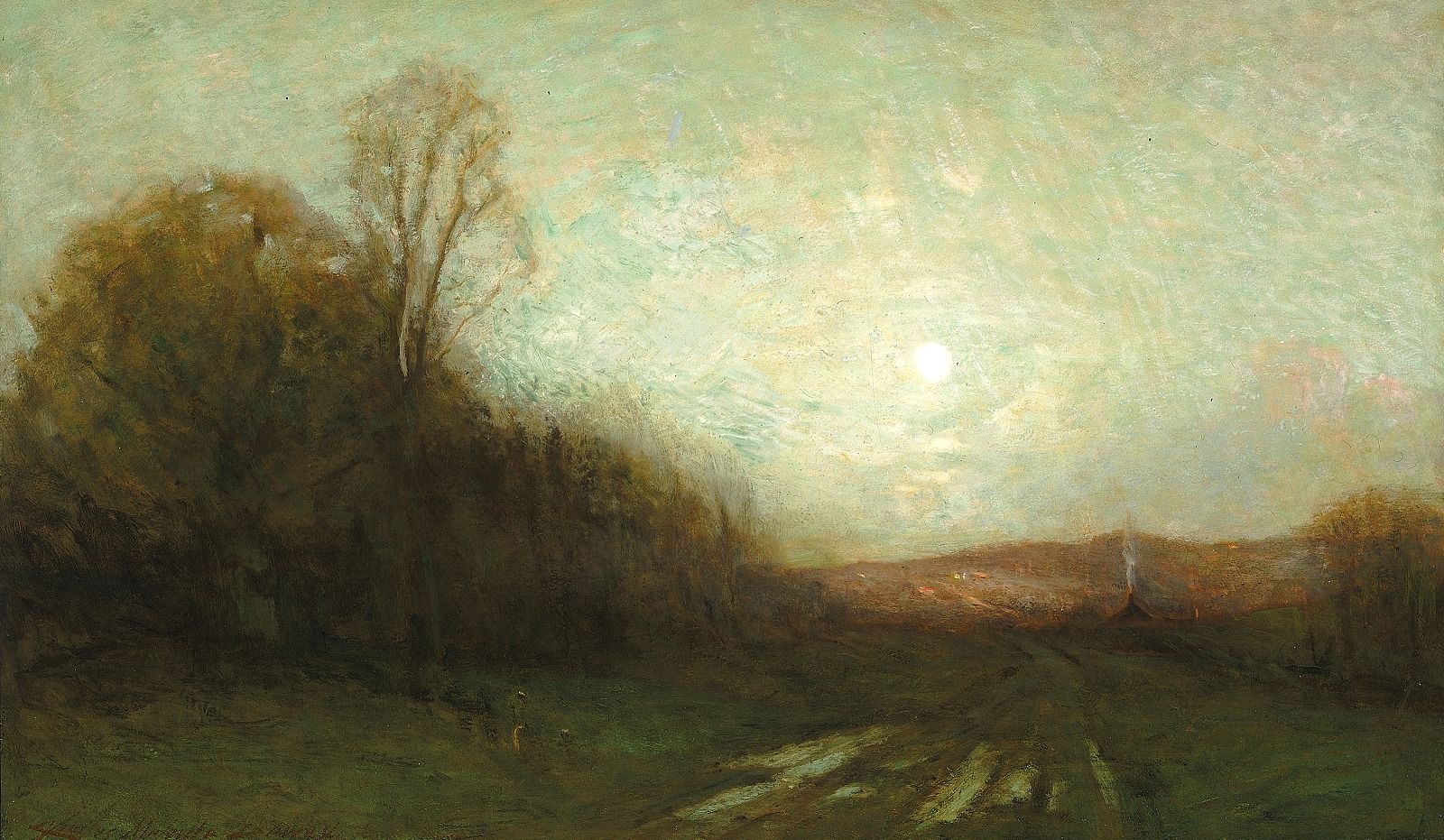
Tonalism is easy to misread as mood painting for tired eyes: dusk, mist, soft trees, low horizons, and a general hush spread across the canvas.[1][2] The stronger reading is more technical. Tonalist painters made atmosphere do the structural work that earlier landscape traditions often handed to peaks, storms, waterfalls, or radiant sunset drama. Lowered contrast, compressed value range, softened edges, and slow color transitions became the means by which a picture held together.[1][4][5]
That shift matters because it changed what an American landscape could ask of the viewer. Fairfield University's Dawn & Dusk exhibition frames Tonalism as a movement that grew out of and reacted to the Hudson River School while helping lay groundwork for modernism.[1] The New York State Museum makes the bridge even plainer in its exhibition title: Tonalism as a pathway from the Hudson River School to modern art.[2] Put those two claims together and the movement stops looking like a minor afterglow. It starts to look like a recalibration of scale. The landscape no longer had to overwhelm in order to matter.
The movement lowered the volume so attention could deepen
That is the first thing worth holding onto. Tonalism did not shrink landscape into decorative quiet.[1][2] It reorganized emphasis. Instead of building grandeur through spectacular incident, Tonalist painters often turned to evening roads, marsh edges, moonrise, veiled trees, distant houses, and weathered fields where the event lay in tonal relation itself.[1][4] Fairfield's description stresses spiritual connection to the natural world and the importance of paintings made from memory.[1] Those two ideas belong together. Memory loosens exact topography, and that loosening lets atmosphere carry more of the picture's force.
Seen in that light, the movement becomes less about haze for its own sake than about a new tempo of looking. A Tonalist painting usually asks the eye to settle before it yields its full structure. Near and far no longer split cleanly. Edges do not insist on themselves immediately. Light drifts across the surface rather than striking it in one climactic burst.[1][2][5] What first appears modest can therefore turn exacting. The picture asks for duration.
George Inness made softness feel deliberate
George Inness sits near the center of that change. The Philadelphia Museum of Art's George Inness in Italy page describes him as a pioneer of Tonalism and characterizes the aesthetic through soft focus and diaphanous layers of paint.[3] That phrasing is useful because it clarifies what kind of softness this is. The effect is not accidental blur or unfinished handling. It is built. Layers thin the boundary between description and recollection. Focus relaxes so that the landscape begins to behave less like surveyed fact and more like a remembered interval.[3]
This is one reason Inness matters beyond biography. He helped move American landscape away from the declarative confidence of earlier panoramic painting and toward something more inward in pressure.[1][2][3] A weaker account of Tonalism would treat the movement as a retreat from ambition. Inness suggests the opposite. Ambition remains, but it has changed key. The painter is no longer trying chiefly to prove that nature is immense. The painter is trying to make the relation among air, light, land, and memory feel continuous enough that the viewer enters a mood without losing formal control.[3]
Dewey and Twachtman show how low contrast became a system
Fairfield's exhibition overview names John Henry Twachtman alongside Inness and John Francis Murphy as part of this Northeastern field.[1] That grouping matters because it keeps Tonalism from collapsing into one artist's temperament. The movement is broader than Inness's example. Twachtman, Murphy, and Charles Melville Dewey all help show how reduced contrast could become a shared system rather than a private mood.[1][4][5]
The Metropolitan Museum of Art makes the point cleanly on Dewey's Sun Shower, calling the picture typical of American Tonalism through its diffused light and delicate color gradations.[5] That description is nearly a definition. Diffusion and gradation replace dramatic outline. A picture organizes itself through tonal drift. Smithsonian American Art Museum says much the same about Dewey's The Close of Day, describing the artist as a practitioner of American Tonalism characterized by muted colors and soft-edged, atmospheric effects.[4] Its object text then turns those abstractions back into visible facts: shadows gathering, the sun slipping below the horizon, puddles catching light, cart tracks leading toward a house with a smoking chimney.[4]
That is exactly the scale on which Tonalism becomes persuasive. The road is ordinary. The house is distant. The light is almost gone. Yet the painting does not feel empty. Tonal relation has become enough to carry event.[4][5] Once that happens, landscape painting no longer depends on spectacle to hold attention.
Why Tonalism belongs on the road to modern art
The New York State Museum and Fairfield both insist on Tonalism's larger historical place because the movement changed what painters thought structure could be.[1][2] It made a landscape legible through restraint. It gave memory and atmosphere formal authority. It allowed the picture to feel emotionally full while narratively sparse. In that sense Tonalism belongs on the road to modern art not because it looked radically new at first glance, but because it relocated importance away from subject matter alone and toward the conditions of perception.[1][2][5]
That is why the movement still holds. Tonalism asks for a slower contract between image and viewer, but it rewards that slowness with unusual coherence. The hush is not an accessory. It is the architecture. By lowering contrast and giving atmosphere the burden of structure, Tonalist painters found a way to make the landscape intimate without making it slight, and modern without making it loud.[1][2][3][4][5]
Sources
- Fairfield University Art Museum, "Dawn & Dusk: Tonalism in Connecticut" - exhibition page describing Tonalism as a transitional movement from the 1880s to the early twentieth century that grew out of and reacted to the Hudson River School, emphasized spiritual connection and memory, and helped lay groundwork for modernism.
- The New York State Museum, "Tonalism: Pathway from the Hudson River School to Modern Art" - exhibition page framing Tonalism as a bridge between nineteenth-century American landscape painting and modern art.
- Philadelphia Museum of Art, "George Inness in Italy" - exhibition page describing Inness as a pioneer of Tonalism and characterizing the style through soft focus and diaphanous paint layers.
- Smithsonian American Art Museum, "The Close of Day" - object page on Charles Melville Dewey's muted colors, soft-edged atmospheric effects, and evening-road composition used here as the article image.
- The Metropolitan Museum of Art, "Sun Shower" - collection page identifying Charles Melville Dewey's painting as typical of American Tonalism through diffused light and delicate color gradations.