Josef Albers is often reduced to a single image: a patient maker of nested squares, cool in manner, systematic to the point of austerity.[1][4][5] The description is recognizable, but it catches him too late. By the time the first Homage to the Square paintings appeared, Albers had already spent decades turning craft, teaching, and formal limitation into ways of sharpening perception.[1][2][4] His real achievement was not to prove that geometry could look elegant. It was to show that a fixed format could keep seeing alive.
That is why the work still feels more restless than its reputation suggests. Albers loved rules, but he used them to expose instability: how one color shifts when another sits beside it, how a hard edge can seem to advance or sink, how the same shape can feel calm in one arrangement and tensile in another.[2][3][5] What looks at first like discipline for its own sake turns out to be a machine for surprise.
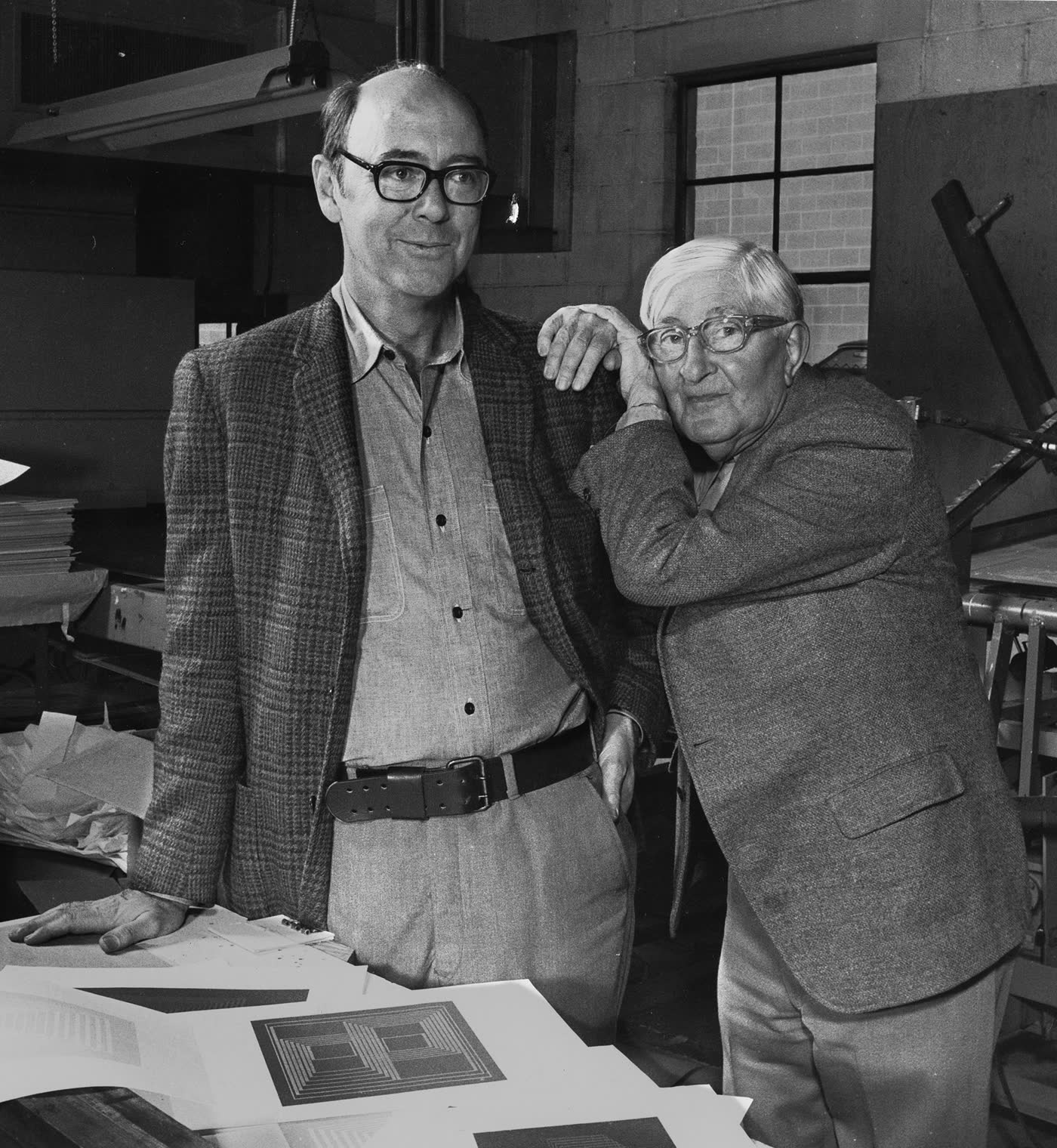
Image context: the article uses an archival production photograph from 1972 rather than a polished standalone reproduction of a square painting. That choice keeps the profile close to the workshop logic that mattered to Albers all along: geometry arrives through procedure, collaboration, printmaking, and repeated acts of adjustment rather than through detached abstraction alone.[6]
Craft came before theory
Albers's early life helps explain why his later art never drifted very far from making as a practical act. The Josef and Anni Albers Foundation notes that he was born in Bottrop in 1888 and that his father, a general contractor proficient in carpentry, house-painting, plumbing, and other crafts, gave him a lasting respect for materials and techniques.[1] That background matters because Albers never treated form as something purely cerebral. Even at his most reduced, he thought through surfaces, edges, supports, and the behavior of tools.
When he arrived at the Weimar Bauhaus in 1920, that craft inheritance met a new kind of experimentation.[1] The Foundation's biography stresses his fascination with making constructions from discarded glass shards and bottle bottoms, an episode that already shows the Albers method in miniature: start with a material fact, accept its limits, then see how far disciplined arrangement can push perception.[1] He did not begin with the square. He began with the proposition that materials could teach the eye.
This is one reason Albers never reads like a doctrinaire stylist, even though he became one of the emblematic Bauhaus figures. The Bauhaus gave him a language of economy and structure, but what he took from it was less a look than a procedure. He learned that reduction could be generative, that repetition could remain investigative, and that visual clarity did not require passivity.[1][2]
Black Mountain made teaching part of the art
After the Bauhaus closed under Nazi pressure, Albers emigrated to the United States in 1933 and taught at Black Mountain College until 1949.[1][4] Whitney's artist page makes clear how central those years were, not only to his own career but to later American art more broadly: students such as Ruth Asawa and Robert Rauschenberg passed through his classes, and Black Mountain became one of the main relay points through which European modernist discipline entered a new American setting.[4]
Yet the deeper point is methodological. The Albers Foundation's teaching overview says plainly that Anni and Josef Albers believed education should encourage exploration and experimentation, and that Josef's goal as a teacher was "to open eyes."[2] The phrase is small, but it reaches far. He did not teach art as a package of approved effects. He taught it as a training of attention.
The same source describes his curriculum in equally direct terms: students had to learn to see the visual field more acutely through line, shape, color, and texture, and when he later took over the Department of Design at Yale, he replaced the existing curriculum with those fundamentals.[2] In other words, Albers did not separate pedagogy from artistic work. Teaching was one of his media. Exercises, problems, and visual demonstrations were all part of the same lifelong project: to make vision less automatic.
That helps explain why Albers's art and writing remain inseparable. The paintings are not illustrations of a theory that came later. The theory crystallized because the studio and the classroom kept pressing on the same perceptual questions.[2][3][4]
The square was a device, not a logo
The most famous result of that pressure was Homage to the Square. Whitney's pages on both the artist and Homage to the Square: "Ascending" give the key facts: Albers began the series in the summer of 1949, continued it for roughly twenty-five years, and built more than a thousand related works from a small set of nested-square layouts.[4][5] Read lazily, that sounds like repetition. Read properly, it sounds like an experiment too large to fit inside one canvas.
What makes the series important is that the square is never the point in itself. Whitney notes that Albers treated the scheme as a means to let color do the real work, and that each work tests how one color projects, recedes, brightens, or dulls according to its neighbors.[5] The structure is strict so that the perception can stay unstable. Far from imprisoning the image, the format clears away distraction.
The making process matters too. Whitney describes Albers preparing composition board with several coats of gesso, penciling one of his fixed layouts, and then spreading paint straight from the tube with a palette knife onto the hard surface he preferred over canvas.[4][5] This technical routine sharpens the conceptual point. The paintings do not invite expressive brush drama. They ask for evenness, precision, and repeatability, because those conditions make small chromatic differences legible.
That is why the square never really sits still. A yellow that felt warm and expansive in one painting can become trapped or acidic in the next. A gray can suddenly turn violet by proximity; an orange can seem deeper because another orange is held behind it.[3][5] Albers took a stubbornly limited armature and made it yield an enormous number of perceptual events.
Interaction of Color gave the project its clearest language
The book that named this logic most clearly was Interaction of Color in 1963.[3][4] The Albers Foundation's page on the book is useful because it shows how decisively he broke with system-first color teaching. Albers argued that a color is almost never seen as it physically is, that color deceives continually, and that understanding must begin not with fixed wheels or abstract orders but with direct observation of context.[3]
That shift remains the center of his importance. Albers did not deny that science can describe color. He insisted that artists confront another truth as well: color is relational in experience.[3] Put one red beside black and it tightens; place it inside pink and it thickens differently; hold a pale square inside a dark field and it may seem to glow outward. This is not decorative relativism. It is disciplined visual empiricism.
Seen from that angle, the famous squares stop looking like icons of cool certainty. They become records of attention. Each one asks what will happen if these exact colors meet inside this exact order, on this exact scale, with no extraneous story to rescue them.[3][5] The answers are often subtle, but subtlety is the point. Albers wanted viewers to discover that looking carefully is an active event.
Why he still feels contemporary
Albers remains current because he solved a problem that still haunts modern art: how to make rigor feel alive.[1][2][4] Many artists either distrust systems altogether or submit to them so completely that the work goes inert. Albers found a third path. He used the repeatable format to intensify difference, and he used teaching to keep form tied to experience rather than to doctrine.
That is why Josef Albers matters as more than the painter of squares. Craft training taught him respect for materials. The Bauhaus sharpened his appetite for reduction. Black Mountain and Yale turned pedagogy into a public laboratory for perception. Homage to the Square gave him a durable structure. Interaction of Color gave that structure its most persuasive language.[1][2][3][4][5] The result is an art of restraint that never becomes static. Under the calm surface, the eye keeps working.
Sources
- Josef and Anni Albers Foundation, "Biography" - official biography covering Josef Albers's Bottrop childhood, craft-trained father, arrival at the Bauhaus in 1920, Black Mountain years, Yale appointment in 1950, and the start of the Homage to the Square paintings.
- Josef and Anni Albers Foundation, "Teaching" - official teaching overview on Albers's aim "to open eyes," his emphasis on line, shape, color, and texture, and his redesign of Yale's curriculum around those fundamentals.
- Josef and Anni Albers Foundation, "Interaction of Color" - official page on Albers's 1963 book, its attack on system-first color teaching, and its experimental method based on direct observation of color in context.
- Whitney Museum of American Art, "Josef Albers" - artist page summarizing the Bauhaus years, Black Mountain teaching, the move to Yale in 1950, and the technical routine behind the Homage to the Square series.
- Whitney Museum of American Art, "Homage to the Square: 'Ascending'" - official collection page on the 1953 painting, the start of the series in 1949, the four layout schemes, and Albers's use of palette knife and composition board to stage color interaction.
- Wikimedia Commons, "File: Norman Ives and Josef Albers.jpg" - archival photograph page for the 1972 image of Josef Albers with Norman Ives during production of Formulation: Articulation at Sirocco Screen-printing in North Haven, Connecticut.