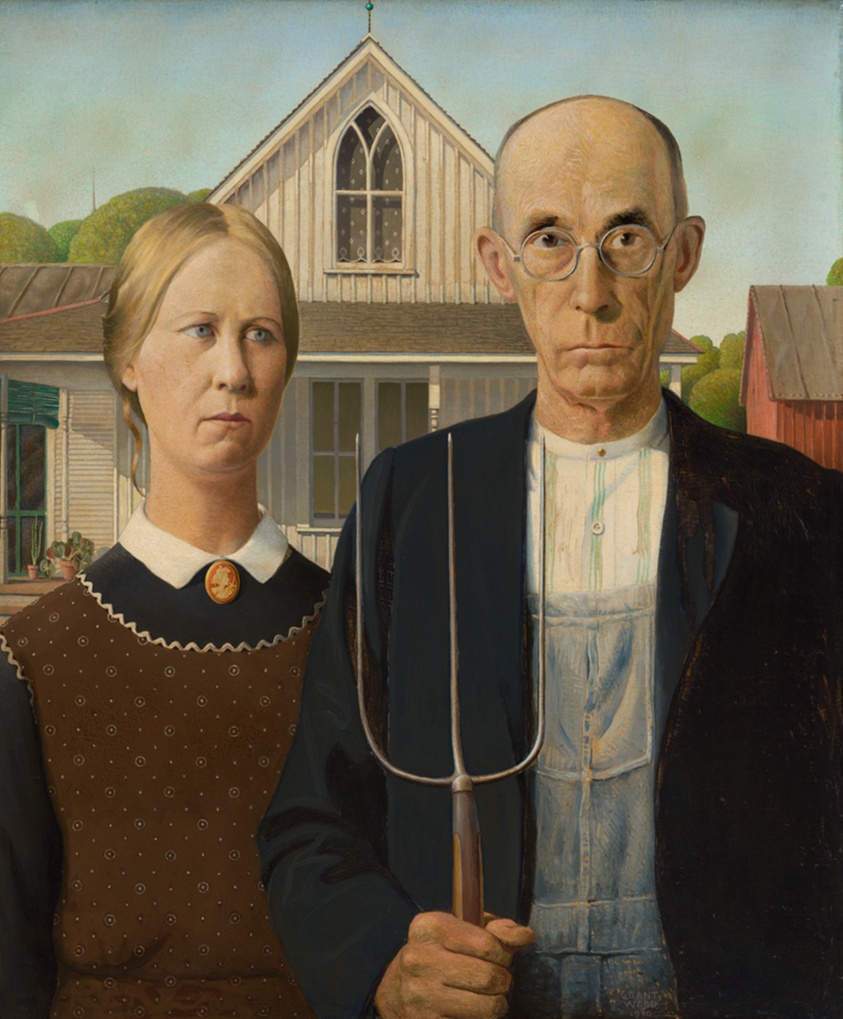
Grant Wood's American Gothic has been so over-reproduced that it is easy to meet it as an idea before meeting it as a painting. It is the parody image, the rural icon, the stern-couple meme, the thing people recognize even when they do not know who painted it.[1][4] But the work keeps its grip for a stricter reason. It is built around a discipline of repeated verticals and tightened surfaces that never lets the figures relax into anecdote. The painting does not simply show two Midwestern people in front of a house. It stages a whole system of stance, architecture, and facial control, then leaves viewers to decide whether that system feels admirable, brittle, funny, or all three at once.[1][2][4]
That unresolved pressure is the key to why the picture survives. The Art Institute's object page makes the basic historical frame clear: Wood featured a farmer and his daughter, posed stiffly outside a house in the Carpenter Gothic mode, and the work caused immediate speculation when it appeared in Chicago in 1930.[1] Britannica pushes the point further by stressing how artificially staged and ambivalent the painting is, even while it draws on familiar regional types.[4] Put those two descriptions together and the old false choice between satire and tribute starts to look too simple. The painting is stronger when read as a controlled performance of steadiness.
The house is not a backdrop; it is a visual mold
The first thing to notice is that the white house does not behave like scenery. It gives the figures their grammar. Wood had seen the house in Eldon, Iowa, and recognized its outdated Carpenter Gothic look immediately; the pointed upper window and narrow trim gave him a whole visual key for the people he wanted to invent in front of it.[1][2][4] In the Art Institute FAQ, Sarah Kelly Oehler recounts Wood's reaction in practical terms: he asked himself who would live in such an old-fashioned structure and decided they would be "American Gothic people."[2]
That matters because the painting does not present the couple as natural inhabitants of open farm space. It pins them against architecture. The upper window rises between and above them like a stern forehead. The house's pointed forms are echoed in the man's collar, the seams of his jacket, and the three tines of the pitchfork.[1][4] By the time the eye has moved across these repetitions, the house feels less like property than like a machine for manufacturing posture.
This is why the painting never really opens outward. Even with sky, trees, and outbuildings present, the composition stays compressed. The house front acts almost like a portrait studio wall. Wood himself said he wanted the figures to resemble "tintypes from my old family album," and that phrase is useful because it explains the picture's strange blend of intimacy and stiffness.[1] Tintypes preserve people by freezing them. American Gothic does something similar. It makes regional identity look preserved under pressure.
The pitchfork is the work's hardest line
Most viewers remember the pitchfork first, and they should. It is not just a prop signaling farm labor. It is the work's strictest formal instrument. Britannica notes the visual echo between the pitchfork and the bib of the overalls, and once that rhyme is seen it is difficult to unsee.[4] The man's body becomes a rack of upright lines: pitchfork handle, jacket opening, shirt buttons, nose bridge, even the long face itself. He does not merely hold the tool. He is organized by it.
That visual hardening changes the painting's mood. If the pitchfork worked only as a joke about toughness, the picture would become thinner than it is. If it worked only as an emblem of honest labor, the picture would become more pious than it is. Instead it does something more interesting: it makes resolve look defensive. The tool is planted, not swung. It suggests work, but it also suggests guarding a threshold.[4] The man is not welcoming us in. He is standing for inspection and refusing ease at the same time.
The woman, meanwhile, does not soften the structure. Her face turns aside rather than meeting ours, and the cameo at her neck, the vertical fall of the apron, and the pulled-back hair keep her inside the same regime of restraint.[1][2][4] The sideways glance is one reason viewers keep telling stories about the pair. Narrative seems available, yet the painting withholds enough expression that none of those stories can settle completely.
Wood assembled types, not a documentary couple
That refusal becomes sharper once the models are remembered. Oehler notes that the woman was modeled by Wood's sister Nan and the man by his dentist, Dr. B. H. McKeeby; they posed separately and were never in the studio together.[2] The painting is therefore not a record of one observed pair standing in front of their home. It is a constructed relation. Wood assembled age, dress, posture, and architecture into an archetype and then let ambiguity do the rest.[2][4]
This helps explain the picture's peculiar emotional temperature. The figures are close together, but they do not read as warm. They share a frame, but not a visible exchange. Viewers keep asking whether they are husband and wife or father and daughter because the painting itself is organized around that uncertainty.[2][4] The ambiguity is not a loose end. It is part of the design. Wood keeps social identity exact enough to feel legible and vague enough to keep attention active.
The Art Institute's artist page adds another useful context: after a 1928 trip to Munich, Wood moved away from a looser impressionistic handling and toward the tightly painted, highly detailed forms that define American Gothic.[3] That shift matters on the surface of the work itself. Everything is clipped, edged, and deliberately arranged. Even the humor has been sanded into precision.
Why the image stayed alive
The painting's afterlife has as much to do with timing as with composition. It appeared just after the 1929 crash, when the country was sliding into the Great Depression, and it immediately provoked argument over whether it mocked Midwestern backwardness or upheld rural values.[1][2][4] Oehler describes the collision vividly: East Coast critics dismissed the figures as provincial, while offended Iowans wrote in to insist they did not look like this at all.[2] That conflict helped push the image into national circulation.
Yet the picture lasts because the arguments never exhausted it. Wood's Regionalist commitment to local subjects is real, but so is the painting's self-conscious artifice.[3][4][5] The Smithsonian's Grant Wood exhibition summary is useful here because it stresses his decorative and design work, not just his easel paintings.[5] That background helps explain why American Gothic feels engineered rather than merely observed. Its authority comes from craft. The painting is regional in subject, but almost heraldic in how it arranges shapes.
That is why the faces still matter. They do not relax into sentiment, and they do not tip fully into caricature. Wood gives us a pair who seem to have been tightened by house, labor, religion, photography, and public expectation all at once.[1][4] The result is an image of American endurance that cannot be read as innocent. American Gothic still feels tense because it knows that steadiness is never just a virtue. It is also a pose people learn when they expect to be judged.
Sources
- The Art Institute of Chicago, "American Gothic" - official object page with the house, the farmer-and-daughter framing, the "tintypes from my old family album" quotation, and the 1930 reception context.
- Sarah Kelly Oehler, The Art Institute of Chicago, "American Gothic: The Top Five FAQs" - museum essay on the Eldon house, the sister-and-dentist models, the 1930 prize, and the painting's early fame.
- The Art Institute of Chicago, "Grant Wood" - artist page on Wood's Regionalism, his 1928 encounter with Northern Renaissance art in Munich, and the stylistic tightening that leads into American Gothic.
- Encyclopaedia Britannica, "American Gothic (painting by Grant Wood)" - article on the painting's staged ambiguity, Old Master echoes, pitchfork symbolism, and popular afterlife.
- Smithsonian American Art Museum, "Grant Wood's Studio: Birthplace of 'American Gothic'" - exhibition page emphasizing Wood's decorative art and design work and the crafted studio context behind the painting.