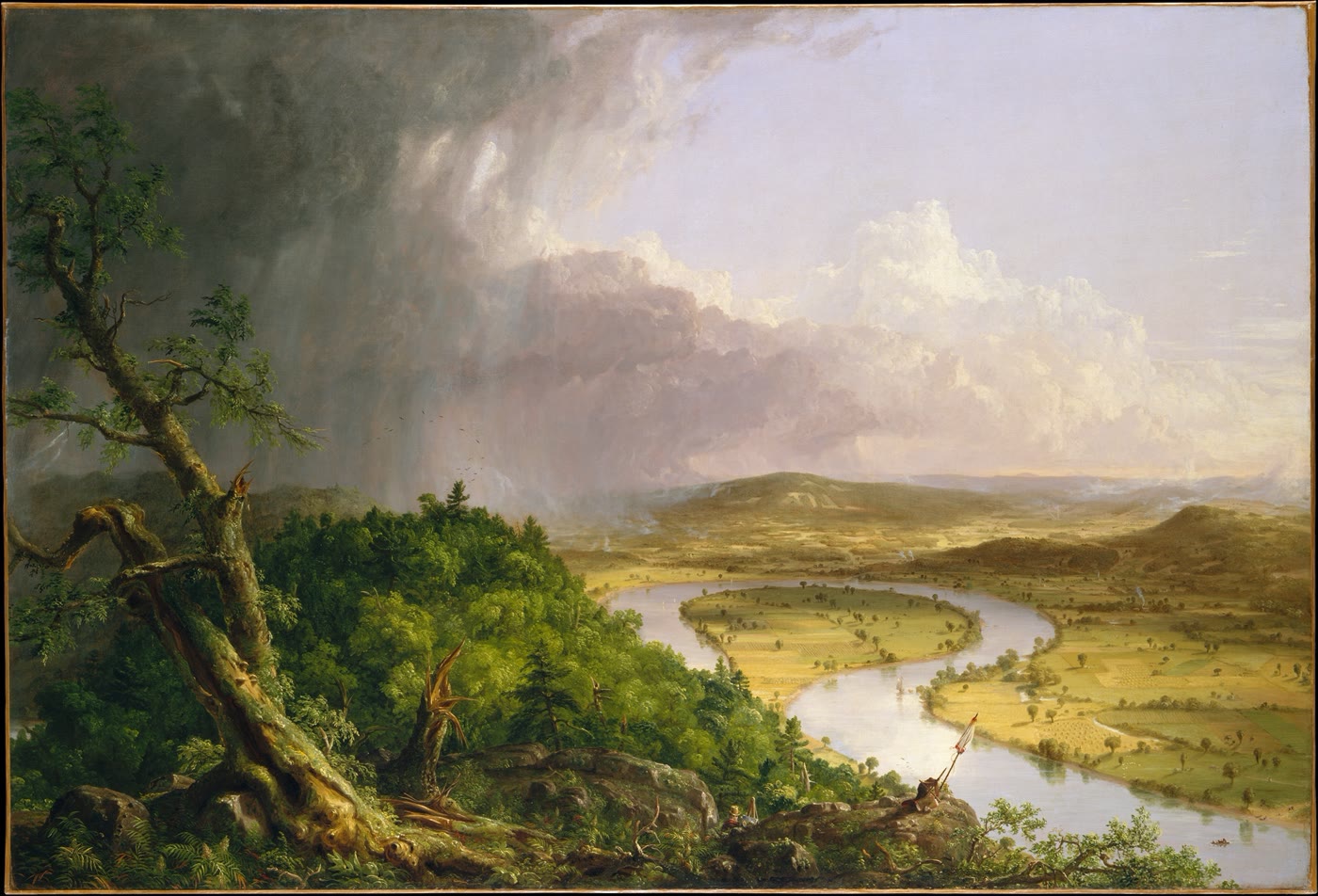
Thomas Cole's The Oxbow is often introduced as a masterpiece of the Hudson River School, then reduced to a neat contrast: wild nature on one side, settled America on the other.[1][4] The contrast is real, but it is too tidy for what the painting actually does. Cole gives us a storm-blackened foreground of broken trunks and rough ascent at left, then opens the view onto a bright looping river valley stitched with fields and roads at right.[1][2][4][5] The painting's pressure comes from the fact that these two conditions do not sit in moral balance. They are forced into one frame where each makes the other look unstable.
That instability is why the picture still feels larger than a scenic view. The Met's object page identifies the work as an oil on canvas from 1836, measuring 51 1/2 x 76 inches.[1] Smarthistory describes it as a movement from the sublime toward the pastoral.[4] The Met's 2022 Spotlight conversation sharpens the point by calling attention to the painting's bifurcated structure, its signs of cultivation and clear-cutting, and its warning energy about destruction dressed up as progress.[2] Read together, those sources suggest that the canvas is not simply describing a place near Northampton, Massachusetts. It is staging an argument about what kind of landscape Americans wanted to recognize as their own.
Image context: the cover uses the painting itself because this essay depends on the whole field. A crop of the valley would turn the work into agrarian serenity; a crop of the storm side would turn it into Romantic drama. Cole's meaning lives in the forced adjacency.[1][6]
1) The famous split is not wilderness versus civilization in any stable sense
The left half of the painting is full of the visual language of the sublime: torn tree stumps, a steep climb, dark weather still hanging in the air, and a sense that the ground itself has not yet settled.[2][4][5] Yet Cole does not let that side stand for untouched nature in any pure form. There are signs of cutting there too. The Met's Spotlight discussion points to the areas of clear-cut forest visible in the distance, which matter because they prevent the picture from becoming a simple elegy for pristine land.[2] Disturbance is present on both sides of the divide, only in different registers.
That is the first reason the painting lasts. Cole does not offer a clean moral allegory in which evil cultivation invades innocent wilderness. He paints a more nervous threshold. The right side is bathed in cleared light and patterned fields, but those fields do not feel inevitable or permanent. They feel newly made, contingent, almost too legible. The river's great curve is beautiful, yet the beauty has the chill of survey and possession inside it.[1][4][5]
This is where the canvas stops being merely descriptive. The cultivated valley is not only peaceful. It is claimed. The storm side is not only chaotic. It is resistant. Cole makes the two conditions touch so closely that the painting becomes less a celebration of settlement than a question about what settlement costs once the axe begins to regularize the land.[2][3][5]
2) Cole puts himself at the hinge so painting becomes part of the argument
The small self-portrait near the center is one of the work's most decisive moves.[2][5] It is easy to miss at first because the landscape scale is so commanding. But once seen, the figure changes everything. Cole is not safely outside the scene recording it from nowhere. He inserts himself precisely where rough foreground and ordered distance meet, perched among the visual debris, umbrella and gear nearby, painting the view into coherence.[5]
The Met's Spotlight text calls this a momentous self-portrait, and the older Met Journal essay explains why it matters: the artist effectively presents himself as the mediator who transforms scenery into national meaning.[2][5] That is not a decorative signature. It is a claim about art's authority. The land does not speak on its own here. It is edited, framed, and interpreted by a painter who knows he is making a public argument.
Thomas Cole's own Essay on American Scenery, published the same year, helps explain that ambition.[3] In that essay he writes about American landscape as national inheritance and imagines a scene of wooded hills, fields, a winding silver stream, rural dwellings, and security dwelling beside the river.[3] The right half of The Oxbow looks uncannily like that verbal construction. The painting therefore does not merely discover a view. It paints a theory of the nation into the view. Cole places himself inside the picture to show that such harmony is not just found in nature. It is composed.
3) Scale keeps the valley from feeling secure
One of the most impressive things about The Oxbow is how much room it gives the eye to travel while refusing emotional rest.[1][5] The valley appears broad, ordered, and sunlit, but the foreground at left keeps interrupting that reassurance. We never fully leave the blasted trunks behind. They remain close, dark, and tactile. The eye can roam over the distant farms, yet the body stays with the rough ledge where the painter stands.
That spatial arrangement matters because it makes cultivation look provisional rather than final. The Met Journal essay argues that Cole synthesized different landscape traditions inside this canvas, setting rough romantic weather and mountains against a more Claudian, beautiful valley.[5] That synthesis is not only stylistic. It is political in a broad cultural sense. The nation that emerges on the right side is held against a memory of force, exposure, and unmastered scale on the left.
Smarthistory goes further and notes how nineteenth-century political ideology and westward expansion hover behind the image.[4] The painting's power comes from never turning those forces into slogan. Cole works through scale instead. The valley is wide enough to suggest future abundance, but the foreground is intense enough to remind us that abundance begins as incision. The bright right side depends on acts of cutting that the dark left side has not yet forgotten.[2][4][5]
4) The painting survives because its national vision is unresolved
If The Oxbow were only a hymn to American plenty, it would feel dated. If it were only a protest against destruction, it would feel narrower than it does. The painting survives because it cannot finally settle its own argument. The Met's recent ecocritical discussion makes that plain: Cole can be read as an early environmental critic of rapid development, yet his wilderness ideal also carries the exclusions and blind spots of his era, especially around Indigenous presence and justice.[2] That does not cancel the painting. It makes its instability more historically visible.
What endures, then, is not a single message but a controlled unease. Cole arranges storm and sunlight, stump and field, resistance and possession, then places his own body between them.[1][2][5] He does not ask the viewer to choose one side and dismiss the other. He asks the viewer to inhabit the hinge where both are true at once. America appears here as prospect and wound, as scenery and system, as blessing and alteration.
That is why the tiny self-portrait matters so much. It keeps the painting from pretending to be neutral nature.[2][5] Someone has made this national view. Someone has decided where the frame begins, how the storm should recede, how bright the valley should become, and how much violence should remain visible in the trees. The Oxbow lasts because Cole lets us admire the scene while also showing that admiration itself is a historical act.
Sources
- The Metropolitan Museum of Art, "View from Mount Holyoke, Northampton, Massachusetts, after a Thunderstorm—The Oxbow" - object page with title, date, dimensions, medium, and collection record.
- The Metropolitan Museum of Art, "Spotlight: Reexamining the Wilderness Aesthetic" - discussion of The Oxbow as a bifurcated landscape with clear-cutting, self-portraiture, environmental warning, and later ecocritical reinterpretation.
- Thomas Cole National Historic Site, Essay on American Scenery PDF - Cole's 1836 text on American landscape, national inheritance, and the ideal scene of hills, fields, and a winding river.
- Smarthistory, "Thomas Cole, The Oxbow" - analysis of the painting's sublime-to-pastoral transition and its relation to nineteenth-century political ideology.
- Oswaldo Rodriguez Roque, "The Oxbow by Thomas Cole: Iconography of an American Landscape Painting," Metropolitan Museum Journal 17 (1982) - essay on the painting's synthesis, self-portrait, and conceptual landscape construction.
- Wikimedia Commons, "File:Thomas Cole - The Oxbow (Met).jpg" - source page for the image reproduction used for the article asset.