Joan Mitchell is often placed in a sentence that sounds complete before her paintings even arrive: second-generation Abstract Expressionist, one of the few women to break through a male field, American painter who spent much of her life in France.[1][2][5] None of that is wrong. It is also not the deepest way into the work. The paintings do not feel durable because Mitchell occupied a slot in postwar art history. They feel durable because she refused the lazy split between abstraction and the outside world. Her canvases stay abstract, but they keep pressure from trees, rivers, city light, poetry, memory, and bodily movement inside the paint.[1][2][4][5]
That pressure is why Mitchell can look fierce without collapsing into pure self-display. The Joan Mitchell Foundation's biography emphasizes the physicality of her painting and its direct ties to landscape, people, poetry, music, and everyday experience.[1] The Whitney sharpens the distinction. Mitchell's paintings belong to the New York School in brushwork and ambition, yet they keep what the museum calls a "lingering" connection to the outside world through light, motion, and natural sensation.[2] This is the crucial point. Mitchell was not trying to hide the world under abstraction. She was trying to repaint what the world leaves behind after it has passed through memory.
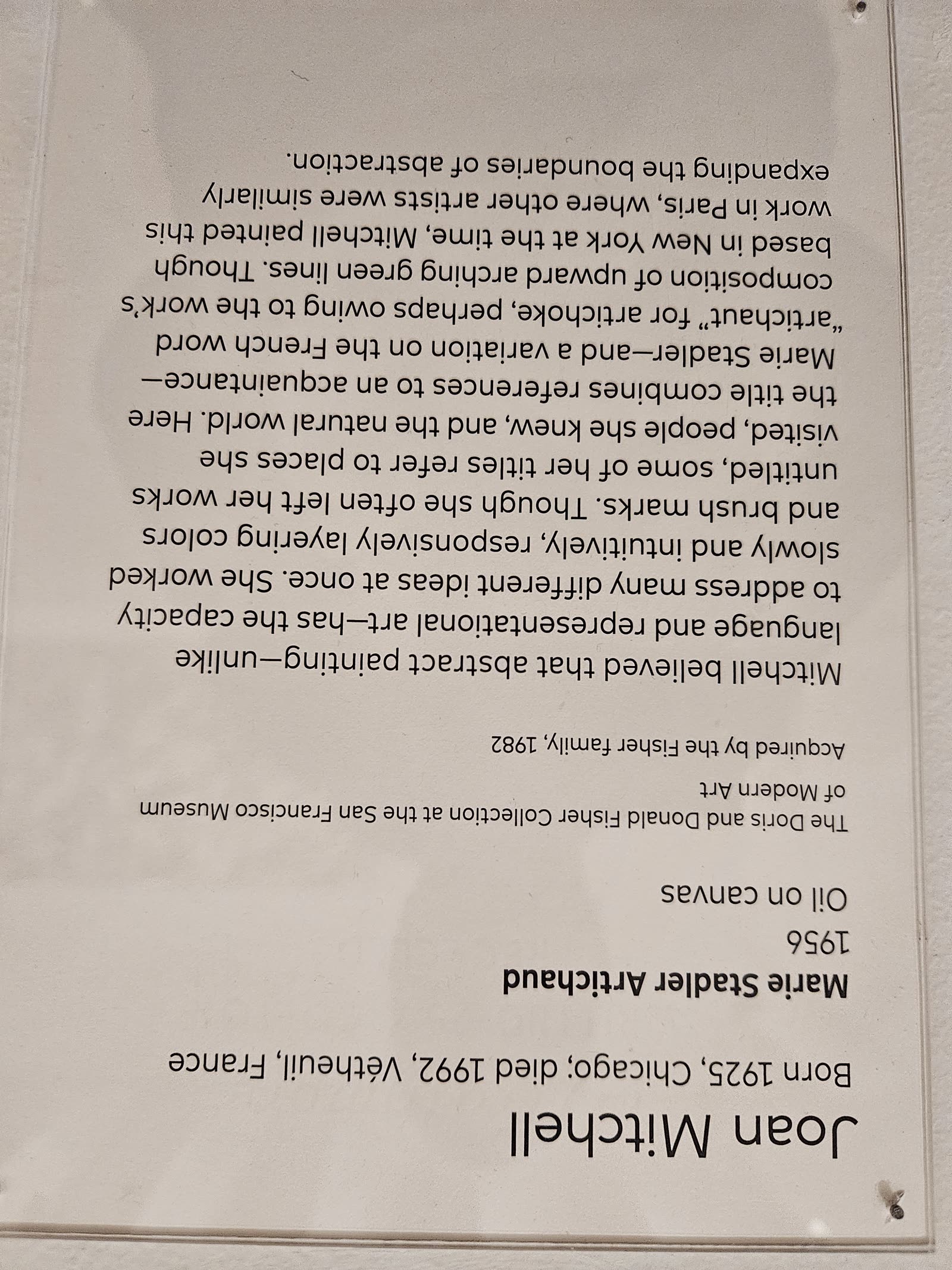
Image context: the cover image is a documented gallery photograph of Marie Stadler Artichaud taken at SFMOMA in 2025.[7] It matters here because Mitchell's achievement is easier to see when a painting is shown as an object in space rather than as a cropped plate in a book. The work reads as both field and event: a burst of gestures held inside a large, breathable ground, with the wall around it making clear how scale participates in meaning.
She did not paint nature from life; she painted what stayed after it
Mitchell's own logic begins with memory rather than transcription. The Foundation biography says she worked from remembered landscapes and remembered feelings rather than from direct imitation, and it links those memories to cities, fields, rivers, lakes, and trees.[1] The Whitney echoes the point by noting that even her most gestural paintings keep evocations of light and movement close to the surface.[2] The distinction matters because it separates Mitchell from two weak readings that still follow her around. One says her canvases are just emotional storms. The other says they are really landscapes in coded form, as though each mark could be translated back into a branch, wave, or horizon. Neither account is strong enough.
The better model is pressure. A place, season, or sensation presses on the painting without becoming a diagram of itself. That is why a title such as Hemlock matters for the Whitney: it does not solve the image, but it allows viewers to feel how a tree might survive in calligraphic spikes, white atmosphere, and clustered vertical force without ever becoming illustration.[2] The same holds for City Landscape. The work's very title sounds descriptive, yet the painting does not map a skyline. It turns metropolitan force into a network of color and interval.[3]
Scale made feeling public
Mitchell's large canvases are not grand for the sake of prestige. They are large because scale is part of how sensation gets made shareable. The SFMOMA retrospective described her art as an effort to unify physical experience with the psychological and emotional, stressing how place affected both the views her paintings express and the dimensions they claim.[5] That is one of the cleanest institutional descriptions of her project. Size, in Mitchell, is not an afterthought added to gestural painting. It is how the body of the viewer gets recruited into the work's weather system.
MoMA's page for Grandes Carrieres supplies a useful material anchor.[6] At nearly ten feet across, the painting asks to be met standing up, not decoded from a safe distance. The point is less monumentality than immersion. Mitchell wanted painting to hold enough room for acceleration, pause, collision, and recurrence. A small reproduction can show color relations, but it cannot fully show why her brushwork feels athletic. The work needs width so the eye has to travel, double back, and keep reassembling the painting as an environment rather than a sign.
This also helps explain why Mitchell remains difficult to reduce to "action painting." The Art Institute's framing of City Landscape is useful here: the canvas feels spontaneous, yet Mitchell herself insisted that she worked slowly and deliberately.[3] That slowness is essential. Her paintings look immediate because they preserve force, not because they were careless records of impulse. Scale gives that force public dimension without turning it into spectacle.
Poetry and painting stayed in the same circuit
Mitchell's mother worked at Poetry magazine, and that early literary atmosphere mattered.[2] It mattered not because Mitchell became a painter of illustrations for poems, but because poetry helped confirm that meaning could remain exact without becoming explicit. The SFMOMA retrospective makes this point strongly, arguing that music and poetry were permanent presences in her life and that their open, personal, and sometimes ambiguous structures helped her think about what painting can carry without naming directly.[5]
Once that is clear, Mitchell's titles and series stop looking ornamental. They are not clues for decoding abstraction into a hidden picture. They are tonal instructions. They tell you that paintings can behave like lines of verse or remembered passages of weather: rhythmic, discontinuous, emotionally exact, resistant to paraphrase. This is also why her landscape relation stayed alive after she moved to France. The shift to Vetheuil in 1968 did not convert her into a painter of French scenery.[1][5] It gave her another lived environment through which memory, light, river space, and seasonal change could keep feeding the work.
The Foundation's Trees exhibition page is especially helpful because it shows how persistent that natural vocabulary remained across decades.[4] Tree form, branching, density, and light-through-structure recur in Mitchell's work not as motifs to be repeated mechanically, but as durable problems for paint. How do you make growth feel simultaneous with fracture? How do you let color behave like foliage, wind, and depth without freezing it into description? Mitchell kept returning to those questions because they let abstraction stay answerable to the world without surrendering its freedom.
Why Mitchell still matters
Joan Mitchell matters because she kept abstract painting from sealing itself off.[1][2][5] She proved that gesture could stay disciplined, that scale could serve intimacy, and that memory could be exact without becoming pictorial transcription. Chicago, New York, Paris, and Vetheuil all remain in the paintings, but not as postcards. They remain as intervals, pressure changes, color shocks, and fields of movement.
That is the achievement worth holding onto now. Mitchell did not choose between abstraction and landscape. She made abstraction carry landscape's afterimage: not the tree, but what the tree does to seeing; not the city, but the tempo it leaves in the nerves; not the riverbank itself, but the sensation of air, distance, and recurrence after the body has left. Her paintings stay alive because they never let paint become only paint. They keep it answerable to weather.
Sources
- Joan Mitchell Foundation, "Joan Mitchell: Biography" - official biography covering her career span, move between New York and France, and the role of landscape, poetry, music, and memory in her work.
- Whitney Museum of American Art, "Joan Mitchell" - artist page on her New York School context, brushwork, relation to the outside world, and memory of landscape.
- Joan Mitchell Foundation, "City Landscape" - artwork page for the 1955 painting, with title, date, medium, and collection context at the Art Institute of Chicago.
- Joan Mitchell Foundation, "Joan Mitchell: Trees" - exhibition page describing how tree forms and natural structure persisted across Mitchell's paintings over decades.
- SFMOMA, "SFMOMA Presents World Premiere of Joan Mitchell in September 2021" - retrospective press release on place, poetry, music, scale, and Mitchell's transatlantic career.
- The Museum of Modern Art, "Joan Mitchell. Grandes Carrieres. 1961-62" - object page providing scale, date, medium, and display context for one of Mitchell's large paintings.
- Wikimedia Commons, "File:Marie Stadler Artichaud by Joan Mitchell, Paintings in the San Francisco Museum of Modern Art, SFMOMA 08.jpg" - source page for the real gallery photograph used as this article's image.