Henri Rousseau is often introduced in one quick stroke: a self-taught customs-office employee who painted jungles he had never seen.[2][3][4] The facts are useful, yet the shorthand can make him sound like a charming accident of modern art, a lovable outsider who stumbled into originality by innocence alone. His stronger importance lies in something more deliberate. Rousseau built a pictorial system in which flatness, patterned foliage, theatrical compression, and dream logic overruled academic naturalism. The jungles endure because they were not travel records. They were constructed stages, assembled in Paris out of gardens, zoos, prints, magazines, and a stubborn willingness to trust an image once it had become internally convincing.[2][3][4][6]
That is also why Rousseau's reputation kept growing after the ridicule. The same qualities that looked awkward to academic eyes looked newly alive to the avant-garde. MoMA's gallery text for Picasso, Rousseau, and the Paris Avant-Garde says Picasso and his circle saw in Rousseau's work an authentic voice more vital than what was taught in art academies.[5] That sentence matters because it shifts Rousseau out of the sentimental category of "naive genius" and into a harder one. He became important not because he failed to know the rules, but because his pictures made other artists wonder whether the rules had become dead weight.
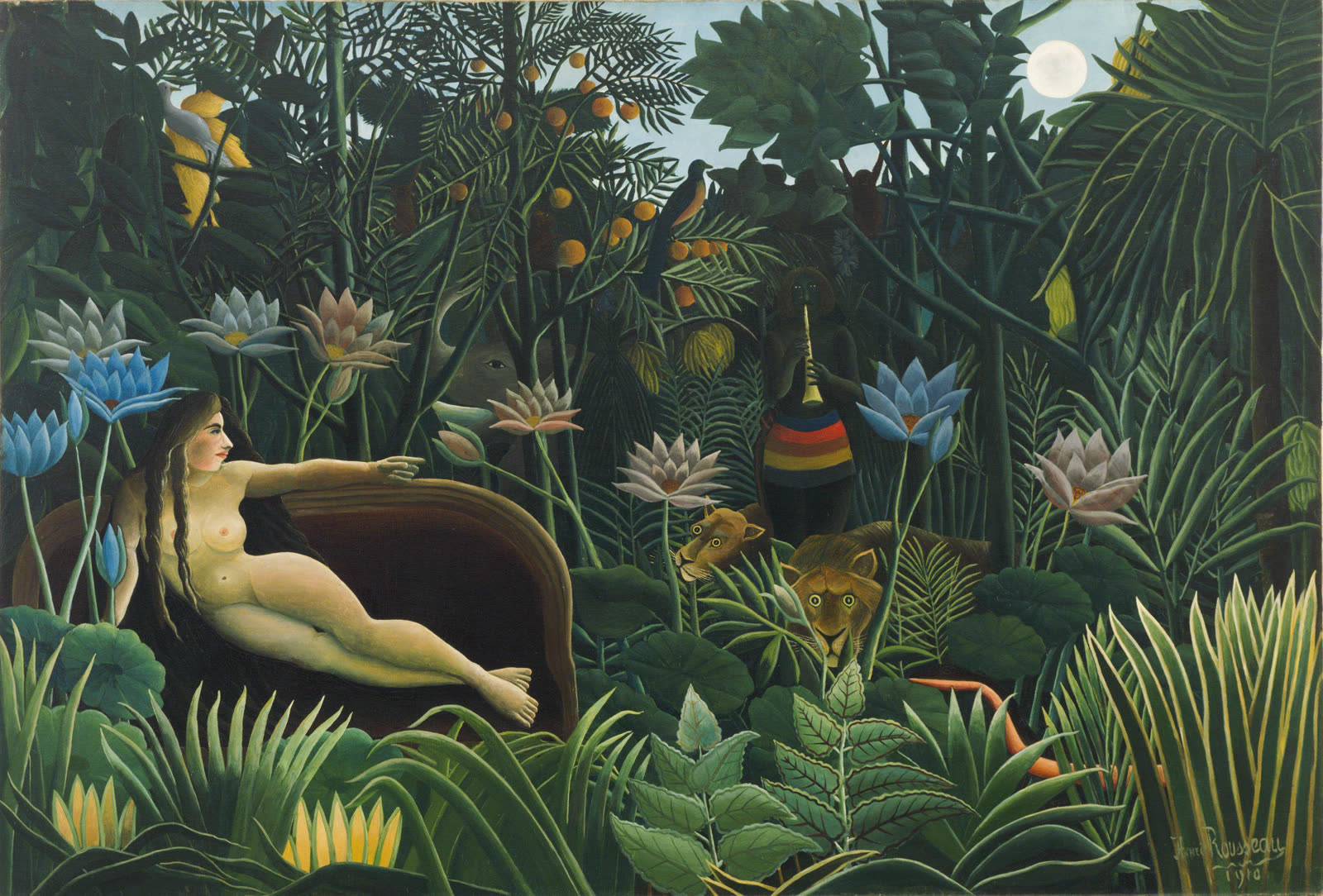
Image context: the hero image uses The Dream because it gathers Rousseau's whole method into one impossible scene. Upholstered interior comfort, botanical excess, flattened depth, and slow-building mystery all share one surface, so the painting can stand as a profile in miniature.[1][2][7]
1) The customs desk mattered because it kept his art outside academic timing
Rousseau's nickname, "le Douanier," came from his job at the Paris Customs Office, even though he never actually held the rank of inspector.[3][4] That bureaucratic identity shaped the way later viewers understood him, and it still matters because it placed him at a visible distance from academic art training. National Gallery London describes him as a self-taught amateur artist who took up painting as a hobby and claimed he had "no teacher other than nature."[3] MoMA's audio on The Dream sharpens the same point by describing him as a self-taught artist whose day job was as a customs agent.[2]
What makes this biographical fact artistically useful is the kind of authority it gave him. Rousseau did not have to prove mastery by matching official standards of depth, anatomy, or painterly finish. His pictures could proceed by another logic: contour first, atmosphere through repetition, scale through accumulation, and mystery through the refusal to smooth out the improbable.[3][5] This is why his work can look both meticulous and unreal at once. He observes closely, yet observation is always being reorganized into an image that obeys a private stage direction rather than a public academic norm.
The result is not incompetence. It is a rerouting of ambition. Rousseau wanted conviction, not polish. He wanted the picture to hold together as an invented world, even if space flattened and anatomy stiffened on the way there.[2][3][5]
2) The jungle paintings are Paris-built theaters, not failed travel pictures
The most important correction to Rousseau's profile is geographical. He never saw a real jungle.[3][6] National Gallery London says the plants in Surprised! combine domestic house plants with tropical varieties seen at the Jardin des Plantes in Paris, whose free botanical garden, zoo, and zoology galleries Rousseau visited often.[3] The Met says much the same of The Repast of the Lion: he based exotic vegetation on studies made in Paris's botanical gardens and adapted wild beasts from ethnographic journals and illustrated children's books.[4] The National Gallery of Art condenses the method with admirable clarity: Rousseau visited the botanical garden and zoo, drew what he saw, then recombined those sketches in the studio into imaginary jungles for animals from different parts of the world.[6]
That studio recombination is the key. Rousseau's jungle scenes do not become weaker once you know they were assembled from Parisian sources. They become more interesting. The pictures are urban fantasies about elsewhere, manufactured from secondhand evidence and arranged with total confidence. Exoticism in Rousseau is therefore not spontaneous overflow. It is montage. Leaves overlap in decorative sheets, animals appear both observed and oddly detached from ground, and space behaves more like a vertical tapestry than a walkable terrain.[3][4][6]
Seen this way, the jungles belong fully to modern city culture. They emerge from botanical display, mass print circulation, museum taxonomies, and the colonial appetite for distant imagery.[4][5][6] Rousseau's great invention was to turn those inputs into a dream stage so coherent that viewers stop asking whether the place is real and start asking what kind of mental weather the picture has created.
3) Surprised! shows how Rousseau made tension out of pattern
National Gallery London's account of Surprised! is especially useful because it reveals how much calculated tension sits inside Rousseau's apparent simplicity.[3] The tiger may be recoiling from lightning or stalking prey; the ambiguity is part of the point.[3] Rousseau reworked the canvas, removed elements, layered the foliage densely, and even used semi-transparent silver-gray stripes to make rain echo the tiger's own striping and the long blades of the jungle.[3] The tiger itself, the museum notes, is a composite built from stuffed specimens, illustrations, and the domestic cat.[3]
All of that matters because it shows Rousseau making drama through arrangement rather than through convincing illusion. The picture feels tense not because it mimics how a storm actually looks, but because every stripe, leaf, and slanted line is enlisted into one atmosphere of suspended attack.[3] Pattern does not soften the scene. Pattern becomes the mechanism of suspense.
This helps explain why Rousseau lasted beyond the anecdote of the customs clerk painter. He discovered that decorative compression could heighten narrative feeling. The jungle turns into a woven pressure field, and the viewer feels that pressure before fully decoding the story.[3][4]
4) The Dream turns Rousseau's whole method into one unforgettable collision
If Surprised! establishes the jungle as stage, The Dream shows what happens when Rousseau lets the stage swallow ordinary reality whole. MoMA's object page records the painting's scale: nearly ten feet wide, painted in 1910, the year of Rousseau's death.[1] In MoMA's audio, curator Ann Temkin calls attention to the strange central fact of the picture: a nude woman reclines on an upholstered sofa placed in the middle of the jungle, and Rousseau himself suggested that she might be dreaming the whole tropical scene around her from a Paris living room.[2]
That explanation is memorable because it tells the truth without exhausting the painting. The sofa is absurd, but the absurdity is exact. Rousseau does not insert a dream token into the jungle as a joke. He fuses interior and exterior, bourgeois room and imagined wilderness, until the picture begins to feel like a fully staged mental set.[2] Foliage presses forward with the same steady authority as furniture. The result is not a fantasy of escape into nature. It is a demonstration that nature, in Rousseau, has already become theatrical and inward.
This is where the artist profile has to move past the word "naive." The Dream is too composed for that word to do enough work. The painting depends on selection, compression, and an almost musical confidence in repetition.[1][2] Rousseau is not naively reporting a vision. He is directing one.
5) The avant-garde recognized Rousseau as permission
MoMA's Picasso, Rousseau, and the Paris Avant-Garde gallery text gives the cleanest late-career verdict on why Rousseau mattered to other artists. Picasso's 1908 banquet honored a painter dismissed by much of the Paris art world, yet Picasso and his milieu saw in Rousseau an authentic voice more vital than academic training.[5] The same text adds that Rousseau's imaginary jungles came from magazines, the botanical garden, and the zoo, while Picasso and his peers were looking elsewhere for their own alternatives to Western tradition.[5]
Rousseau therefore mattered as an opening. He showed that a painting could abandon the prestige of seamless realism and still feel inevitable. It could be stiff, frontal, layered, patterned, and openly invented, yet still command the room.[3][5] That lesson reached beyond Rousseau's own subjects. It helped make space for modernism's broader suspicion of inherited finish and inherited taste.
His importance in 2026 lies there. Rousseau's pictures still teach that authenticity in art does not have to mean raw immediacy or private confession. It can also mean constructing an image so fully on its own terms that viewers accept its climate, its scale, and its impossible logic the moment they step inside. The customs desk, the botanical garden, the rain-striped tiger, the sofa in the jungle, and Picasso's salute all belong to the same story.[2][3][4][5][6] Rousseau made dream theaters out of borrowed materials, and modern art has been living with that permission ever since.
Sources
- The Museum of Modern Art, Henri Rousseau. The Dream. 1910 - object page with date, scale, medium, and collection record.
- The Museum of Modern Art, Henri Rousseau. The Dream. 1910 - audio transcript with curator Ann Temkin on Rousseau's customs job, Paris research sources, and the sofa-in-the-jungle dream logic.
- National Gallery, London, Henri Rousseau, "Surprised!", 1891 - object page on Rousseau's self-taught status, Paris botanical-garden sources, pantograph use, rain patterning, and avant-garde reception.
- The Metropolitan Museum of Art, The Repast of the Lion - object page on Rousseau's botanical-garden studies, use of journals and illustrated books, and the origin of "le Douanier."
- The Museum of Modern Art, Picasso, Rousseau, and the Paris Avant-Garde - gallery text on Picasso's 1908 banquet and why Rousseau's work mattered to the avant-garde.
- National Gallery of Art, Art Starters: Henri Rousseau - educational page on how Rousseau drew plants and animals in Paris, then recombined them into imaginary jungle scenes.
- Wikimedia Commons, File:Henri Rousseau 005.jpg - source page for the reproduction used to build the article image asset.