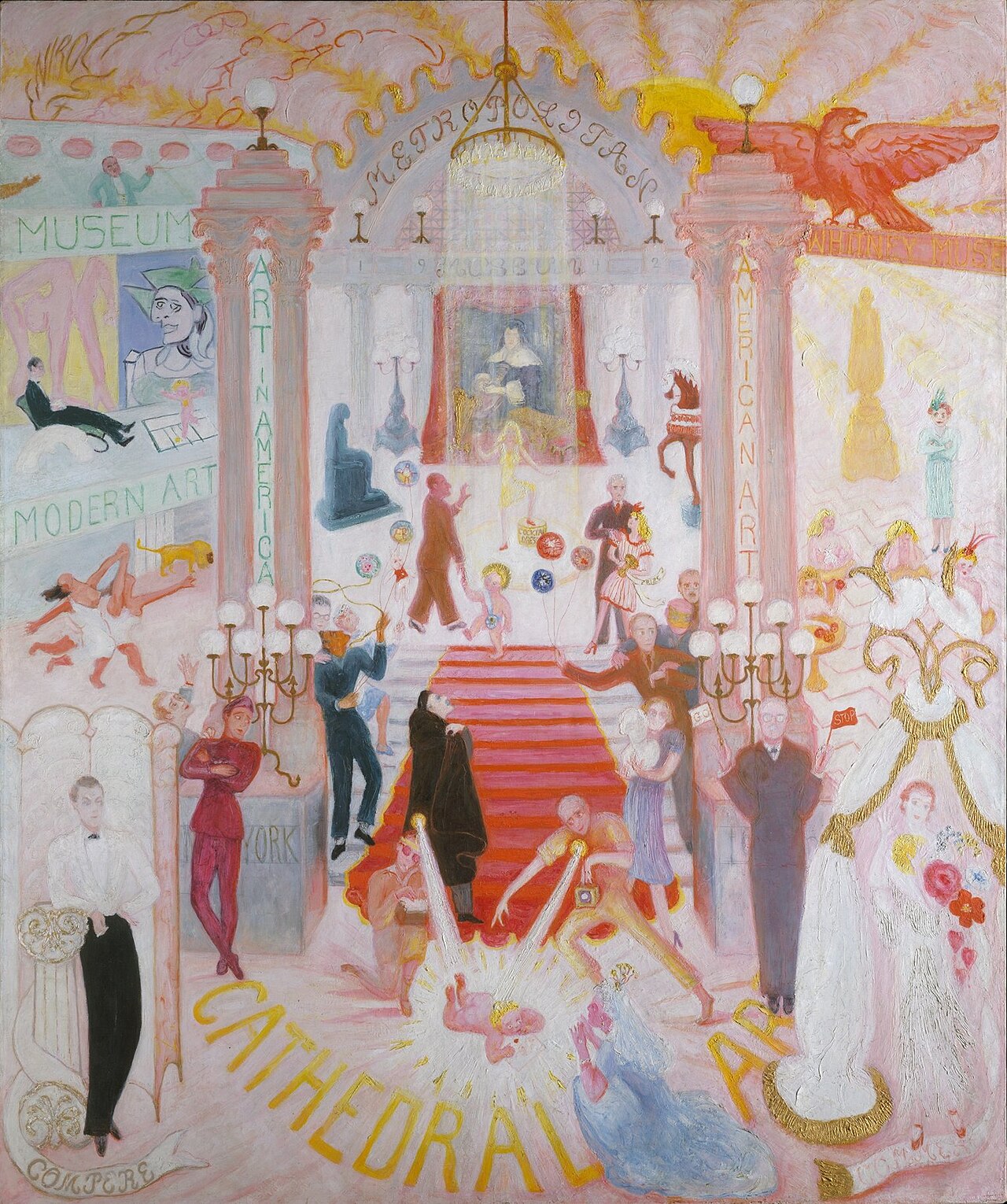
Florine Stettheimer's The Cathedrals of Art looks at first like a celebration of New York museums: pink light, grand steps, chandeliers, famous institutions, famous people, and a cloud of theatrical motion. Stay with it longer and the mood changes. The painting is affectionate, but it is not obedient. It turns the museum into a social theater, a place where art is displayed, reputations are made, directors preside, critics circulate, photographers aim, and the artist herself slips into the scene as both participant and witness.[1]
Image context: the cover is a real photographic reproduction of Stettheimer's 1942 painting from the Met collection, sourced through the Wikimedia Commons file page. It is the right image because the argument depends on the painting's own crowded museum stage rather than on a generic museum photograph or a generated visual.[2]
That is why the word "cathedral" works so well. Stettheimer is not saying that museums simply replaced churches in a secular age. She is showing how museum culture borrows ceremony: staircases, thresholds, processions, lights, guardians, high altars, and privileged lines of sight. But her cathedral is also a party with rules. The guests are not humble worshippers. They are dealers, critics, artists, patrons, and institutional figures moving inside a pastel system of prestige.[1][3]
The Met identifies the 1942 canvas as the final work in a four-painting sequence about New York's modern institutions: Broadway, Fifth Avenue, Wall Street, and art museums.[1] That sequence matters because it prevents a soft reading. Stettheimer's "cathedrals" are not only beautiful places. They are power centers. Broadway turns entertainment into ritual, Fifth Avenue turns consumption into display, Wall Street turns money into civic architecture, and The Cathedrals of Art turns museum culture into a ceremonial market of recognition.[1][4]
In this painting, three museums become a single impossible building. MoMA appears at upper left, the Met occupies the center, and the Whitney is staged at upper right.[1] The composition does not try to make architectural sense. It makes social sense. The museums are compressed into one arena because, in art-world life, they already function as related stages. Artists want to enter them, critics want to interpret them, donors and directors want to shape them, and viewers learn to treat them as places where cultural value becomes visible.
The center is the Met's grand stair, but Stettheimer makes it feel less like masonry than choreography. Figures gather, pose, point, descend, and watch. Lamps and chandeliers become stage lights. A red carpet pulls the eye upward. Paintings within the painting behave like altarpieces, trophies, and backdrops at once. Nothing is still in the solemn museum-label sense. The whole picture feels as if an opening, a procession, and a gossip column have arrived at the same time.
That social density belongs to Stettheimer's larger method. Columbia University Libraries describes her as a New York-based painter and designer whose Upper West Side salons, hosted with Ettie and Carrie, brought her into regular contact with avant-garde artists and writers including Marcel Duchamp, Alfred Stieglitz, and Leo Stein.[3] The Cathedrals of Art carries that social knowledge into institutional form. It is a group portrait of a cultural network, a history painting of New York's art institutions, and a genre scene of people behaving in the specialized manners of the museum world.[1][3]
Her own presence sharpens the joke. The Met notes that Stettheimer includes herself at the lower right among critics, dealers, photographers, and other art-world figures around the stairs.[1] She does not stand outside the institution as a pure satirist. Nor does she disappear into reverence. She places herself inside the field she is analyzing. That makes the painting less a denunciation than a knowing self-portrait of participation: the artist recognizes that the museum machine is absurd, glamorous, selective, and necessary all at once.
MoMA's account of Family Portrait, II helps explain the logic of that self-insertion. In that 1933 painting, Stettheimer shows herself with palette and brush inside a family scene that opens onto Manhattan, flowers, apartment life, and social performance.[5] MoMA's audio commentary stresses that she wanted a portrait style that was not simply naturalistic; she depicted herself as artist while also showing herself as sister, daughter, hostess, and part of New York's cultural fabric.[6] The Cathedrals of Art extends that portrait method from family to institution. It asks what a museum portrait looks like when the building, the audience, and the hierarchy all become characters.
This is why Stettheimer's sweetness can mislead. The colors are airy, the scale is decorative, and the figures often seem almost weightless. Yet the painting is built around sharp institutional intelligence. Directors watch from elevated zones. Museum names become banners. Works of art become emblems inside larger systems of display. Viewers become a crowd. The comedy depends on exact observation: museums claim to preserve art above ordinary life, but they are also made of appointments, personalities, ceremonies, donors, publicity, taste, and competition.[1][4]
Britannica's summary of Stettheimer's cathedral series is useful because it frames the canvases as both glorification and critique of the modern city.[4] That double verb is the key. The Cathedrals of Art does glorify. It gives museums splendor, light, and almost liturgical centrality. But it also critiques by making the splendor look socially produced. The museum does not descend from heaven. It is built by people, guarded by people, populated by people, and converted into authority by repeated rituals of attention.
The painting's pleasure lies in refusing to choose between affection and analysis. Stettheimer loved New York's cultural world enough to paint its specific actors and institutions, but she understood its theatricality too well to paint it straight. Her soft pinks and golds do not soften the argument. They make the argument more exact. Prestige often arrives in attractive forms. Social power rarely announces itself as power; it arrives as a stairway, a gala, a label, a director's gaze, a museum banner, a crowd that knows where to look.
Seen this way, The Cathedrals of Art is not a quaint insider fantasy. It is a durable picture of how art worlds work. The museum becomes a stage where public value is rehearsed until it feels permanent. Stettheimer's brilliance was to paint that system without flattening it into cynicism. She gives us the lights, the comedy, the devotion, the vanity, the architecture, and the artist standing inside the ceremony, aware that the cathedral is real because everyone keeps acting as if it is.
Sources
- The Metropolitan Museum of Art, "Florine Stettheimer, The Cathedrals of Art" - official object page identifying the 1942 painting, the four-part Cathedrals series, the three New York museums, and the art-world figures gathered around the Met staircase.
- Wikimedia Commons, "File:'The Cathedrals of Art' by Florine Stettheimer, 1942.jpg" - source page for the real photographic reproduction used as the article image, with work metadata and Met collection information.
- Columbia University Libraries, "Florine Stettheimer at Columbia" - institutional overview of Stettheimer's New York studio, salons with Ettie and Carrie, avant-garde circle, European training, and Columbia's Stettheimer holdings.
- Encyclopaedia Britannica, "Florine Stettheimer" - reference biography summarizing Stettheimer's salons and the Cathedrals series as glorifying and critiquing modern New York institutions.
- The Museum of Modern Art, "Florine Stettheimer, Family Portrait, II" - collection entry on Stettheimer's self-presentation, family portrait structure, salon milieu, and 1930s Manhattan backdrop.
- The Museum of Modern Art Audio, "Florine Stettheimer. Family Portrait, II. 1933" - curator Anne Umland's notes on Stettheimer's non-naturalistic portrait method and her roles as artist, daughter, sister, hostess, and New York cultural figure.