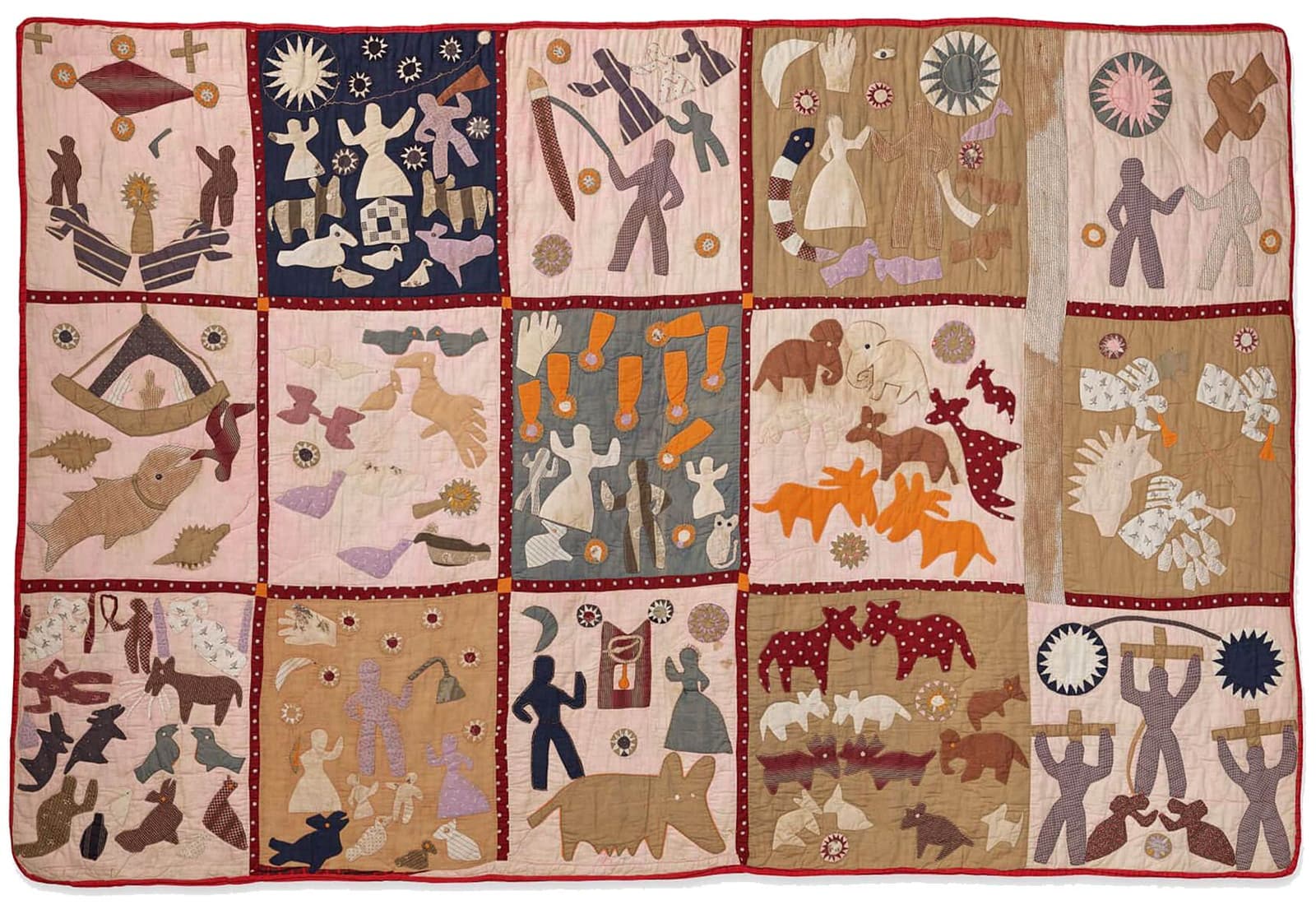
Harriet Powers's Pictorial quilt does not behave like a quilt that happens to include pictures. It behaves like a picture system built out of quilt logic. Made in Georgia in the 1890s and now held by the Museum of Fine Arts, Boston, the work is cotton plain weave, pieced, appliqued, embroidered, and quilted: a domestic technique turned into a public visual archive.[2][3] Its fifteen panels hold biblical scenes, weather events, celestial signs, animals, figures in crisis, and remembered episodes from oral report.[1][3][5]
That compression is the first thing to take seriously. Powers does not separate sacred time from historical time. The stories of Job, Jonah, and biblical judgment sit beside events such as the Leonid meteor storm of 1833, the darkened sky remembered as Black Friday in 1780, and the freezing weather of February 1895.[3][5] The quilt therefore asks to be read less as illustration than as a theory of memory. What matters is not only what happened. What matters is how an event becomes durable enough to be told again, cut into cloth, arranged in a square, and kept in front of the eye.
Image context: this is a real photographic image of Powers's actual textile, not a diagram, chart, or generated visual. It belongs here because the article's argument depends on seeing the quilt as a material field: fabric pieces, seams, figures, blocks, and colors carry the meaning, not an external explanatory graphic.[2]
The grid holds events without flattening them
The fifteen-panel grid might first look orderly. It gives the viewer rows, borders, and a stable rectangular field. But the order is not the order of a printed timeline. The blocks do not simply march from beginning to end. Instead, each scene occupies its own charged cell, and the whole quilt asks the eye to travel by association: storm to judgment, animal to omen, scripture to local report, remembered terror to visual teaching.[3][5]
That is why the grid matters. Powers needed structure, but not a structure that would make all stories equivalent. A grid lets the quilt hold many kinds of knowledge together while preserving the pressure inside each one. A biblical scene can keep its devotional force. A meteor shower can keep its remembered shock. A winter disaster can keep its local specificity. The work becomes a field of witnesses rather than a smooth narrative strip.
The MFA's Fabric of a Nation exhibition page emphasizes that Powers's two surviving quilts, the Pictorial quilt and the Smithsonian's Bible Quilt, were brought together as exceptional works of artistry and storytelling by an artist born into slavery in Athens, Georgia.[3] That biographical fact matters, but it should not reduce the quilt to testimony alone. Powers is not simply recording hardship. She is designing a visual structure capable of carrying knowledge across unequal systems of ownership, literacy, race, religion, and museum preservation.
Applique makes memory physical
Applique is often treated as a craft label, but in this quilt it is the central intellectual operation. Powers cuts fabric into bodies, animals, signs, and forms, then stitches them onto a larger cloth ground. A printed picture can pretend that an image simply appears. Applique makes appearance visibly made. Every figure carries the fact of being selected, cut, placed, edged, and held.
The New Georgia Encyclopedia is useful here because it links Powers's bold applique storytelling to African and African American design inheritance, while also warning that the recorded interpretations of the quilts likely passed through other people's hands.[4] That double point is essential. The quilt is not a transparent transcription of Powers's speech. It is a material artwork whose meanings survived through fabric, memory, and later documentation, some of it mediated by white owners and institutions.[1][4]
That mediation should make us look harder, not give up. The cut fabric bodies have a blunt force that resists being smoothed into polite folk-art charm. They do not ask to be naturalistic. Their power lies in contour, emblem, and position. A figure can stand for a person, a soul, a biblical actor, an eyewitness memory, or a community warning. The less illusionistic the figure is, the more directly it can act as a sign.
Sacred history and local history share one surface
The most radical thing about the Pictorial quilt may be its refusal to separate the Bible from the weather. In a museum label, the categories are easy: religious subject, historical event, textile technique, African American art. In Powers's quilt, those categories are stitched into one surface. The sky is not background. It is an actor. Cold, darkness, falling stars, animals, and biblical scenes all become signs through which the world can be interpreted.[3][5]
Britannica's account notes that Powers's later quilt combines biblical stories with historical events, including the 1833 Leonid meteor shower, whose terror was remembered as a possible sign of Judgment Day.[5] Whether a viewer accepts that theology is beside the point. The artistic fact is that Powers gives cosmic and local events the same visual seriousness as scripture. She makes memory accountable to awe.
That is different from treating the quilt as a set of captions. The scenes are not illustrations subordinate to a written explanation. They are pictorial propositions. A storm remembered in cloth is not merely "about" a storm. It asks how a community stores fear after the sky has returned to normal. A biblical trial shown in fabric does not merely summarize doctrine. It asks how suffering, endurance, and divine order can be pictured by someone whose own life crossed slavery, emancipation, farm labor, debt, and public display.[1][4][5]
The quilt's afterlife is part of the reading
Powers's Bible Quilt was displayed at the Athens cotton fair in 1886, and her Pictorial quilt followed in the 1890s after the earlier work had attracted attention.[1][5] That fair and exhibition history matters because the quilts were never only private bedcovers. They entered public looking, purchase, patronage, and institutional memory. The Pictorial quilt was later connected to Charles Cuthbert Hall and eventually came to the MFA through the Maxim Karolik bequest.[2][5]
This afterlife complicates the work. Powers's art became visible through systems that did not give Black women equal control over reputation, money, ownership, or interpretation. But the quilt also outlasted those systems' attempts to make it minor. The MFA's exhibition materials argue that quilt display had long been limited by assumptions about region, form, motif, domestic use, and women's work; Fabric of a Nation tried to reframe quilts as complex American art objects and historical records.[3]
The Pictorial quilt makes that reframing feel overdue rather than generous. Its ambition is already present on the surface. Fifteen panels are not a decorative flourish. They are a claim that cloth can think in episodes, omens, testimony, and theology. They are also a claim that domestic skill can carry public history without asking permission from painting.
Why the work still feels awake
The quilt's power now is not only that it preserves rare nineteenth-century African American textile art, though it does. It is that it makes the act of preservation visible. Memory here is not abstract. It has edges. It has thread. It has blocks that keep different kinds of time from dissolving into one another.
That is why Powers's unevenness matters. The figures do not need Renaissance depth. The panels do not need academic finish. Their authority comes from a different grammar: cut shape, symbolic density, oral inheritance, stitched emphasis, repeated looking. The quilt does not imitate official history. It builds a counter-archive in cloth.
Seen this way, Pictorial quilt is not a charming predecessor to later textile art. It is a demanding artwork about how stories survive when their makers are not given stable institutional power. Powers made applique read like memory because memory, for her, had to be assembled, protected, and shown. The quilt remains awake because it still makes the viewer do that work: move from panel to panel, refuse a single category, and recognize that a sewn image can hold scripture, weather, history, and survival in the same field.[3][4][5]
Sources
- Encyclopedia.com, "Powers, Harriet" - encyclopedia entry on Powers's quilts, the 1886 Cotton Fair display, the Bible Quilt sale to Jennie Smith, the Pictorial Quilt's fifteen sections, and its biblical, meteorological, and astronomical subjects.
- Museum of Fine Arts, Boston, "Harriet Powers, Pictorial quilt, 1895-98" - MFA media image page for the photographic image used as this article's cover and the work's material description.
- Museum of Fine Arts, Boston, "Fabric of a Nation" - exhibition page bringing together Powers's two surviving quilts and framing American quilts as complex artistic, historical, and personal records.
- Ashley Callahan, "Harriet Powers." New Georgia Encyclopedia, last edited September 1, 2020 - biographical and interpretive account of Powers's applique storytelling, African and African American design inheritance, and documentation issues.
- Encyclopaedia Britannica, "Harriet Powers" - reference overview of Powers's life, two surviving quilts, Bible Quilt sale history, and Pictorial Quilt subjects including biblical scenes and historical/celestial events.