Elizabeth Catlett's art is often introduced through its commitments: Black women, workers, mothers, anti-racist struggle, Mexican printmaking, accessible public image. That is all true, but it can make the work sound as if its politics arrived first and its form followed dutifully behind. Catlett is stronger than that. Her politics survive because the forms are so exact. A head leans forward. A cheekbone catches light. A hand becomes nearly architectural. A linocut edge makes a face feel cut from pressure rather than merely drawn from observation.[1][2][4]
The useful word for Catlett is not softness, even when the subject is care. Her tenderness is carved. In sculpture, she gives maternal bodies mass, balance, and inward concentration. In prints, she lets the cut line do ethical work: it clarifies, hardens, protects, and repeats. The result is an art of feeling without sentimental blur. Catlett makes dignity physical enough to stand, print, and travel.[2][3][4]
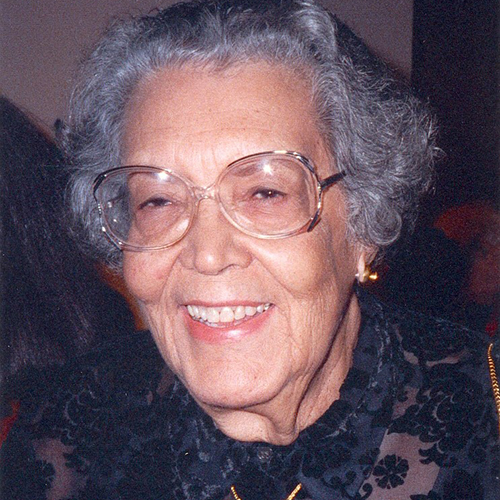
Image context: this article uses one real photographic portrait, not a diagram, chart, generated visual, or symbolic placeholder. The photograph is relevant because the profile is about embodied presence: Catlett's own career joined teaching, workshop practice, public activism, and a tactile art of faces and figures.[1]
Training gave the work its spine
Catlett was raised in Washington, D.C., the granddaughter of formerly enslaved people, and entered art through institutions that both opened and blocked the path. The National Museum of Women in the Arts notes that Carnegie Institute of Technology refused her admission because of race; she went to Howard University instead, where her teachers included Lois Mailou Jones and Alain Locke, and graduated with honors in 1935.[1] Britannica adds the crucial next sequence: she worked in New Deal mural practice, studied at the University of Iowa, and in 1940 became the first student to earn an MFA in sculpture there.[2]
Those facts matter because Catlett's art is not an outsider witness drifting around the academy. It is trained, deliberate, and materially ambitious. Howard gave her a Black intellectual setting. Iowa gave her sculptural discipline. New York and Harlem gave her a working-adult classroom and the public audience she later treated as central rather than secondary.[2][5] By the 1940s, as modernism was opening multiple paths away from naturalism, Catlett was moving toward a figurative language that could carry social address without becoming illustration.[2]
That choice was not conservative. It was strategic. Abstraction could claim freedom from narrative, but Catlett needed a figure that could be recognized by the people she cared about and still withstand close formal scrutiny. She made the face, the torso, the mother-and-child group, and the worker's body into modern forms with public obligations.[1][2][3]
Mexico changed access, not only style
In 1946, Catlett received a Rosenwald Fund fellowship to work in Mexico City, a move that became more than a study trip.[2][5] The Library of Congress catalog record for her 2002 oral history summarizes the arc she later recalled: Howard, the University of Iowa, Harlem's George Washington Carver School, the fellowship to Mexico, meeting Francisco Mora, and joining the Taller de Grafica Popular.[5] That workshop context is essential. It gave Catlett a model of art as repeatable, distributable public language rather than a luxury object sealed in a private room.
The Amon Carter Museum's page for Sharecropper makes the printmaking logic plain: Catlett identified with the Taller de Grafica Popular's political message and its commitment to accessible images for broad audiences.[4] A linoleum block is cut once and printed many times. The image can move. It can reach viewers who will never stand before a unique bronze or a museum pedestal. For Catlett, reproduction was not a loss of aura. It was part of the ethics.
Mexico also sharpened her sculptural language. MoMA's magazine essay on Mother and Child identifies the 1956 work as terra cotta and describes the sculpture's intimate but monumental physicality.[3] The technical point matters because Catlett's maternal forms are not generic icons of warmth. They are built. Their tenderness has structure, volume, and learned material memory. The mother shelters the child, but the sculpture also asks how protection is made: by weight, by curve, by the way one form holds another without dissolving into it.
The Black woman is not a symbol in the abstract
Catlett's recurring Black female figure can be misread as emblem alone. The stronger reading is more specific. She was not making "the Black woman" as a flat slogan; she was building a repertoire of social positions: sharecropper, mother, organizer, domestic worker, historical witness, student, singer, revolutionary, elder.[1][2][3] MoMA's magazine essay on Mother and Child points back to Catlett's 1946 print series on the role of Black women in the fight for democratic rights, which helps explain the breadth of that serial thinking.[3]
That breadth keeps the figure from becoming decorative uplift. Catlett's women are dignified, but dignity in her work is not politeness. It can be tired, watchful, stern, frontal, maternal, defiant, or inward. In Sharecropper, the Amon Carter Museum describes a woman seen from below, formed by Catlett's dynamic linework into an icon of strength and resilience.[4] Catlett's formal solution is to make the face unforgettable without making it individualized in a narrow portrait sense. The woman is one person and many people at once.
Britannica's broader account helps explain why that image-world was never limited to famous subjects. Catlett chose historical figures such as Harriet Tubman and Malcolm X, but she also returned to anonymous workers and strong solitary Black women.[2] The art does not simply memorialize suffering. The cut line dignifies by refusing vagueness. The hat brim, cheek, neck, and gaze are organized as force. The viewer is not invited to pity from above. The viewer is made to meet the figure's composure.
Why the 2025 retrospective matters
The retrospective Elizabeth Catlett: A Black Revolutionary Artist and All That It Implies framed her as an artist of formal rigor and social commitment, moving across sculpture, printmaking, and political history.[6] Just as important, the project traced Catlett across U.S. and Mexican contexts, with the Brooklyn Museum and National Gallery of Art presenting the exhibition in collaboration with the Art Institute of Chicago.[6]
That institutional scale matters because Catlett long sat uneasily in several art-historical containers at once. She was American and Mexican. She was a sculptor and a printmaker. She worked with modernist simplification but refused modernism's frequent suspicion of social purpose. She made art for broad publics without letting craft become simplistic. A major retrospective does not fix those tensions by smoothing them out. It gives viewers enough work to see that the tensions were the engine.
Catlett's art still feels urgent because it rejects a false choice between care and power. Motherhood does not weaken sculpture. Accessibility does not weaken printmaking. Political commitment does not weaken form. In her best works, each pressure strengthens the others. The carved body keeps care from becoming vapor. The linocut edge keeps politics from becoming vague. The repeated image keeps private admiration from becoming the only audience.
That is why Catlett's tenderness feels carved. She knew that people who had been distorted by caricature, poverty, racism, and official neglect needed more than sympathetic representation. They needed images built with enough force to answer distortion at the level of form. Catlett gave them weight, line, repetition, and presence. She made art that could hold a child, face a system, and still keep its edge.[1][2][4][6]
Sources
- National Museum of Women in the Arts, "Elizabeth Catlett" - artist profile and source page for the photographic portrait used as this article's cover.
- Encyclopaedia Britannica, "Elizabeth Catlett" - biographical overview covering Catlett's Washington upbringing, Howard and Iowa training, Mexico City move, Taller de Grafica Popular, sculpture, printmaking, and major themes.
- The Museum of Modern Art Magazine, "Elizabeth Catlett's Mother and Child" - essay on the 1956 terra-cotta sculpture, Catlett's earlier mother-and-child work, and the Black Woman print series context.
- Amon Carter Museum of American Art, "Sharecropper" - object page on Catlett's 1952 linocut, Taller de Grafica Popular context, accessible imagery, and the print's strength-and-resilience reading.
- Library of Congress catalog record, "Elizabeth Catlett oral history interview conducted by Camille O. Cosby, 2002-06-12" - catalog record for the interview covering Catlett's Howard, Iowa, Harlem, Mexico, and Taller de Grafica Popular recollections.
- Brooklyn Museum and National Gallery of Art, "Elizabeth Catlett: A Black Revolutionary Artist and All That It Implies" - press release for the retrospective, its organizing institutions, venues, and career scope.