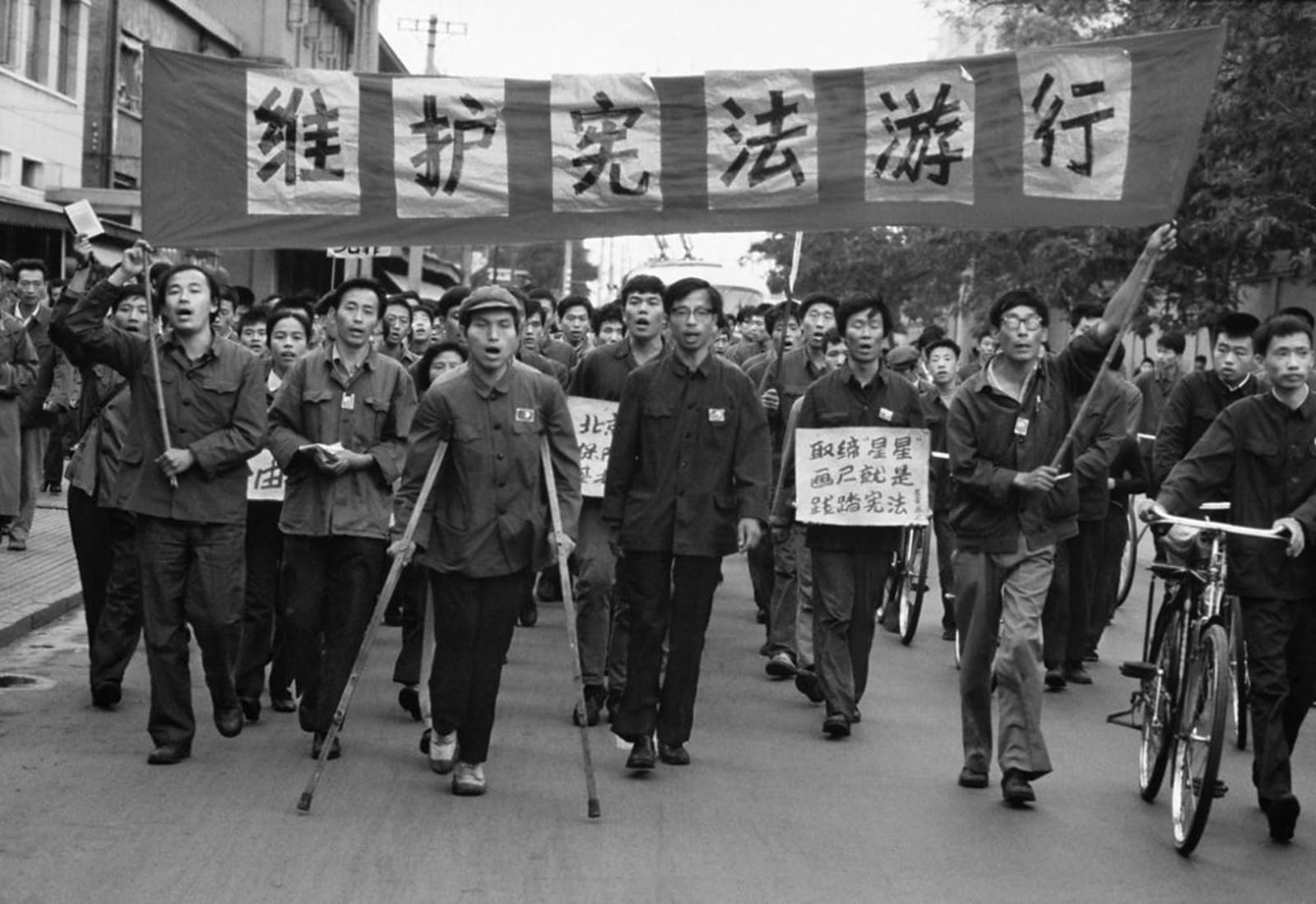
Image context: Liu Heung Shing photographed this Stars-linked procession in Beijing on October 1, 1979, four days after the group's outdoor exhibition opened beside the National Art Museum of China's predecessor. The cover is M+'s reproduction of that documentary photograph. Its banner, crowd, hand-lettered placards, walking sticks, and bicycles record the moment an argument over where art could appear became a public march.[1][2][5]
The artworks are missing from the photograph. In their place, a banner spans nearly the full width of a Beijing street. Men on foot and beside bicycles press toward the camera. One marcher advances on two walking sticks. The large characters overhead announce a march to uphold the Constitution; smaller placards make the dispute more specific. What had begun with paintings, prints, and wooden sculptures tied to a fence was now moving through the city as a demand.
This is an art movement whose most revealing form is not a signature brushstroke but a sequence: exhibition, closure, procession, negotiation, exhibition again. The Stars Group did not share one look. Its largely self-trained members worked across incompatible styles and media, from abstraction and expressive painting to woodcut and politically charged sculpture. What joined them was the insistence that individual experience and formal experiment belonged in public—even when the official art system had no place for either.[2][4][5]
The fence outside the China Art Gallery, now the National Art Museum of China, gave that insistence a structure. It held the works, marked the limit of institutional permission, and let ordinary passersby become an audience without entering the building. The Stars exhibition began where the museum ended because the boundary itself had become the argument.
The fence was display architecture and evidence
Early on September 27, 1979, twenty-three young artists installed more than 150 works on the railings between a small park and the China Art Gallery. A modest notice near the gallery entrance redirected museum visitors toward the outdoor display. Inside, an official national exhibition marked the thirtieth anniversary of the People's Republic; outside, oils, ink paintings, prints, and wooden sculptures arrived without official approval.[2][3][4]
The location was improvised but exact. The artists had tried to secure a recognized venue and failed. By hanging their work alongside the country's leading art institution, they could use its foot traffic without pretending to possess its endorsement. A park fence became a gallery wall, but it never stopped looking like a fence. Every vertical bar kept the difference between admission and exclusion visible.
That visibility changed how the art addressed its audience. A museum normally controls the threshold, selects the work, and gives the encounter institutional legitimacy before a viewer arrives. Here the artists selected themselves. People could stop on the way past, look through or along the railings, talk with the makers, and write responses. Zheng Bo's study of the Stars event argues that the park's relative openness enabled both access and debate; the exhibition's comment books eventually accumulated approval, disagreement, and multiple interpretations instead of delivering one authorized reading.[3]
The fence therefore did more than solve a venue problem. It turned an administrative refusal into a spatial fact that anyone could inspect. The works were outside, the official exhibition was inside, and the public occupied the charged interval between them.
Pluralism was the common discipline
Calling the Stars a movement can suggest a visual grammar as recognizable as Futurist speed lines or Cubist facets. That model fails here. The group's unity depended on difference.
In a 1980 discussion compiled by critic Li Xianting, the work was described through two broad impulses: engagement with lived society and exploration of form. The artists rejected the idea that one had to cancel the other. Their exhibition statement connected responsibility to contemporary life with the need to invent new forms for new thoughts and feelings.[2] Social witness without formal freedom would repeat the habits of propaganda; formal experiment without lived pressure could become an escape.
Wang Keping's sculpture shows the two impulses meeting in one piece of wood. While carving Silence, he allowed a knot to suggest a stopped mouth, then cut the eyes as if sealed over. Found material, absurdist theater, bodily mutilation, and the memory of enforced silence converged without becoming an illustration of a slogan.[2][6] Huang Rui, by contrast, pursued color, geometric space, expressive portraiture, and images of the ruined Old Summer Palace. Qu Leilei linked private thought and emotional strain to questions of law and political violence. Other members used woodcut, ink, oil, figuration, or abstraction.[2]
Borrowing from international modernism mattered, especially after long restrictions on abstraction, surrealism, and other forms considered politically suspect. Yet it is too simple to cast the group as a delivery system for Western styles. The artists were testing what could happen when personal memory, a piece of timber, an unfamiliar color relation, or an ordinary body no longer had to submit to a prescribed public image. Their shared style was the right not to share one.
The group's name condensed that ethic. Co-founder Ma Desheng later contrasted the many individual stars with the single “red sun” that had dominated his childhood imagination. Many stars meant many people: separate sources of light rather than one center around which every image had to orbit.[4] The visual diversity of the exhibition was not a weakness in the movement's identity. It was the identity.
Looking became a public act
The Stars did not invent unofficial art in Beijing. Earlier in 1979, the April Photography Society and the No-Name Painting Society had already organized important exhibitions outside the usual state-art framework.[2][5] Placing the Stars within that larger opening matters: origin stories become misleading when they clear the field around one dramatic event.
What distinguished the fence exhibition was the tight coupling of experimental form, institutional boundary, and public confrontation. The viewers were not incidental background. Photographs show them gathering close to Wang Keping's suspended sculptures and studying paintings at eye level. Chi Xiaoning climbed along the fence with a hand-wound 16mm camera while Ren Shulin fed him short reels of film obtained through his workplace. Their surviving footage follows the installation, spectators, police intervention, march, negotiation, and later exhibition; M+ identifies it as the only known moving-image record of the sequence.[4]
That camera changes the history available to us. It shows faces adjusting to unfamiliar work rather than merely proving that the work was there. Zheng's account of the comment books makes the same point in another medium: viewers praised, disputed, misunderstood, and reinterpreted what they saw.[3] After years in which public culture was expected to transmit a correct ideological message, variation in response was itself consequential.
The exhibition produced no consensus, and that was one of its achievements. Public life appeared not as a mass repeating one answer but as strangers exercising attention beside a fence.
The march changed the medium, not the claim
Police intervened on September 28. On the morning of September 29, the exhibition was formally closed and the works were removed or held inside the gallery. The artists and allied editors from unofficial journals then organized a demonstration for October 1, National Day. Starting near Xidan Democracy Wall, the procession moved toward the Beijing municipal leadership with demands for constitutional rights, political democracy, and artistic freedom.[2][4][5]
Liu Heung Shing's photograph catches the march head-on. The banner acts almost like the top edge of a moving picture, but the scene refuses a neat frame. Bicycles enter from the side, placards overlap bodies, and the crowd continues past both edges. The group is visually collective without becoming uniform. That is the same structure the exhibition had proposed: many individuals held together by a shared public action.
It would be easy to let the march swallow the art and remember the Stars only as dissidents. The sequence argues for a subtler relation. The paintings and sculptures did not become interchangeable political posters after police closed the show. Rather, their differences exposed a common condition: plural expression requires somewhere to appear, an audience able to respond, and rules that do not make permission depend on aesthetic obedience. The march carried that condition into the street.
The camera also preserves a decisive substitution. At the fence, art objects faced viewers. In the march, bodies, banners, walking sticks, and bicycles carried the exhibition's unresolved claim. The medium changed from displayed things to organized movement; the demand for a public encounter stayed intact.
Entering the institution did not erase the outside
Negotiations produced a permitted Stars exhibition at Huafangzhai in Beihai Park from November 23 to December 2, 1979. Twenty-three artists showed 163 works. In August 1980, a second exhibition finally entered the national gallery itself.[2][5][6] The route from an exterior fence to an interior museum can look like a simple story of recognition: outsiders protest, authorities yield, the avant-garde earns its room.
But the earlier installation prevents so tidy a conclusion. Once the fence had shown that a public could assemble around work without prior institutional validation, admission could no longer appear to be the source of the art's significance. The museum offered scale, protection, and visibility. It did not retroactively create the audience, the formal experiments, or the arguments that had already gathered outside.
Nor should the Stars become the only origin assigned to contemporary Chinese art. The April photographers, No-Name painters, unofficial journals, Democracy Wall activists, and artists working critically within academies all formed part of the period's cultural opening.[2][5] The Stars' particular contribution was to bind several problems into one visible event: who may exhibit, what forms may count as art, where a public may gather, and how individual expression survives contact with a collective cause.
That is why the absence of a house style matters. A conventional movement proves its coherence when different artists begin to look related. The Stars proved theirs by making room for unlike images and then defending the conditions under which those differences could be seen. The fence carried the works because the museum would not. It also revealed something a finished gallery wall tends to hide: every exhibition is an arrangement of access, authority, and attention.
The Stars entered the museum later. Their defining threshold remained outside it.
Sources
- M+ Museum, “Liu Heung Shing, China After Mao—Stars Group Painting March, Beijing, 1979” — official collection record for the documentary photograph used as the cover, including title, date, medium, dimensions, and collection credit.
- Museum of Modern Art, Contemporary Chinese Art: Primary Documents — translated exhibition statements, the October 1 letter, Li Xianting's 1980 conversations with Stars artists, and a chronology of 1979 unofficial art activity.
- Zheng Bo, “Creating Publicness: From the Stars Event to Recent Socially Engaged Art,” Yishu: Journal of Contemporary Chinese Art 9, no. 5 (2010) — analysis of the park, fence, audience access, comment books, and demonstration as a struggle over public discourse.
- Andy Cohen, “The Story of Chi Xiaoning and His Smuggled Camera,” M+ Magazine (March 5, 2020) — account of the Stars' connection to Today, the fence exhibition, viewer footage, police intervention, march, and preservation of the only known moving-image record.
- University of Vienna, “Avant-Garde Artists and Writers,” The Chinese Democracy Movement of 1978–1981 — research chronology connecting the Stars with other unofficial groups, Democracy Wall, the October march, Beihai exhibition, and 1980 national-gallery show.
- Wang Keping, “The Stars: Contemporary Chinese Avant-Garde” — artist-maintained archive of the group's membership, exhibition dates, photographs, memoir material, and Wang's sculptural practice.