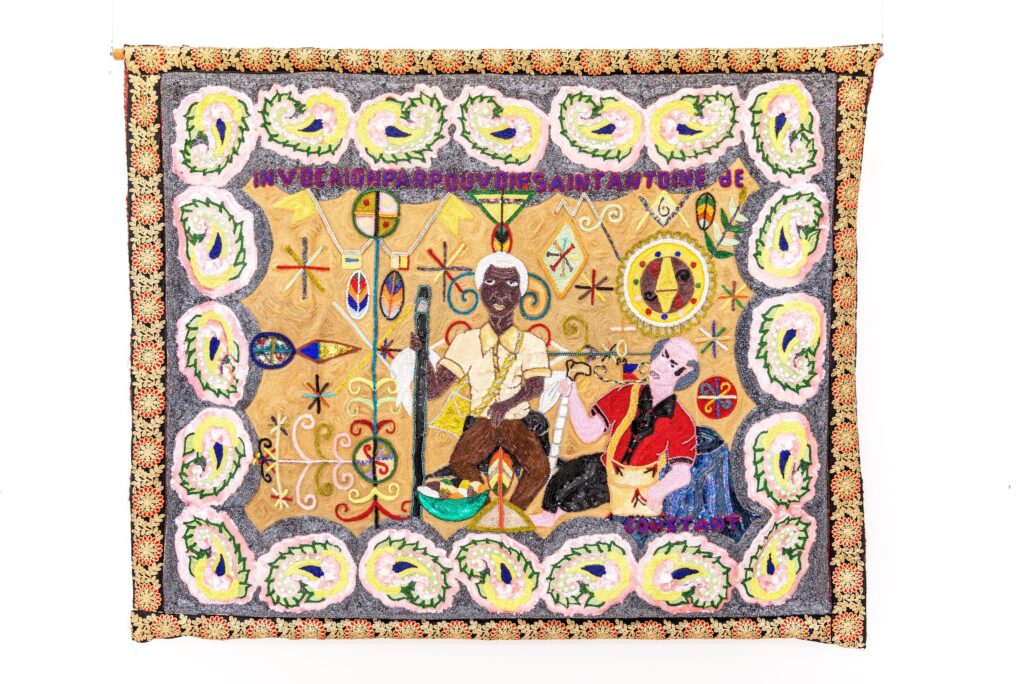
Image context: PAMM's photograph of Invocation for Saint Anthony shows the actual textile discussed below. Beads and sequins are the scene's physical units: they give bodies their edges, interrupt one color with another, and return real light toward the viewer. The museum dates the work 2015–19 and identifies its materials as sequins, beads, and silk on cotton.[1]
From the front, Myrlande Constant's textiles offer abundance all at once. Figures crowd around meals, ceremonies, disasters, saints, spirits, trees, snakes, instruments, and offerings. Borders thicken into patterned bands; the ground fills until bare cloth nearly disappears. In Invocation for Saint Anthony (2015–19), two seated figures, canes, a bowl of offerings, directional marks, and vèvè-like geometries occupy a surface a little under five feet wide. Beads do not merely decorate its picture. They are how the picture exists.[1]
The surprise lies behind that surface. Constant draws on the reverse of cloth stretched across a horizontal frame. Working with one hand above and one below, she uses a tambour hook and chain stitch to secure each bead or sequin on the unseen face. Pérez Art Museum Miami's account of her process says she works intuitively and looks at the finished beaded side only when the work is complete.[1][6]
That reversal is more than a virtuoso trick. It reorganizes picture-making. A painter can step back, compare the newest mark with the whole, glaze over a passage, or scrape it away. Constant's method commits the image through linked, tactile decisions while its public face remains out of view. Drawing becomes route; stitch becomes memory; light arrives last. To understand the result, it helps to begin not with the glitter but with the structure that holds it.
The flag was already an image in motion
Constant works within the Haitian tradition of drapo Vodou—ceremonial flags that honor the lwa, or spirits. Drapo are commonly made from satin, velvet, or rayon and embellished with beads, sequins, appliqué, fringe, and other reflective materials. A flag is generally dedicated to a particular lwa through associated colors and signs. Historical examples bring African-derived sacred symbols into relation with Catholic processional banners, military ensigns, and Masonic regalia; the form is a record of synthesis, not a sealed visual vocabulary.[3]
The object's use matters to its optics. Drapo are presented near the beginning of ceremonies, saluting the spirits and helping gather the energies of participants; they were not developed only for motionless contemplation on a white wall.[3] A sequin does not hold one color in the manner of a painted square. As cloth, viewer, or illumination shifts, it flashes, dims, borrows the room, then flashes elsewhere. The viewer, textile, and light source together keep changing the work.
Museum display can make the drapo look like a fixed rectangular picture, and Constant's compositions can sustain that kind of close looking. But the tradition supplied a more active premise before she altered its scale or stitching: reflected light could be a material, and an image could announce presence by moving through space. Her innovation did not begin from blank fabric or from a supposedly anonymous “craft.” It began inside an accomplished sacred form with its own dimensions, protocols, makers, and visual intelligence.[3]
Tambour makes a line that is also a fastener
Constant learned tambour embroidery as a young worker making beaded wedding dresses with her mother in a Port-au-Prince factory. In the early 1990s she carried that commercial garment technique into a field then dominated by male flag makers, using glass beads as well as sequins and eventually directing much larger, denser compositions.[1][5][6]
Tambour holds the fabric drum-tight across a frame.[6] The hook enters from the back. A hand beneath the cloth supplies the bead on the front; the returning thread catches and locks it into a continuous chain. The operation joins two kinds of mark that drawing usually separates. Each placement adds a visible point to the image, but it also strengthens the hidden line that holds the next point in sequence.[1]
This is why the technique is better understood as syntax than as surface finish. A bead may become an eye, a shirt button, a fruit, a star, or one interval in a field of color. Yet it remains a hard object with a hole and an orientation. It cannot be feathered into its neighbor like wet pigment. Curves must be paced through successive attachments; dense color is accumulated, not spread. Sequins contribute broader disks of reflection, while smaller beads can sharpen outlines, shift texture, or make a passage feel directional. The image grows by choosing not only where color sits, but how material repeats.
The reverse-facing process adds another constraint. Because Constant does not continuously judge the final face from a conventional viewing position, the preparatory drawing and the practiced rhythm of the stitch carry unusual authority. Improvisation still occurs—the museum account explicitly describes the work as intuitive—but it happens through touch, sequence, and local decisions rather than constant correction against the total front view.[1] What looks optically lavish is built through disciplined partial knowledge.
Invocation for Saint Anthony turns a border into an event
Invocation for Saint Anthony provides a compact demonstration. PAMM dates the work 2015–19, identifies its materials as sequins, beads, and silk on cotton, and gives its dimensions as 47 by 58½ inches. The museum interprets its subject as an honoring of Legba, guardian of the crossroads and the lwa saluted first in many ceremonies, through an association with Saint Anthony.[1]
At a distance, the rectangle reads with the heraldic directness of a flag: central figures, enclosing frame, bright signs. Up close, that hierarchy keeps breaking open. The yellow-ochre ground is not empty air around the figures. Symbols, changes of direction, and small chromatic interruptions keep it active. A bowl near the seated figures suggests an offering and forms a cluster of colored rounds. Canes act as attributes and long linear accents. Even a gaze becomes a literal beaded line connecting one body to another.[1]
The border does not merely fence the sacred scene from the outside. Because its repetitions are made with the same beads and chained labor as faces, clothing, ground, and signs, it belongs to the same material tempo. Center and edge differ in iconographic function but not in substance. Constant can therefore make the eye oscillate: first the legible figures, then a row of tiny decisions; first a coherent emblem, then an expanse whose density refuses to remain background.
This is one way tambour changes narrative capacity. Traditional drapo often organize a central image or vèvè within a geometric border.[3] Constant preserves that intelligible rectangle while loading it with incidents. Her figures do not float as isolated badges. They share space, gesture, look, carry, gather, and occupy different scales. The stitch links the textile physically; repetition links its population visually.
Light is not the varnish
Constant has described her practice as “painting with beads.”[1] The phrase claims the complexity and pictorial ambition conventionally reserved for painting, but it should not make the materials sound interchangeable. Pigment represents illumination by arranging values and hues. A faceted bead or metallized sequin also redirects illumination that is actually present.
Fowler Museum curators Katherine Smith and Jerry Philogene put the distinction precisely: Constant does not only depict light; she works with it. Reflective elements animate color, texture, outlines, and figures as conditions around the textile change.[4] Photography inevitably stabilizes that behavior. It gives us an invaluable record of composition and detail, yet every still image selects one settlement from a surface designed to keep renegotiating with the room.
This makes looking bodily. Move a step and a dull patch ignites while another recedes. Approach and narrative coherence loosens into beads, holes, thread, and minute gaps. Withdraw and thousands of attachments resolve again as a gathering. Constant's density is not visual excess for its own sake. It sets up repeated crossings between material and image, labor and radiance, the single fixed element and the scene that will not stay fixed.
Monumental scale is workshop scale
As Constant expanded drapo into monumental tableaux, the labor exceeded the romance of one hand alone. The Venice Biennale's 2022 artist account notes both the large wooden frames and the assistance of multiple studio workers; a profile based on interviews with Constant and the Fowler's curators reports that the largest textiles can involve as many as twenty collaborators.[5][6] Scale here is organizational as well as physical.
That fact sharpens rather than dilutes authorship. Constant establishes the composition, material language, technique, and workshop through which many linked placements become one work. The hidden chain stitch offers a useful model: no bead is visually lost in the whole, but none holds without a connected structure. Studio labor should therefore remain visible in any account of the medium, especially because the technique itself came from industrial garment work and because Constant's practice opened authority in a field long coded male.[1][5]
The route from wedding-dress factory to international exhibition can be told too neatly as escape—from labor into art, from ritual object into museum masterpiece, from anonymous handwork into named authorship. The works resist that ladder. Drapo had ceremonial power, formal history, and expert makers before contemporary art institutions paid sustained attention. Constant's low-paid factory training under poor conditions was also a source of formidable knowledge.[6] Museum recognition, including the Fowler's 2023 retrospective—the first U.S. museum exhibition devoted to a Haitian woman contemporary artist—changed Constant's visibility; it did not create the value of beadwork or Vodou visual culture.[2][3]
What Constant changed is more exact and more consequential. She made a garment stitch carry crowded histories. She enlarged the flag without emptying it of spirits or signs. She used beads not as a final shimmer laid over an image, but as the smallest durable decisions from which a social scene could be assembled.
The finished face may be revealed last, but it is not an accident. It is the visible side of drawing, practiced touch, linked thread, delegated labor, inherited form, and anticipated light. Constant builds from the back so that, at the front, every point can join a world.
Sources
- Pérez Art Museum Miami, “Myrlande Constant: Invocation for Saint Anthony” in Caribbean Art Highlights — official source image and collection guide with work metadata, visual description, subject, and a step-by-step account of Constant's tambour process.
- Fowler Museum at UCLA, “Myrlande Constant: The Work of Radiance” — official retrospective page documenting the artist's thirty-year practice, subjects, and exhibition history.
- Fowler Museum at UCLA, “Saluting Vodou Spirits: Haitian Flags from the Fowler Collection” — curatorial overview of drapo materials, scale, ceremonial use, iconography, and cultural synthesis.
- Katherine Smith and Jerry Philogene, “Painting with Beads and Light,” Fowler Museum Vital Matters — curatorial analysis of reflective material, color, texture, composition, and light in Constant's work.
- La Biennale di Venezia, “Myrlande Constant,” The Milk of Dreams, 59th International Art Exhibition (2022) — official artist entry on Constant's adoption of glass beads, large-scale frames, narrative compositions, studio assistance, and place within drapo.
- Siddhartha Mitter, “An Artist Who Blends Secular and Sacred (With Sequins),” The New York Times (January 25, 2023), republished by UCLA Arts — reported profile on tambour's garment-work lineage, Constant's reverse-side process, studio collaboration, and narrative expansion of drapo.