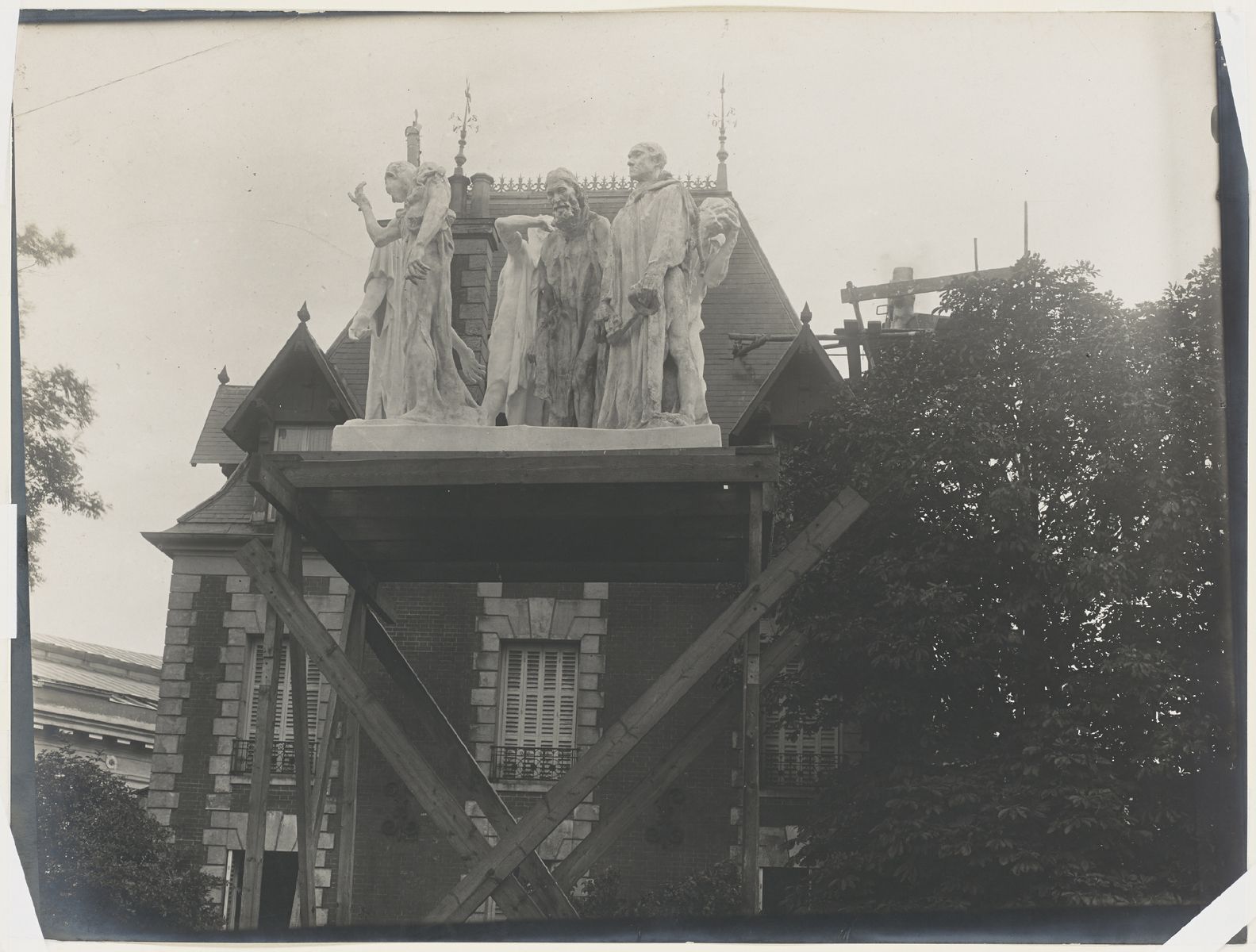
Image context: the cover is Jacques-Ernest Bulloz's gelatin silver photograph of Rodin's actual sculptural group on a tall scaffold in the garden of the Villa des Brillants at Meudon. It is not a reconstruction or an explanatory graphic. The Musée Rodin preserves the print as a photographic object, while its account of Rodin's 1913 test identifies the scaffold as five metres high. The rough timber is the evidence: Rodin was testing what height would do to the work.[1][2]
At first, the photograph looks like a monument caught before completion. Six figures stand far above the garden on a tower of raw timber. The support is too large to ignore and too provisional to pass for architecture. Trees crowd the figures; a roofline sits below them. What ought to be backstage has taken over the scene.
That is precisely why the image matters. In 1913, Auguste Rodin used a five-metre scaffold to judge how a cast of The Burghers of Calais would appear near London's Parliament. He wanted the group to break against the sky and answer the scale of the surrounding buildings.[2] Nothing about the modeled bodies changed during the test. Yet almost everything about their meaning did.
A pedestal touches a sculpture at only one surface, but it edits every other relationship. It decides where the horizon cuts the work, whether viewers meet a face or a pair of feet, how far a body must stand back, whether a monument shares the pavement or commands it. It can make engineering disappear as authority. It can also become so conspicuous that “support” is no longer an adequate name for what it does.
Rodin tested two impossible distances
Rodin's group refuses the single heroic body expected of a conventional public monument. The six burghers are physically gathered but emotionally separate: one carries the city's keys, others bend, turn, or hold themselves inside their own fear. Their bare feet and heavy garments make sacrifice look bodily rather than allegorical.[2]
The placement problem followed from that decision. Rodin considered presenting the figures close to the ground, where their scale and suffering would meet passersby directly. He also considered the opposite: raising them high enough to read as a broken silhouette against the sky. Calais accepted neither extreme, preferring a more customary monument base.[2]
Ground level and five metres up can sound like contradictory wishes. They make more sense as two attacks on the same neutral middle. A conventional pedestal separates civic hero from civic crowd while pretending that separation is natural. Rodin's low version would have made the burghers fellow bodies in the square. His high version would have surrendered intimacy to distance, turning gesture into skyline. One asks the viewer to share the figures' ground; the other asks the whole city to become their background.
The scaffold photograph records the second proposition before stone could make it look inevitable. Its lumber openly declares that height is being manufactured. A finished plinth tends to conceal the choice it embodies; this temporary one shows placement being composed.
Brancusi let the base enter the sculpture
Constantin Brancusi briefly worked in Rodin's orbit, but he shifted the pedestal question. Rodin asked where a completed group should stand. Brancusi asked where the sculpture ended.
In his Paris studio, bases were not standardized museum furniture. He carved them from wood, limestone, and marble; made some for particular works; built others from forms that had begun as sculptures; and rearranged combinations without treating them as arbitrary. Subject guided altitude. Birds rose above the head, portraits tended toward eye level, and sleeping or infant heads stayed low.[3]
Consider Maiastra of 1910–12. MoMA records a white-marble bird, 22 inches high, on a three-part limestone pedestal 70 inches high. The middle section is itself Double Caryatid, an earlier sculpture.[3] If the dimensions are divided into “art” and “support,” most of the vertical event is misclassified. The bird's lift begins long before the marble bird begins.
The Art Institute of Chicago's Golden Bird makes the sequence still more legible. Its polished bronze rises from stone and wood, including a central polyhedron cut from a tree trunk whose growth rings turn across its faces. The museum describes the contrast between the reflective, streamlined bird and the rougher geometric mass below.[4] But contrast is only half the effect. Each change of material prepares the next one: earthbound weight, carved rhythm, narrow point of contact, upward flare. The base does not merely hold flight. It gives flight a run-up.
Brancusi therefore made the pedestal both more visible and harder to isolate. It could move from one combination to another, yet it remained formally consequential. It was furniture, sculpture, interval, and viewing instruction at once. Once the support participates that fully, drawing a clean border around the artwork becomes a curatorial convenience rather than a visual fact.
Manzoni aimed the pedestal at everything
Piero Manzoni pushed that unstable border outward. In Herning in 1961, he made Socle du monde (Base of the World): an iron-and-bronze plinth measuring 82 by 100 by 100 centimetres, installed with its title inverted. The conceit is exact and enormous. Instead of elevating one object above the world, the upended base designates the terrestrial globe resting on it as art.[5]
The work is funny because it exposes how much power a pedestal usually exercises with so little explanation. Put an unremarkable object on a plinth and the platform tells us to pause, circle, protect, and interpret. Manzoni retains that declarative grammar but removes its ordinary limit. The nominated object is no longer a bronze, a vase, or a carved figure. It is the ground beneath the viewer and every institution that might validate the claim.
Yet the gesture does not abolish the art system. It depends on a singular metal object, a title, an artist, a date, and continued institutional care. The world does not visibly change when it becomes the supposed sculpture. What changes is the direction of attention: the small plinth below makes the planet conceptually hover above it. Support becomes an act of designation.
Whiteread made the plinth face itself
Rachel Whiteread's Monument produced a different inversion in Trafalgar Square in 2001. The north-west plinth had remained empty for almost 150 years before the temporary commission programme began. Instead of supplying the absent general or monarch that such a base seemed to request, Whiteread cast the plinth itself in clear resin, turned the cast upside down, and placed it on the granite original.[6]
The result was not an empty platform and not quite an occupant. It was a solid double of support: heavy enough to be structurally daunting, transparent enough to catch weather and light. The Institute of Contemporary Arts and Greater London Authority publication describes the resin's changing hue and records Whiteread's wish to create a quiet pause in the square.[6] Granite appeared to remember itself as atmosphere.
Manzoni's plinth expands its claim until everything becomes sculpture. Whiteread's contracts attention back onto the device making such claims possible. Her cast gives the pedestal a top, a bottom, a reflection, and a body to be looked at. It also turns vacancy into content. The long-unfilled base no longer reads as a failed monument waiting for the right authority; its waiting becomes the subject.
That matters in Trafalgar Square, where elevation is inseparable from public representation. A plinth does not only lift mass. It proposes who or what deserves durable visibility, and it trains the body below to look up. By doubling the platform instead of filling it, Monument made that proposal visible without resolving it.
Support is a public verb
These four moves do not form a tidy history in which modern sculpture simply escapes the pedestal. Rodin changes its height. Brancusi absorbs it into composition. Manzoni reverses its field of designation. Whiteread casts its authority back at itself. In every case, support remains active.
Putting sculpture directly on a gallery floor does not make the question disappear. The floor can become a plinth spread to the dimensions of the room. Nor does calling a base “part of the work” settle the issue, because someone must still decide its orientation, height, material, and relation to surrounding bodies. The relevant question is not whether a pedestal is present. It is what form of attention has been built underneath the encounter.
Return to Bulloz's photograph and the ungainly scaffold begins to look unusually honest. It shows a sculpture's public meaning under construction. The burghers have not merely been raised; distance, sky, architecture, and the viewer's neck have been recruited into the work. A pedestal was never just underneath. It is where sculpture begins negotiating with the world.
Sources
- Musée Rodin collections, “Monument des Bourgeois de Calais sur un échafaudage” — object record for Jacques-Ernest Bulloz's gelatin silver photograph, including creator, technique, Meudon location, dimensions, and inventory number.
- Musée Rodin, “La Sculpture dans l'espace” — institutional exhibition text (in French) on the pedestal as an active part of sculpture, Rodin's 1913 five-metre scaffold test, and his rejected low and high proposals for The Burghers of Calais.
- Museum of Modern Art, Constantin Brancusi Sculpture exhibition guide, 2018 — curatorial discussion of Brancusi's mobile groups, carved bases, subject-specific heights, and the dimensions and components of Maiastra.
- Art Institute of Chicago Open Access API, “Golden Bird,” 1919/20 — institutional collection record and curatorial analysis of the sculpture's bronze, stone, wood, growth rings, and base-to-bird transition.
- Fondazione Piero Manzoni, “1961: Socle du monde and more” — foundation chronology identifying the work's Herning context, inverted title, materials, dimensions, and world-as-art proposition.
- Institute of Contemporary Arts and Greater London Authority, Fourth Plinth: Contemporary Monument, 2012 — programme history and curatorial account of Rachel Whiteread's clear-resin, upside-down cast and its changing relation to weather and civic space.