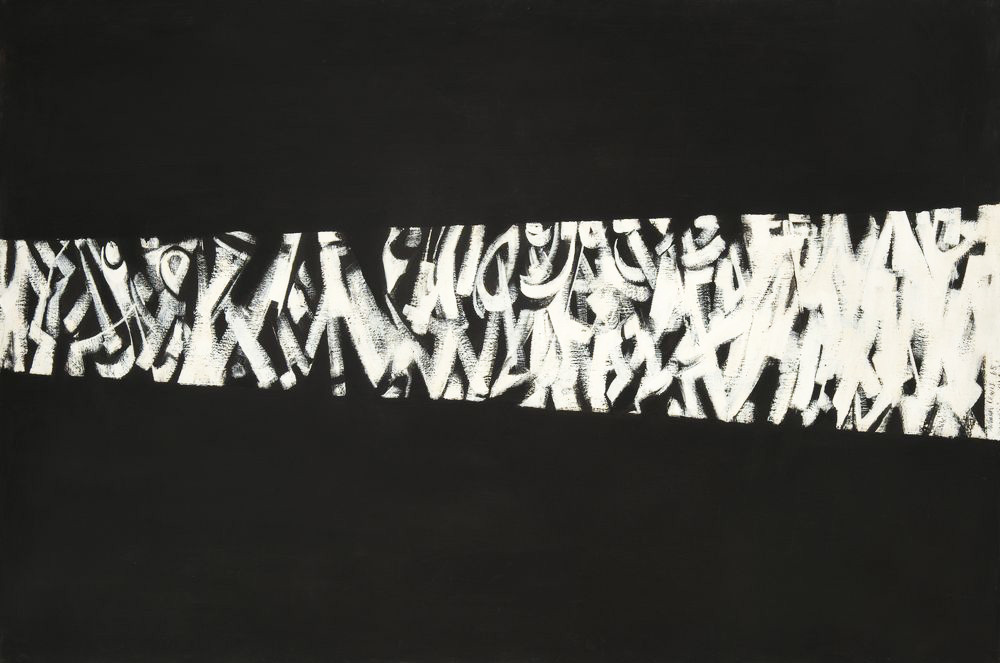
Image context: this is a photographic reproduction of Norman Lewis's actual painting, not a diagram or a modern reconstruction. The Phillips Collection identifies Processional as a 1964 work included in Spiral's black-and-white group exhibition. Its crowded strip of marks is the right entrance to the movement because it makes political assembly legible without turning abstraction into a code with only one answer.[5]
A river of pale marks crosses a nearly black canvas. At first it looks like agitated handwriting: strokes lean, collide, open into loops, and tighten into wedges. Then the strip begins to populate itself. An oval becomes a head. A narrow upright becomes a torso. Hard white angles lift like placards. The dark above and below is so spacious that the procession seems both monumental and precarious, a crowd holding its shape inside a field that could swallow it.
Norman Lewis called the painting Processional. He did not draw a march in the descriptive manner of a news photograph, yet he did not seal the work away from history either. Movement lives in the tension between the collective band and every unstable mark within it. The painting introduces the problem that organized Spiral, the New York collective Lewis helped found in 1963: what can one deliberately narrow exhibition condition hold when artists disagree about political address?
Spiral never solved that question with a manifesto. Its fifteen members included social realists and abstractionists, artists formed by the Harlem workshops of the 1930s and a much younger artist, Emma Amos, still establishing her place in New York. They argued about political responsibility, racial identity, artistic freedom, access to institutions, and the usefulness of a group itself. Their one documented exhibition imposed a common palette—black and white—while leaving almost everything else open. The restriction turned the gallery into a comparative instrument: coalition could be tested in public without pretending that agreement already existed.
The movement began as a practical response to a march
In the summer of 1963, before the March on Washington for Jobs and Freedom, Romare Bearden, Charles Alston, Norman Lewis, and Hale Woodruff brought Black artists together in New York. Bearden later remembered an early practical idea: organize artists, hire a bus, and travel to Washington as a visible constituency. The bus did not become the group's defining work. The meetings did.[1][4]
The artists continued gathering, first around Bearden's studio and then at a rented space on Christopher Street in Greenwich Village. The final roster held fifteen names: Alston, Amos, Bearden, Calvin Douglass, Perry Ferguson, Reginald Gammon, Felrath Hines, Alvin Hollingsworth, Lewis, William Majors, Richard Mayhew, Earl Miller, Merton Simpson, Woodruff, and James Yeargans. From 1963 into 1965, they met regularly to debate what a Black artist might owe the civil-rights struggle and what the American art world owed Black artists.[1][2]
Those are related questions, but they are not identical. One concerns imagery and public obligation: should art represent demonstrations, violence, dignity, anger, or a shared Black experience? The other concerns structure: who receives gallery representation, reviews, sales, museum acquisition, and permission to count as an important American artist? Lewis's 1968 oral history makes that second pressure explicit. He described accomplished Black artists being repeatedly pushed aside while far weaker white artists found a path through the same institutions. Economic exclusion, not a shortage of aesthetic ambition, made collective discussion urgent.[3]
This distinction keeps Spiral from being reduced to a design problem—how to invent an instantly recognizable “Black” look. Its members were asking whether solidarity required formal agreement at all. The Studio Museum's later reconstruction emphasizes how widely their practices and positions differed: oil, collage, printmaking, and watercolor; figuration beside modernist abstraction; opposing views on the merger of art and politics.[2] Spiral was less a school than a room in which incompatible answers had to remain in conversation.
Black and white became a common limit, not a common language
Spiral's only documented group exhibition, First Group Showing: Works in Black and White, ran from May 14 to June 4, 1965, at the Christopher Street space. The artists' statement said the palette arose from “technical concerns,” while conceding that “deeper motivations may have been involved.”[1] That guarded phrasing is more revealing than a grand declaration would have been. It leaves the exact practical calculation unresolved while establishing one voluntary limit across several media. In 1965, the same choice could not help carrying racial and political pressure. The group refused to specify one fixed meaning.
The works used the limit differently. Reginald Gammon's Freedom Now compressed demonstrators into an urgent wedge of faces and signs. Charles Alston's monochrome abstraction let dark and light wrestle as material forces. Bearden fractured photographed bodies and rooms into collage. Lewis made a march hover at the threshold of recognition. Richard Mayhew, a painter of what he called mindscapes, submitted a landscape—a reminder that a Black artist's political presence did not depend on illustrating a political event.[2][6]
Put those works together and the exhibition's real achievement appears. A shared palette does not erase the gap between a depicted crowd and an abstract one, between direct address and indirect resonance, or between a public event and a landscape. Instead, the palette makes those gaps unusually visible. Every artist begins with the same narrow chromatic condition; nobody arrives at the same pictorial destination.
That matters because labels such as “protest art” can make subject and action seem interchangeable. Gammon's massed demonstrators declare urgency through cropped faces, open mouths, and signs. Lewis's marks require the viewer to participate in recognition: crowd, writing, rhythm, void. Neither approach is automatically more committed. Each constructs a different relation between political history and visual experience. Spiral's group format allowed those relations to stand beside one another without a jury selecting the official one.
Lewis made abstraction answerable without making it literal
In Processional, the pale band occupies only a fraction of the canvas. Lewis could have filled the field with motion; instead he gives the assembly a severe horizontal path. The surrounding black is not neutral background. It makes cohesion look achieved rather than guaranteed. Some marks remain bright and distinct, others disappear into gray, and the band thickens unevenly as it moves across the picture.[5]
The eye keeps switching scales. From farther away, one sees a single procession. Up close, the procession breaks into brushwork whose individual units refuse stable anatomy. That alternation gives the painting its political intelligence. Collective force does not require each participant to become visually identical, yet the crowd exists only because separate marks enter a relation. Lewis found a formal equivalent for assembly without turning people into a slogan.
The painting also rejects a false opposition between abstraction and social meaning. Lewis had sustained an abstract practice while watching the dominant story of Abstract Expressionism largely exclude him. His oral history does not describe that exclusion as evidence that abstraction belonged to white artists; it describes an art world failing to recognize whose abstraction mattered.[3] Processional answers by occupying both territories at once. Its brushwork remains irreducibly abstract, but its title, date, procession rhythm, and Spiral exhibition context keep history close.
This is an interpretation, not a claim that every white mark corresponds to a particular marcher or placard. The painting is powerful precisely because that conversion never becomes exact. Lewis lets recognition approach, recede, and approach again. Political meaning does not sit behind the abstraction waiting to be decoded. It happens through the labor of seeing a crowd form without losing the instability of its parts.
A rejected collaboration changed Bearden's art
Spiral's disagreements could be productive even when they stopped a project. Bearden proposed that the members make a picture together from photographs. In his 1968 account, he described cutting out trees and figures to demonstrate how one artist might build a landscape while another added people. The group showed little interest. Bearden continued alone.[4]
That failed collective experiment opened directly into the collage work that transformed his career. In 1964, he began cutting and combining printed photographs, enlarging some compositions as photostats, and using fragmentation to hold multiple spaces, scales, and Black experiences in one field. MoMA's Prevalence of Ritual/Conjur Woman No. 1 preserves that translation from pasted image to photographic enlargement; the institution dates it to the same year that collage became Bearden's central method.[7]
The sequence complicates any clean story of collective success. Spiral did not produce the proposed joint artwork, but the proposal changed what one member believed an artwork could be. Collective value therefore cannot be measured only in objects signed by everyone. A meeting can supply resistance, friction, an abandoned plan, or a technique that becomes useful elsewhere. Bearden's collages are not “Spiral style.” They are evidence that a group can alter individual practice without absorbing it.
They also show the difference between unity and combination. A collage does not make its fragments homogeneous; cuts and mismatched scales remain visible. In that sense, Bearden's new method became an unintended analogue for Spiral itself. The group could assemble distinct histories and approaches inside one frame, but the seams were the condition of the assembly, not a defect to conceal.
Mutual respect did not make the room complete
Spiral's original statement valued artists of divergent backgrounds coming together on terms of mutual respect.[1] The achievement was real, but the roster also exposes a boundary. Emma Amos was the only woman in the group and its youngest member. Her presence connected generations and widened the conversation, yet singular inclusion is not the same as an inclusive structure. In a later oral history, Amos recalled how much she learned through Spiral while also describing the gendered social position of being as close to “one of the boys” as she could get.[8]
That asymmetry matters to a movement history because institutions are built not only by what participants debate, but by who is repeatedly available to debate. Spiral challenged the white art world's sidelining of Black artists while reproducing a much narrower opening for Black women. Naming that limit does not cancel the group's work. It prevents “collective” from becoming a flattering word that hides the shape of the room.
The group itself was brief. Weekly meetings stopped, the Christopher Street space disappeared, and no second program consolidated the artists into a durable organization. Yet brevity should not be confused with failure. Some members later helped support the emerging Studio Museum in Harlem, and Bearden and Lewis joined Ernest Crichlow in founding Cinque Gallery in 1969 to create exhibition opportunities for younger artists.[2][9] Spiral's afterlife lived less in a signature look than in the continuing need for Black artists to build spaces of recognition, argument, and access.
The exhibition made disagreement legible
Spiral is easiest to remember as fifteen artists, one exhibition, and a black-and-white palette. That summary becomes useful only when the palette is understood as a test rather than a brand. Under the same restriction, a protest crowd could remain plainly figurative, a landscape could decline direct narration, a collage could make fragmentation social, and an abstract procession could gather without becoming fully literal.
Return to Lewis's painting and the movement's structure is there in miniature. The marks do not merge into one smooth body. They overlap, pull apart, and still travel as a band. Empty black space presses on their route. What holds them together is not sameness but relation.
Spiral's most durable answer to the question of political art was therefore not a rule about what Black art should depict. It was a curatorial proposition: a narrow common condition could let a coalition appear without disguising the disputes inside it. Black and white did not settle the argument. It gave the argument a surface.
Sources
- Anacostia Community Museum, “From the Permanent Collection: Artists of the Spiral Collective, 1963–1965” — institutional chronology, roster, exhibition dates, and excerpts from Spiral's 1965 artists' statement.
- Studio Museum in Harlem, “Spiral: Perspectives on an African-American Art Collective” (2011) — exhibition history, member list, range of media and positions, and the collective's institutional afterlife.
- Archives of American Art, Smithsonian Institution, “Oral history interview with Norman Lewis, 1968 July 14” — Lewis on serving as Spiral's first president, institutional exclusion, economics, and the need for the group.
- Archives of American Art, Smithsonian Institution, “Oral history interview with Romare Bearden, 1968 June 29” — Bearden's account of the March on Washington idea and the rejected collaborative collage proposal.
- The Phillips Collection, “Norman Lewis's Abstract Works” (2020) — reproduction and discussion of Processional, its 1964 metadata, crowd-like forms, and inclusion in Spiral's exhibition.
- Smarthistory, “Teaching guide: Spiral, Black Art and the Civil Rights Movement” — synthesis of the group's debates, exhibition constraint, and the contrasting approaches of individual members.
- Museum of Modern Art, “Romare Bearden, Prevalence of Ritual/Conjur Woman No. 1” — object record and account of Bearden's 1964 turn to collage and photostat enlargement.
- Archives of American Art, Smithsonian Institution, “Oral history interview with Emma Amos, 2011 November 19–26” — Amos's retrospective account of Spiral and her position as its only woman member.
- National Gallery of Art, “Romare Bearden” — institutional biography covering Spiral, Bearden's period collage practice, and the 1969 founding of Cinque Gallery with Norman Lewis and Ernest Crichlow.