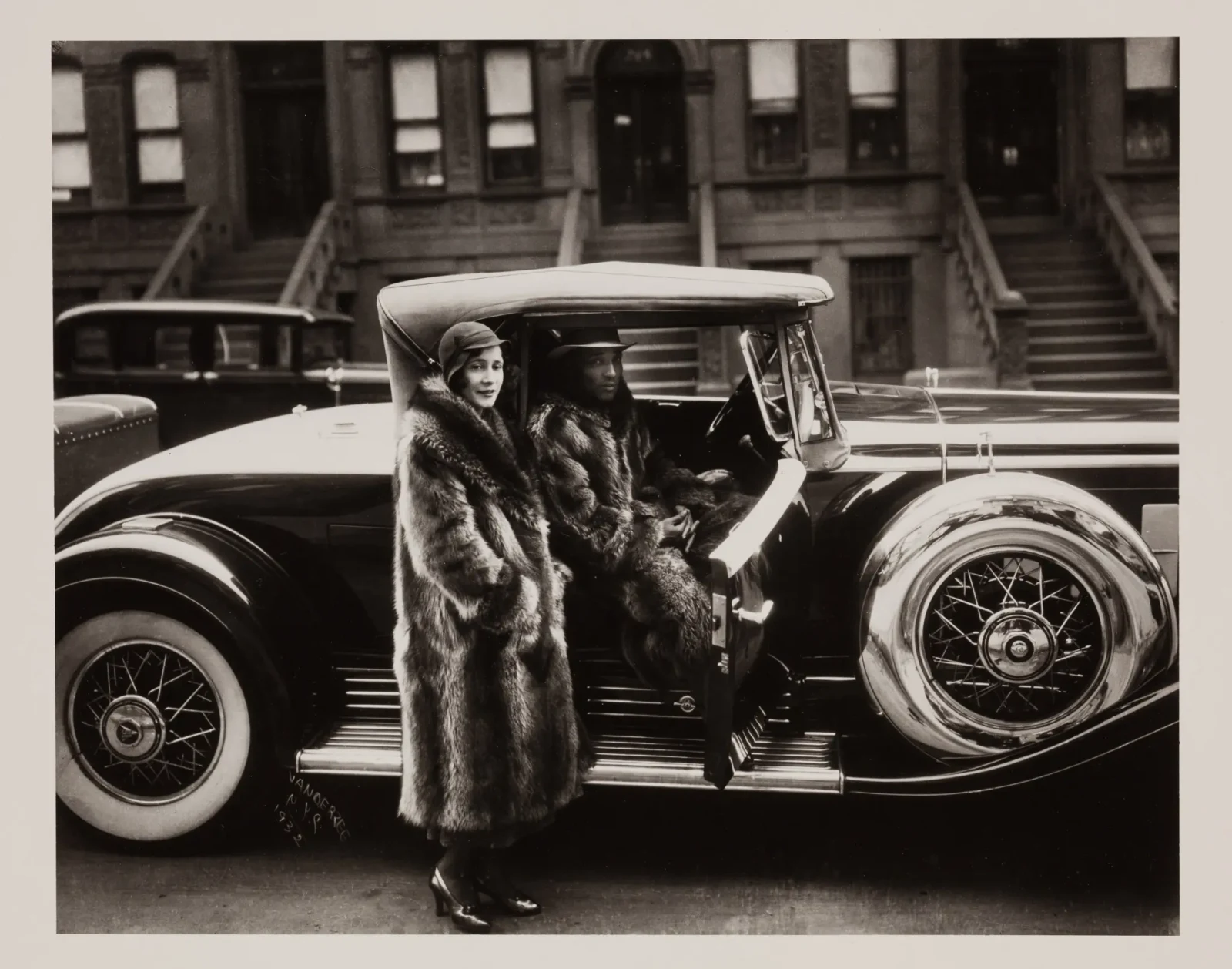
The car is going nowhere, and that is its great advantage. Parked beside a Harlem sidewalk, it offers James Van Der Zee a long, gleaming platform on which to arrange a portrait. A man sits inside. A woman stands alongside. Their raccoon coats bring a thick, unruly texture into a world of polished metal, straight masonry, and neatly repeated windows. The vehicle promises movement; the photograph asks everyone to hold still.[1]
Made in 1932, the picture is known as Couple in Raccoon Coats and Couple, Harlem. MoMA identifies the automobile as a Cadillac V-16, an exceptionally luxurious model.[1][2] But recognizing the expensive things is only the beginning of looking. Van Der Zee makes those things organize our encounter with the people. The coats give their bodies volume; the car gives them an imposing setting; the street makes their presentation public.
My reading is that the picture's real subject is this achieved composure. We meet two people through an arrangement they have paused to inhabit. The photograph records a display of prosperity while leaving much of their lives outside the frame.
Fur interrupts the machine
Let your eye travel along the car before returning to the faces. The bodywork establishes a horizontal sweep. Wheels interrupt it with circles; the upright windshield changes its direction. Small bright fittings make the dark vehicle articulate, catching the eye at one point and passing it to another. A machine built to carry people becomes a structure for looking at them.[1]
The coats behave differently. Their irregular edges and mottled surfaces resist the automobile's clean boundaries. Even in black and white, fur and metal remain unmistakably separate kinds of matter. One absorbs light into a multitude of small variations; the other gathers it into reflections. Van Der Zee's portrait draws much of its pleasure from letting those textures coexist.
The matching garments connect the sitters without giving them identical roles. The woman occupies the street beside the car, her standing figure setting a vertical against its length. The man appears within the vehicle. Their different positions allow the picture to present a pair while keeping each person spatially distinct. The University of Michigan Museum of Art describes the woman as appearing about to take the passenger seat.[4] That suggestion of an interrupted departure gives the pose a small reserve of action: the picture feels held, rather than inert.
Neither face fills much of the frame. This is a portrait in which surroundings do unusually substantial work. Crop tightly around the heads and you would retain likenesses while losing the relationships that make this photograph memorable: body to coat, coat to car, car to street.
A street can do the work of a studio
Behind the couple, the brownstones supply repetition and depth. Windows, entrances, and stoops make a setting that remains legible as a lived street. The car's elaborate surfaces stand against that steadier architectural rhythm. The photograph gives its subjects room to appear exceptional without floating them free of a neighborhood.[1][2]
Van Der Zee knew how to build a setting. By the late 1910s he had opened a Harlem photography studio, and his clients could choose among painted backgrounds, props, and wardrobe options. The National Gallery of Art describes a practice in which composing a portrait meant attending to the entire visible occasion, not merely placing a face before a camera.[3]
That background helps explain the assurance of this outdoor picture. The street offers the depth and architectural pattern that a studio backdrop might provide. The automobile supplies a place to sit, an enclosing shape, and a social signal. The photographer can work with what the location offers while retaining the formal care of a commissioned portrait.
His studio wardrobe does not establish the origin of these particular coats: the sources cited here do not say that the couple borrowed either their clothing or the car. A portrait can be deliberate and still record something real: how people present themselves, which objects they gather around them, and the appearance they are willing to sustain before another person's lens.
Prosperity is visible; biography is not
The year changes the encounter. A luxury automobile and substantial fur coats photographed during the Great Depression carry an economic charge. MoMA reads the picture through the couple's display of success; the University of Michigan emphasizes how Van Der Zee's pictures of Black middle-class life offered alternatives to dominant representations of the period.[2][4]
Those contexts give the photograph weight without supplying a complete biography. We cannot read a bank balance from a reflection on a fender, identify an occupation from a coat, or reconstruct a marriage from the distance between two bodies. Even the calm we perceive belongs first to the finished image. It need not describe everything the sitters felt.
This limit makes the portrait more interesting. Its visual confidence is available to us; the people remain partly private. Their clothing and setting invite attention, but neither sitter has to yield an entire life story in exchange. The camera preserves their appearance with considerable specificity while the familiar title leaves them unnamed.
There is also a limit to treating the photograph as a statement about all of Harlem. A single prosperous-looking couple cannot establish how a whole neighborhood lived. What it can establish is the presence of this particular image within the neighborhood's visual history. Its elegance deserves attention in its own right, without being required to stand for everyone.
The photograph has more than one date
The reproduction above introduces another useful distinction. The Detroit Institute of Arts dates the photographed scene to 1932 but its gelatin silver print to after 1980. The Metropolitan Museum of Art holds another print catalogued as 1932, printed later.[1][5] The date of the camera exposure and the date of the physical object need not coincide.
That interval belongs to the picture's history. The National Gallery's account describes a portfolio of earlier photographs reprinted in 1974, including this image. It also places renewed attention to Van Der Zee within the aftermath of the Met's controversial 1969 exhibition Harlem on My Mind, which excluded Black painters and sculptors while presenting the neighborhood's social history.[3] Later circulation brought his photographs to audiences beyond the people and occasions for which he originally worked.
Knowing this, return to the parked car. The picture reaches us through a later print and a museum reproduction, but its compositional decisions remain available to inspect. The woman's upright figure checks the automobile's horizontal reach. The coats interrupt its shine. The brownstones hold the scene in place. Two people have stopped long enough to become a picture, and Van Der Zee has made that pause feel expansive.
Sources
- Detroit Institute of Arts, James Van Der Zee, Couple in Raccoon Coats — source of the reproduced photograph; 1932 exposure, print made after 1980, medium, credit, and accession 2008.415.
- Museum of Modern Art, James Van Der Zee, Couple, Harlem, 1932 — collection record and commentary on the Cadillac V-16, portrait setting, and presentation of prosperity.
- National Gallery of Art, “James Van Der Zee's Photographs of Harlem Explored in Exhibition,” July 21, 2021, updated November 8, 2021 — studio practice, the 1974 portfolio, and the context of Harlem on My Mind.
- University of Michigan Museum of Art, The Couple in Raccoon Coats, accession 2015/2.34 — physical description and interpretation within Van Der Zee's photographs of Black middle-class life.
- The Metropolitan Museum of Art, James Van Der Zee, Couple, Harlem, accession 2021.446.1.2 — a separate gelatin silver print catalogued as 1932, printed later.