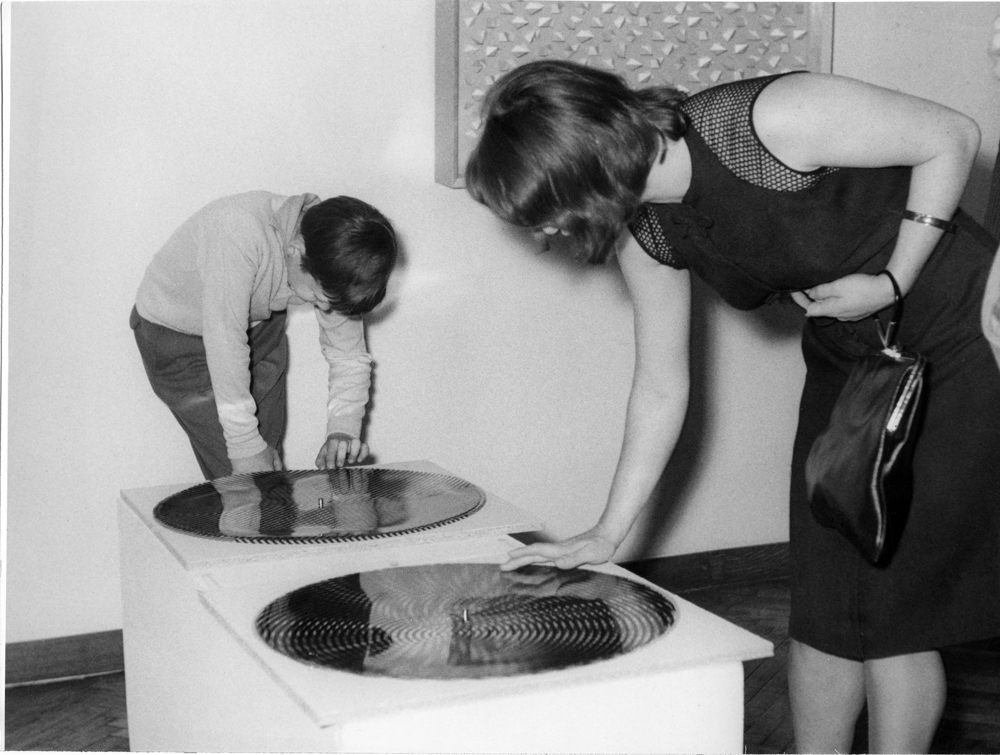
Image context: this is an archival exhibition photograph, not a reconstruction. Two visitors lean over Rudolf Kämmer's Drehgrafik at New Tendency 3 in 1965, their hands close to its circular surfaces. The work is presented as something to manipulate rather than contemplate from a protected distance. That physical relation between a rule-built object and an active viewer came before the movement's formal embrace of computers, and it helps explain why the machine later seemed less like an invasion than a continuation.[5]
The computer entered New Tendencies after a failure.
That is not the usual origin story for early digital art. Retrospective accounts naturally gravitate toward early machine-produced graphics, glowing arrays, plotters, and algorithms. New Tendencies can supply all of them. Across five major Zagreb exhibitions between 1961 and 1973, the international network moved from concrete, programmed, optical, and kinetic work toward “Computers and Visual Research,” the multilingual journal Bit International, and encounters among artists, engineers, and scientists.[2][3][6]
But the machine was not the movement's starting gun. It arrived in 1968–69 as a proposed way through a crisis that had already formed around the gallery wall. New Tendencies had tried to replace the lone inspired artist with the visual researcher, the unique masterpiece with a reproducible system, and the passive audience with a participant. By the middle of the decade, its systematic language was becoming a marketable style, its claims to democracy coexisted uneasily with internal policing, and its borrowed scientific method had not delivered the social transformation it promised.[1][2][3][4]
The computer did not solve those contradictions. It made them operational in a new medium.
Zagreb made a network possible
New Tendencies was never simply a Croatian school or a tidy group with fixed membership. Its first exhibition opened at Zagreb's Gallery of Contemporary Art in August 1961 after a meeting between the Croatian critic Matko Meštrović and the Brazilian-born, Germany-based artist Almir Mavignier. What began as a group exhibition became a recurring international platform; a Paris meeting in 1962 helped prepare the second Zagreb exhibition in 1963, followed by New Tendency 3 in 1965, Tendencies 4 in 1968–69, and Tendencies 5 in 1973.[1][2]
The location mattered. Yugoslavia had broken with Stalin in 1948 and occupied a non-aligned position in the Cold War. Zagreb could therefore act as a meeting point rather than a branch office of either bloc. The network first connected artists and critics from Eastern and Western Europe, including South American artists working in Europe, then broadened to participants from the United States, the Soviet Union, South America, Africa, and Asia.[2][4][5]
This geography did not erase political difference. It gave difference a working address. Exhibitions, catalogues, symposia, letters, and later a journal allowed ideas to circulate through an institution in a socialist country while refusing the familiar choice between Soviet-bloc socialist realism and the Western market's celebration of individual expression. Armin Medosch describes New Tendencies as a non-aligned modernism seeking an art adequate to mass production rather than Abstract Expressionism or socialist realism.[4][5] Its technology story begins inside that third position.
The first machine was a relation
In the early exhibitions, “programmed” did not necessarily mean software. It meant that an artwork could be generated from stated procedures, repeated units, controlled variations, industrial materials, or optical relations instead of being explained through a singular expressive gesture. System mattered more than signature.
The ambition was larger than a cool geometric look. Artists and theorists argued for teamwork, multiplication, public access, and a research-like approach to perception. They wanted to demystify creation and loosen the work of art from scarcity. Medosch's study of the first phase shows how the viewer was recast as a participant in a relational field: movement by the body changed what the work disclosed.[5] Darko Fritz's history likewise connects unstable media, light, motion, and audience activity to the movement's campaign against the unique, completed object.[2]
The Drehgrafik photograph makes that claim tangible. An adult and a child lean toward the work's two circular discs rather than keeping a polite viewing distance. Their attention is bodily: heads lowered, shoulders tipped forward, hands entering the field. The piece does not need to collect information about them to make their presence consequential. Its “program” lies in an ordered surface made variable through manipulation. The visitor supplies time.
This was visual research in a double sense. The artist arranged conditions for investigating perception; the visitor encountered perception as an event rather than a private faculty. For a few seconds, an exhibition could model a less hierarchical relation among maker, object, and public. The gallery behaved like a laboratory, but the experiment's subject was also the gallery's social order.[4][5]
Success exposed the weak point
The phrase “visual research” carried a danger: research can become an authority word before it becomes a method. By 1963, the movement's case for rationality, industrial production, and objective investigation had sharpened. So had arguments about which works truly belonged. Fritz traces how the initial pluralism narrowed into stricter formal criteria, with “right” and “wrong” tendencies enforced in the name of progress. A network that imagined itself democratic developed an uncertain hierarchy and intense internal conflict.[2]
Public recognition created another problem. Many New Tendencies artists appeared in the Museum of Modern Art's 1965 exhibition The Responsive Eye. The New York show helped make optical effects legible as “Op Art,” a consumable international style. What Zagreb's network had framed as socialized research could now return as spectacular surface and individual market identity. The eye was activated; the political argument attached to that activation was much easier to lose.[1][2]
In her contribution to a 2014 program booklet produced by Croatia's Ministry of Culture and the Museum of Contemporary Art Zagreb, curator Margit Rosen frames the crisis with unusual bluntness. Around 1965, participants recognized that they had not built an economic alternative to the art market, that gallery experiments could imitate scientific method without producing scientific knowledge, and that audiences might consume the results as decoration or entertainment.[1] The diagnosis cut to the heart of the project. A moving work could make a viewer move, but it could not guarantee what that movement meant.
This is the wall the computer encountered. It was not just a newer tool waiting to replace paint. It offered a more literal location for procedures, variables, calculation, repetition, and information—the concepts New Tendencies had already been testing metaphorically and materially. It also promised new collaborators and a new institutional scale. Whether that promise escaped the old problems was another question.
Tendencies 4 moved the program into software
During Tendencies 4 in 1968 and 1969, Zagreb hosted exhibitions and colloquia under the heading “Computers and Visual Research.” The organizers launched Bit International, whose run from 1968 through 1972 reached nine numbered issues, including two double issues.[6] Across that run, information aesthetics, concrete poetry, television, design, and computer art entered the same editorial project.[2][6] For a period, the gallery became a junction among university laboratories, corporations, artists, designers, critics, and scientists from both sides of the Cold War.
The continuity with the earlier work was deliberate. A plotted image or computer-controlled light object could be understood as the result of a program just as a kinetic relief could be understood through its ordered elements and permitted changes. Software made the term less figurative. Instructions now ran on machines; mathematical structures could be iterated at speeds and scales unavailable to the hand.[2][3]
At the same time, the computer turn changed the movement's participant base. Fritz notes that many newcomers were scientists working in universities and private or public corporations.[2] That broadened the project beyond the professional art world while tethering production to institutions holding equipment and technical knowledge. The distribution suggests a boundary the movement's democratic language could not erase: a reproducible result might still depend on specialized machinery, expertise, and permission. The computer relocated the access problem rather than abolishing it.
It also sharpened the movement's dispute about objectivity. Information aesthetics offered methods for describing complexity and formal order, yet a numerical account of an image could not decide whom the work served, how a public would encounter it, or why one possible output mattered more than another. A machine could execute a procedure with uncommon fidelity. It could not validate the social hopes packed into the procedure.
Bonačić put calculation in the street
Vladimir Bonačić made the computer turn visible at architectural scale. A research scientist who moved into artistic production through New Tendencies, he used mathematical structures and custom-built light systems rather than asking a computer to imitate a painterly hand. During the Tendencies 4 period, his reported 36-metre computer-generated light installation on Zagreb's Kvaternik Square carried visual research beyond the gallery.[2]
The public setting mattered as much as the electronics. A luminous algorithm on a city facade borrowed the infrastructure and scale of commercial signage while refusing to deliver an advertisement. Fritz argues that Bonačić came unusually close to the movement's earlier ideal: exact method, purposeful software, constructed hardware, reproducibility, scientific knowledge made perceptible, and a work available in shared urban space.[2]
Yet even this apparent synthesis remained temporary. The light work depended on a particular site, apparatus, commission, and public attention. Its mathematical rule did not make its politics self-executing. What it achieved was narrower and more persuasive: it showed that an algorithm could organize a civic encounter, not only a sheet of computer graphics.
That difference keeps New Tendencies from becoming a simple prehistory of today's generative images. Its central question was not whether a machine could produce a novel pattern. It was how a program might redistribute authorship, labor, perception, and access—and what happens when the system that produces the work contradicts the social claim the work makes.
By 1973, “program” also named a conceptual instruction
Tendencies 5 did not conclude with a victory lap for digital art. Its 1973 structure placed constructive visual research, computer visual research, and conceptual art beside one another. The organizers tried to link them through the idea of the program and through works executed by someone other than the originating artist. A computer algorithm, a geometric system, and a textual instruction could all separate conception from material realization.[2]
That arrangement both enlarged the movement and exposed its limits. Conceptual artists did not necessarily share the older confidence in rational visual research; computer practitioners did not necessarily share conceptual art's institutional critique. The Tendencies 5 symposium brought these positions into dialogue, but Fritz describes the exchange as marked by mutual misunderstanding.[2] “Program” was a bridge word, not proof that everyone had crossed to the same side.
Seen across the full sequence, New Tendencies therefore resists a clean technology timeline. It did not advance smoothly from handmade geometry to kinetic objects to computer art to conceptual instructions, each new stage superseding the last. Instead, every phase reopened the same unsettled problems: who originates, who executes, who gets access, what the viewer does, whether method can be objective, and whether reproducibility actually defeats the market.
The unfinished experiment is the legacy
New Tendencies matters now because it joined questions that contemporary culture often pulls apart. It treated technology as an aesthetic medium, an institutional arrangement, and a political wager at once. It understood that the look of a programmed work could not be separated from the people, machines, and permissions that made the program executable.[1][4][6]
Its failure is part of that value. The network did not replace the art market with public research. It did not dissolve artistic ego into anonymous teamwork. It did not make aesthetic judgment objective, and the computer did not rescue those goals. But New Tendencies left unusually clear evidence of artists and institutions testing those propositions in public rather than merely announcing them.
Return to the 1965 photograph. The two visitors bending over the discs occupy the narrow space between collective participation and stylish optical spectacle. Both readings are possible. Their touch changes the encounter, but the work does not control what they learn. Three years later, a computer would make New Tendencies' procedures more explicit and its calculations more powerful. It would not close that gap.
Sources
- Croatian Ministry of Culture and Museum of Contemporary Art Zagreb, New Tendencies and Architecture: Abstraction, Ambience, Algorithm (2014) — institutional overview, movement chronology, archival exhibition documentation, and the mid-1960s crisis account.
- Darko Fritz, “New Tendencies,” Oris 54 — detailed movement history covering the five Zagreb exhibitions, internal crisis, Tendencies 4, Bit International, Vladimir Bonačić, and the 1973 conceptual-art turn.
- Ljiljana Kolesnik, “Zagreb as the Location of the ‘New Tendencies’ International Art Movement (1961–73),” in Art beyond Borders, Central European University Press (2016) — open-access study of Zagreb's role in cross-border artistic exchange.
- Ars Electronica Archive, “Armin Medosch: New Tendencies,” festival catalogue (2016), pp. 211–12 — institutional presentation of Medosch's research on non-alignment, participatory visual research, the 1968–69 computer turn, and the 1973 exhibition.
- Armin Medosch, “Art as Visual Research,” Journal for Research Cultures 1 (2015) — study of the 1961–63 phase, the active viewer, visual research, and the archival Drehgrafik photograph used as the cover.
- ZKM, contents for Margit Rosen, ed., A Little-Known Story about a Movement, a Magazine, and the Computer's Arrival in Art (MIT Press/ZKM, 2011) — dated inventory of the exhibitions, symposia, Bit International issues, historical texts, and archival sections in the sourcebook.