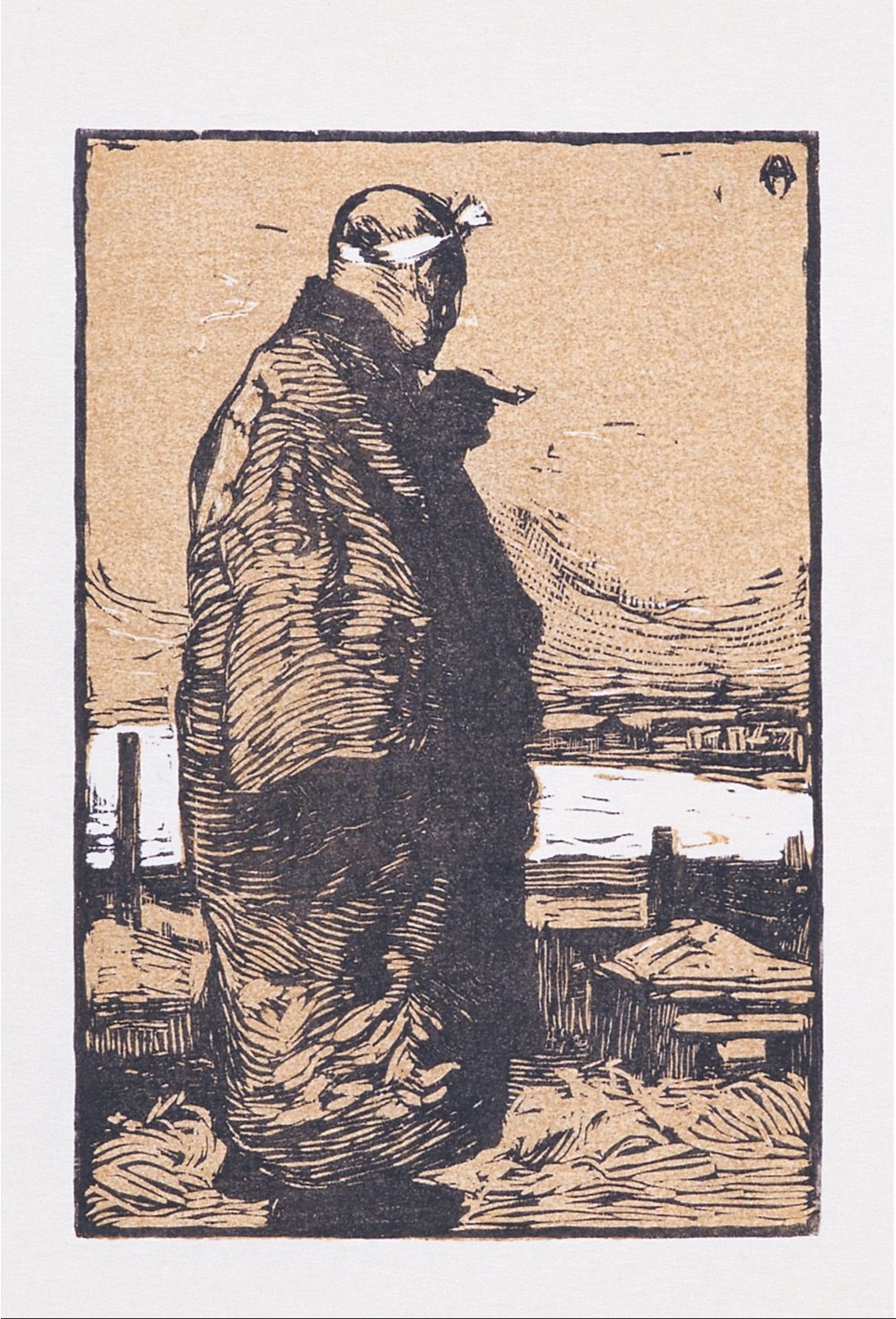
Image context: this archival reproduction shows a real impression of Yamamoto Kanae’s Fisherman, the design widely credited with opening the sōsaku-hanga story. The file records this sheet as an April 1963 printing of the 1904 image, so it is evidence of the design and its afterlife rather than the magazine page on which the work first appeared.[1][2][3]
The fisherman fits inside a sheet scarcely wider than a hand. His pale cheek, nose, and knuckles push through a mass of dark clothing; the background arrives in broad, muted bands rather than an illusion of deep space. Nothing is polished into invisibility. The blunt cuts and resistant grain tell you that a block stood between the first drawing and the final image.
That visible resistance is the point. Yamamoto Kanae’s Fisherman (Gyōfu) is regularly credited as the first work of sōsaku-hanga, or “creative prints.” A 1904 impression entered the literary magazine Myōjō on page 45 of its July 1 issue, where a small woodcut became an argument about a large question: who counts as the author of a print?[3][4]
In the established commercial system associated with ukiyo-e and continued by many twentieth-century shin-hanga publishers, authorship was distributed. A designer supplied an image; specialist carvers translated it into blocks; printers controlled pigment, moisture, registration, and pressure; a publisher coordinated production and sale. Sōsaku-hanga artists asserted a different ideal. The artist should conceive, carve, and print the work, accepting all three jobs as parts of one expressive act.[4][5]
The movement is therefore easiest to recognize not by one subject or one look, but by a changed credit line. Its artists made portraits, city views, religious figures, landscapes, and abstractions. What joined them was a claim that the path through the block belonged inside artistic authorship—not behind it.
Fisherman changed the production credit
The work’s scale matters. The Aichi Prefectural Museum of Art records its 1904 Fisherman as a woodcut measuring 16.3 by 11.1 centimeters; the Smithsonian’s closely related magazine impression is 16.5 by 10.8 centimeters.[2][3] This was not conceived as a grand autonomous sheet. It circulated through Myōjō, one of the small literary and artistic magazines in which early creative-print experiments found a public.
Ritsumeikan University’s Nihon no hanga Digital Museum treats those coterie magazines as more than containers. They were forums where visual art met literature, politics, theory, and an emerging avant-garde. Calling Fisherman a beginning thus does not mean that one small image instantly founded a stable school. It means the image made a new production ethic visible in a network already debating what a modern artist should be.[4]
Look again at the figure. The roughness is not proof of careless making, and refinement did not belong exclusively to collaborative workshops. The difference lies in where the work asks us to locate value. A specialist printer might suppress incidental variation to produce consistent impressions from another artist’s design. Here, the block’s stubbornness can read as contact with Yamamoto’s own decisions. A gouge removing too much, an edge held back, a patch of ink landing unevenly: each risk returns to the same maker.
This is why the familiar three-part formula—drawn, carved, printed by the artist—was more than a workflow checklist. It proposed an ethics of consequence. The image could no longer be credited to an originating idea while the intelligence of carving and printing disappeared into “execution.” One person claimed the whole chain, including its failures.
Three jobs produced more than one style
It would be easy to turn self-production into a romantic cult of the handmade. The art is more varied than that. Bowdoin College Museum of Art describes a recognizable tendency toward blocky forms, flat color, rough cutting, and exposed wood materiality, but these are family resemblances rather than a uniform code.[5]
Onchi Kōshirō demonstrates the range. A printmaker, book designer, poet, editor, and organizer, he helped make abstraction central to sōsaku-hanga. His experiments extended beyond conventional carved wood to wax paper, cardboard, string, and found matter; the printing surface became a place where texture could generate form rather than merely reproduce a prior drawing.[6][7] Saitō Kiyoshi, by contrast, made the plate’s flatness and woodgrain active parts of spare portraits and architectural views.[8] Munakata Shikō pushed cutting toward muscular black-and-white rhythm and religious intensity. The ideal of unified labor did not dictate what the result had to resemble.
Nor was the boundary with shin-hanga absolute. The Ritsumeikan digital exhibition notes that some sōsaku-hanga artists sometimes used professional carvers or printers, while artists working in publisher-led contexts could involve themselves directly in production.[4] That caveat is essential. “Self-made” describes the movement’s critical center, not a reliable test for sorting every sheet.
The strongest distinction is therefore rhetorical as well as technical. Sōsaku-hanga made control of the process a public sign of artistic seriousness. It taught viewers to read a broad cut, imperfect registration, or conspicuous grain as evidence of encounter between artist and matrix. Once that expectation existed, even a work involving assistance could be judged within the new language of individual expression.
Independence needed magazines, associations, and a front room
There is a productive contradiction at the movement’s heart: an art devoted to individual authorship survived through collective infrastructure.
Magazines came first. Yamamoto’s Fisherman needed Myōjō; Onchi, Tanaka Kyōkichi, and Fujimori Shizuo soon made the short-lived print-and-poetry journal Tsukuhae a laboratory for images, lettering, verse, and page design.[4][7] In 1918 Yamamoto, Oda Kazuma, Terasaki Takeo, and Tobari Kogan formed the Japan Creative Print Association. Its department-store exhibitions drew crowds and gave scattered studio practice a public name.[4]
Onchi later made sociability almost literal. He established Ichimokukai, the First Thursday Society, in 1939. Artists met at his home to compare prints, exchange encouragement, and keep a field alive under worsening wartime conditions. The British Museum credits the group’s monthly meetings with sustaining the creative-print ideal through the war; the Smithsonian traces its postwar gatherings and Onchi’s continuing mentorship.[6][7]
This was not a workshop division of labor in the old sense, but neither was it solitary genius. Artists still required peers who could criticize an impression, contribute to a portfolio, organize an exhibition, preserve a scarce sheet, or introduce a younger maker to a collector. Sōsaku-hanga relocated collaboration. Instead of dividing the making of one print among specialists, its networks shared the work of making printmaking matter.
That distinction also exposes a limit in the movement’s early public image. The heroic “artist does everything” formula sounds universally open, yet access to training, tools, associations, exhibition space, and recognition remained uneven. After World War II, women increasingly entered creative printmaking; in 1956 a group including Iwami Reika and Yoshida Chizuko formed Joryū Hanga Kyōkai and exhibited together for roughly a decade.[9] Their association did not dilute individual authorship. It made individual careers more possible.
The postwar audience enlarged the claim
Sōsaku-hanga began before World War I, but its international visibility accelerated after World War II. Bowdoin’s exhibition history places that rise inside the complicated new proximity between Japan and the United States: museum shows carried the work abroad, while members of the Allied occupation, and later travelers, journalists, and businesspeople, bought prints and formed collections.[5]
That audience did not merely discover a finished movement. It helped select the version that traveled. Foreign viewers could admire sōsaku-hanga as both modern art and a renewal of Japan’s woodblock lineage—a combination that made rough grain, compact scale, and artist-controlled production especially legible.[5] This is an inference from the reception record, not proof that every artist worked for foreign taste. It does show that “independent expression” gained meaning through institutions capable of exhibiting, collecting, and narrating it.
Saitō Kiyoshi’s career supplies a sharp hinge. His Steady Gaze won the Expatriates Japanese Prize at the 1951 São Paulo Biennale, a result the Smithsonian says surprised critics who expected painting to carry Japan’s prestige. In 1956, support from the U.S. State Department and Asia Foundation sent him to exhibit across the United States and Europe.[8] The print had moved from a marginal category toward diplomatic and international visibility.
Success created its own tension. A movement that opposed the subordination of print to painting could now be prized as a polished emblem of national culture. A practice built around control by the individual artist circulated through biennials, state sponsorship, museums, dealers, donors, and occupation-era collecting. The apparatus changed, but it did not cancel the original claim. It revealed its true scale: authorship is never only what happens at the block. It is also the story a culture builds around whose labor deserves to be seen.
The grain is a record, not a signature
Return to Fisherman and the later impression reproduced above. The 1963 printing is a useful warning against treating “made by the artist” as a mystical guarantee of one untouched object.[1] A woodblock is a repeatable matrix. Impressions can be pulled at different times; blocks can wear; ink, paper, and pressure can change. Even the image treated as the movement’s origin has an afterlife in which design date and printing date must be kept separate.
Sōsaku-hanga’s enduring achievement was not the abolition of every assistant or the invention of roughness. It was a revaluation of the middle steps. Carving stopped being a transparent bridge between drawing and image. Printing stopped being the neutral delivery of a carved design. The block, paper, pigment, pressure, and sequence of impressions all entered the field of decisions for which the artist claimed responsibility.
Three jobs became one authorship argument. Yet magazines carried it, associations named it, friends sustained it, and collectors moved it across borders. The movement’s most interesting lesson is therefore not that independence means working alone. It is that artistic independence begins when hidden decisions—and the labor behind them—become visible enough to debate.
Sources
- Wikimedia Commons, “Kanae Yamamoto (1904) Gyōfu.jpg” — archival reproduction used for the cover, identifying the pictured sheet as an April 1963 impression of the 1904 design and crediting the Yamamoto Kanae Memorial Museum.
- Aichi Prefectural Museum of Art, “Fisherman” — official object record for Yamamoto Kanae’s 1904 woodcut, including dimensions and public-domain collection image status.
- Smithsonian National Museum of Asian Art, “Fisherman, printed on p. 45 in Myōjō on July 1, 1904” — official record for the magazine impression, publisher, medium, dimensions, and date.
- Ritsumeikan University Art Research Center, Nihon no hanga Digital Museum, “The Sōsaku hanga movement” — movement overview covering coterie magazines, Fisherman, the 1918 association, stylistic tendencies, and the porous boundary with shin-hanga.
- Bowdoin College Museum of Art, “Sosaku-hanga: Twentieth-Century Japanese Creative Prints” — exhibition essay on production, material style, postwar cultural exchange, collecting, and museum reception.
- The British Museum, “Fresh Praise: Fuji” — object record and curatorial note on Onchi Kōshirō’s book design, print associations, and the wartime role of Ichimokukai.
- Smithsonian National Museum of Asian Art, “Onchi Kōshirō” — institutional artist profile on Tsukuhae, experimental printing, association leadership, and the First Thursday Society.
- Smithsonian National Museum of Asian Art, “Saitō Kiyoshi” — institutional profile on woodgrain, the 1951 São Paulo Biennale prize, and Saitō’s 1956 international tour.
- The Art Institute of Chicago, “A Sign of Things to Come: Prints by Japanese Women Artists after 1950” — exhibition page on women in postwar sōsaku-hanga and the 1956 formation of Joryū Hanga Kyōkai.