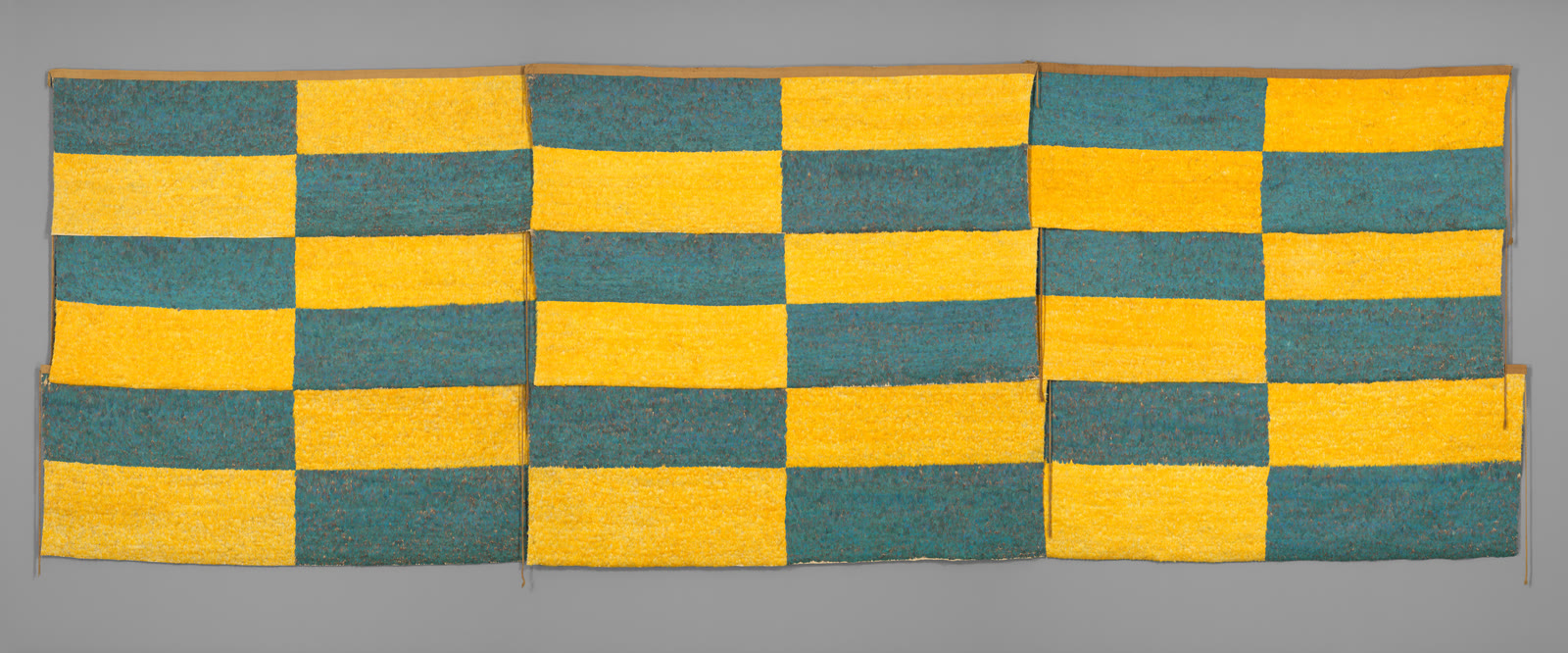
Image context: this is a museum photograph of the actual Wari panels, not a reconstruction. At page scale, their blue and yellow rectangles can resemble painted abstraction; the photograph restores the nap, seams, heading bands, and small irregularities that make the geometry a feathered object.[1]
From across a gallery, the nine panels look almost blunt: turquoise-blue and solar-yellow rectangles, staggered like masonry across a field more than six meters wide. There is no modeled figure, no border narrative, no gradual shading. Color meets color at right angles.
Move closer and the supposed flatness lifts. Every block is made from small glossy body feathers. Their tips overlap in rows; their vanes catch light at slightly different angles; the blue shifts toward teal and brown where orientation and wear interrupt the uniform field. The surface is neither painting nor conventional weaving. It is plumage rebuilt on cloth.
The Metropolitan Museum of Art dates the panels to 600–900 CE and identifies them with the Wari, whose influence extended across much of the central Andes centuries before the Inca. The nine-panel arrangement measures about 2.07 by 6.14 meters, yet it represents only a fraction of an extraordinary reported find: roughly ninety-six related panels recovered at Corral Redondo on Peru's far southern coast in 1943.[1][4]
Their visual force begins with a technical reversal. Textile normally makes a surface by crossing thread with thread. These makers wove a cotton support, then made it disappear beneath a second skin.
The drawing began with a bird
The blue and yellow were not mixed in a bowl. Museums have conventionally identified them as contour feathers from Ara ararauna, the blue-and-yellow macaw: blue from the bird's dorsal side, yellow from the ventral side.[1][6] The 2026 isotope study cautions that the exact macaw species still deserves investigation.[3] The secure technical point is anatomical and chromatic: makers separated small blue back feathers from yellow underside feathers. The Met's object record describes tens of thousands of feathers on each panel; its gallery transcript offers an estimate of approximately 17,000 per panel.[1] That number should be read as an expert estimate, not a recovered workshop ledger. It is still useful because it restores the scale of a surface that can look effortless.
The body of the macaw supplied a ready-made palette, but not a ready-made picture. Contour feathers are short, soft-edged, and naturally graded. Makers had to select for hue, size, condition, and likely orientation before a clean rectangle could emerge. In other words, the first act of design occurred before anything touched the backing: blue separated from yellow, dorsal from ventral, usable from unsuitable.
This makes the grid more material than it first appears. Its two main colors preserve the anatomy of a bird even after the bird has vanished from view. The Saint Louis Art Museum, which holds a related Wari panel, interprets the blue-back/yellow-underside division as symbolically meaningful as well as visually balanced.[6] That reading is evocative, but the safer claim is the one the object can prove: the geometry reorganizes a real top and bottom into alternating fields.
Knot, string, stitch, shingle
The panels were not made by pushing individual quills one by one through a finished cloth. Christine Giuntini's technical study of Peruvian feather mosaics reconstructs a more deliberate sequence. A feather shaft was bent near the base. Cotton cords were knotted around the bend, often using two strings so the feathers would lie flat and face the same direction. Many feathers became a continuous feathered string; those strings could then be handled as units.[2]
Next came attachment. Rows of feathered cord were stitched onto a finely woven plain-weave cotton foundation. Each new row overlapped the one below it, much as shingles shed water or a bird's own feathers cover one another. The overlap concealed not only the attachment stitches but the valuable woven textile beneath. What appears to be a block of uninterrupted blue is therefore a stack of decisions: bend, knot, align, stitch, overlap, repeat.[1][2]
Color changes required a physical cut. When a yellow rectangle ended, the maker could not simply dip a brush into blue. The current feather string stopped and another began. The edge between hues is a boundary in labor as well as in sight. Small variations along those boundaries—the slight waviness of a row, a visible seam between adjoining panels, a feather turned enough to catch another tone—keep the work from becoming a mechanical checkerboard.
The top edge adds another material register. The panels carry a woven band of camelid fiber, with braided cords at the sides on many examples.[1][2] The band finishes the feathered field; the cords imply that the panels were secured or suspended. They are clues to use, but not instructions preserved from the workshop. No surviving cord can tell us exactly which wall, frame, ceremony, or architectural interval once received it.
A color field assembled across ecosystems
Technique does not stop at the artisan's hands. Before knotting could begin, the materials had to converge.
Corral Redondo lies in the dry western foothills of the Andes, near the Pacific. Macaws with blue dorsal and yellow ventral plumage live in tropical lowlands far to the east. Camelid fiber belongs to the highlands between. A single panel therefore joins animal materials whose ecological homes are separated by altitude, climate, and hundreds of kilometers.[3][5] The cotton foundation is another procured material, but the isotope study did not establish where it was grown or locate the workshop.
Older accounts recognized this geography as evidence of long-distance exchange. A 2026 study by Noreen Tuross and Linda M. Reynard makes the material route more specific. The researchers combined radiocarbon measurements with stable-isotope analysis of feathers and tassels sampled from panels in six United States museum collections. Their dates place the growth and acquisition of the animal materials broadly around 750–900 CE, within the Middle Horizon and Wari period. Their isotope results support Amazonian-region macaw husbandry on a restricted, probably maize-heavy diet and high-Andean origins for the camelid fiber.[3]
The dating is compatible with an intensive production episode, but it does not supply an exact workshop calendar. Radiocarbon dates the growth of feathers and fiber rather than the moment of assembly, and the statistical range can accommodate a longer span. Likewise, the isotopes identify broad source ecologies, not a named aviary, caravan route, or weaving center.[3]
The distinction between evidence and inference matters here. Isotopes do not name the keepers, trace a particular caravan, or locate a lost workshop. They constrain where animals lived and what they consumed. Combined with the number and near-uniform format of the panels, however, they make casual gathering implausible. This color field depended on planned access to birds, fiber, cotton, skilled labor, and routes capable of bringing them together.
The blue and yellow thus record more than taste. They are logistical colors. A rectangle begins in plumage management and selection; it crosses ecological zones; it enters a workshop as sorted material; only then does it become geometry.
Ninety-six panels, one missing installation
The reported discovery can tempt the imagination into completing a vanished room. Accounts say local residents excavated six to eight enormous face-neck jars, each holding rolled panels, with a total of about ninety-six. Rolled storage and the arid ground help explain the remarkable condition of many examples. The panels average roughly 74 centimeters high and just over two meters wide; assembled, the complete group would have covered more than 150 square meters.[2][3][4]
But Corral Redondo was not uncovered through a controlled modern excavation. Heidi King's re-examination of Peruvian reports found inconsistent details and evidence that mummy bundles were also present. She proposed that the jars and panels may have accompanied an important burial or formed offerings in a ritual setting, while emphasizing that the context cannot be reconstructed with certainty.[4] Soon after the discovery, many panels left Peru and dispersed through the international art market; a University of Toronto research project notes that they now sit in museums and private collections across several countries.[5]
That broken context sets a firm limit. The side cords make hanging plausible. The repeated size makes coordinated display plausible. The Met suggests that panels may once have adorned a building's walls.[1] None of those clues proves the original arrangement. Calling the works “mantles,” as some early reports did, is equally difficult because their format is poorly suited to clothing.[2]
What survives is a modular system without its score. Each panel can stand as a complete blue-and-yellow composition, but repetition implies an environment larger than any one piece. Seams would have divided the expanse into measured intervals. Feather nap would have changed with the viewer's position and with moving light. Architecture may have supplied scale; bodies moving nearby may have supplied animation. We can infer those effects from the medium while leaving the installation itself unresolved.
The jars preserved movement
The panels' apparent freshness is not proof that feather is an easy material to preserve. Within the Met's group, Giuntini found dramatic differences: some feathers remain brilliant and flexible, while other panels are torn, worn, or missing large areas. The cotton foundations also vary in their construction, perhaps pointing to different weaving centers, production moments, or both.[2]
Those variations are not defects to read past. They expose the partnership between soft material and dry burial. A feather bends, sheds light, and abrades; a cord stretches; a rolled panel remembers pressure as a crease. The work survives because makers built a resilient layered structure and because later conditions happened to protect it. Technique and circumstance are inseparable in the object we see.
That is also why the modern-looking grid should not detach the panels from their history. “Color field” is a useful visual analogy, not a claim that Wari artists anticipated a twentieth-century movement. Their rectangles arise from another material logic. Blue is a dorsal feather gathered in quantity. Yellow is a ventral feather sorted to match. A line is where one cord ends and another begins. A luminous plane is thousands of curved vanes laid to catch light together.
The Wari panels turn plumage into architecture without letting either term become a metaphor alone. They are literally animal surfaces reorganized at building scale. Their simplicity is the final effect of a complex chain—bird, ecosystem, exchange, sorting, knotting, stitching, possible display, ritual deposition—that the finished geometry compresses but never erases.
From far away, the panels offer two colors. Up close, they reveal a continent in motion.
Sources
- The Metropolitan Museum of Art, “Nine Feathered Panels” — object record, public-domain image, construction notes, dimensions, dating, and gallery transcript.
- Heidi King, ed., Peruvian Featherworks: Art of the Precolumbian Era (The Metropolitan Museum of Art, 2012) — archaeological overview and Christine Giuntini's technical and conservation study.
- Noreen Tuross and Linda M. Reynard, “Isotopes of feather art: location, husbandry, production and antiquity,” Isotopes in Environmental and Health Studies (2026) — radiocarbon and stable-isotope analysis of Corral Redondo panel materials.
- Heidi King, “The Wari feathered panels from Corral Redondo, Churunga Valley: a re-examination of context,” Ñawpa Pacha 33, no. 1 (2013) — reconstruction and limits of the reported 1943 discovery context.
- University of Toronto Archaeology Centre, “Coral Redondo” — research-project overview of the find, collection dispersal, and cross-institutional materials study.
- Saint Louis Art Museum, “Panel” — object record for a related Wari panel, including overlapping-row construction and material-geography context.