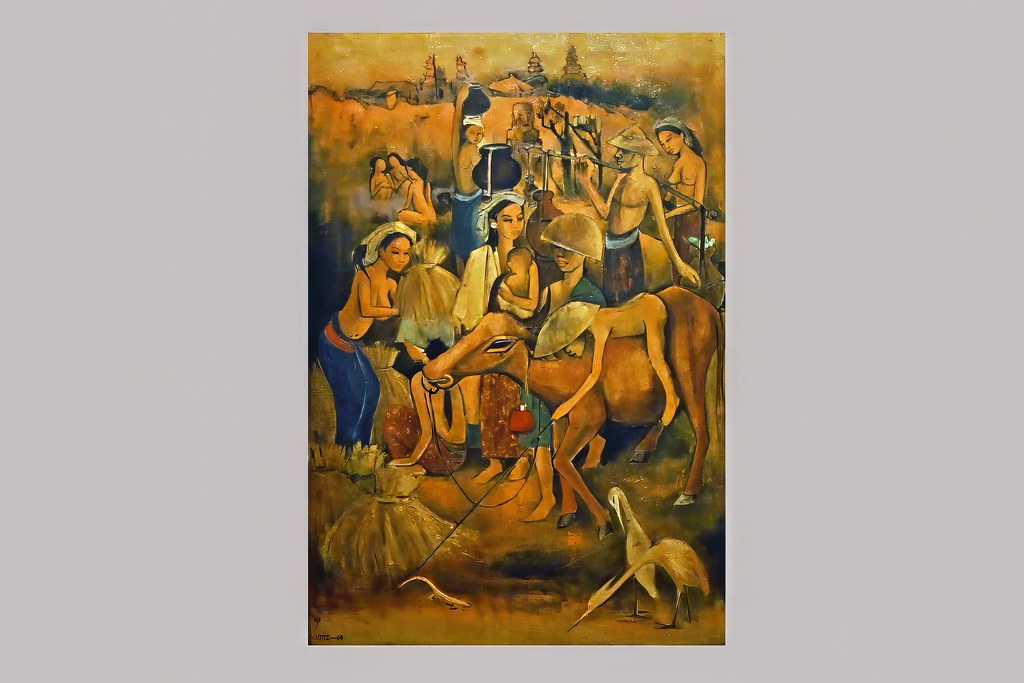

A painting can be finished enough to exhibit and still not be finished by its artist. Cheong Soo Pieng's monumental In a Balinese Village entered public view in 1953, when a black-and-white reproduction appeared in the catalogue for the Pictures from Bali exhibition. A decade later, Cheong returned to the same canvas and reworked it. The painting now carries a date that behaves less like a birthday than a corridor: 1953, 1952–64.[2][3]
National Gallery Singapore's five-and-a-half-minute film When is a Painting Complete? makes that corridor visible. Released on the museum's official channel in April 2024, it belongs to the Gallery's At the Conservator's Bench series and focuses on how an archival photograph, infrared photography, and X-radiography allow researchers to distinguish the painting's public states.[1][2] The film is compact, but its question is large. Does “finished” name the instant an artist stops, the state an audience first sees, or merely the latest surface an object happens to carry?
The film is worth watching for its method rather than for a sensational promise of a “lost” picture. Each form of evidence has a different job. A catalogue fixes what viewers could see in 1953. Infrared and X-rays register features the present surface conceals. The current painting records the choice Cheong ultimately left visible. None of those records, alone, explains why he changed his mind.
The catalogue photograph is a time stamp
The first evidence in this story is visually modest: a monochrome catalogue reproduction. It is easy to treat such an image as an impoverished substitute for a colorful painting. Here, its limitations are exactly what make it valuable. The photograph does not need to recover every hue or brushstroke. It needs to prove that a particular arrangement had already been declared public in 1953.[3]
That distinction changes how we look at the current work. National Gallery Singapore identifies the surviving object as oil on canvas, marouflaged onto hardboard, and measures it at 195 by 131 centimeters.[3] At that scale, revision was not a casual correction made at the edge of a sketch. Cheong reopened a composition that had already acquired exhibition history.
The old reproduction also prevents technical imaging from becoming a guessing game. When buried marks appear under infrared or X-ray examination, researchers can compare them with a dated external record. The catalogue and the object corroborate one another: one preserves an earlier visible arrangement; the other physically contains evidence of how that arrangement was transformed. What looks at first like two paintings can be read as two public states of one material object.[2][3]
Infrared and X-rays do not see the same thing
The film's most useful move is to place several kinds of looking beside one another. Infrared photography extends beyond the narrow band of radiation the human eye can register. Depending on the materials, it can clarify underdrawing and changes beneath upper paint layers. X-radiography responds instead to differences in the materials' density and construction. Neither is a universal “see-through” switch; each makes some features legible while leaving others obscure.[2][5]
The practical work was conspicuously collective. For Cheong Soo Pieng: Layer by Layer, curator Teo Hui Min worked with conservator Diana Tay of BARC Labs and specialists from Singapore's Heritage Conservation Centre. Radiographers at Singapore General Hospital helped scan selected paintings.[3] Paintings conservator Keziah Lim describes how the works exceeded the dimensions of a human torso, so several X-ray exposures had to be made and then stitched into a complete record. By October 2023, In a Balinese Village itself had traveled to the hospital for this process.[5]
That scene matters because conservation films can make discovery look instantaneous: point a machine at a masterpiece and wait for the secret to appear. In practice, an X-ray of a large painting is assembled through handling plans, multiple exposures, alignment, interpretation, and comparison. The machine produces data; the historical claim emerges only when people connect that data to the catalogue image, the current surface, the support, and the known exhibition chronology.[3][5]
A finish date becomes an interval
National Gallery Singapore states the basic sequence plainly: the initial version was completed in 1953, and Cheong reworked it in 1964.[2][3] The word “completed” is not wrong in the first clause simply because revision follows in the second. In 1953 the painting had reached one genuine finish: it could be selected, reproduced, titled, and encountered by an audience. In 1964 it reached another.
This is why the expanded date is more honest than replacing 1953 with 1964. A single late date would erase the work's first public life. A single early date would make the visible composition appear to have existed before Cheong painted it. The interval preserves both facts. It turns metadata into a compact account of duration.
Cheong's broader career makes sustained experiment unsurprising, though it cannot supply a motive for this particular revision. He worked across oil, ink, watercolor, printmaking, batik, and sculpture; later accounts repeatedly emphasize his movement among styles and materials.[3][6] That context tells us that change belonged to his practice. It does not tell us whether In a Balinese Village was revised because of dissatisfaction, a new formal idea, damage, a forthcoming display, or some combination the surviving evidence cannot name.
The buried version is not the “truer” painting
Technical images carry a seductive hierarchy. The hidden layer can feel more authentic simply because access to it required special equipment. Yet the earlier composition is not automatically Cheong's secret truth, and the later surface is not a disguise to be stripped away. Both were authored. The first is historically important because it was exhibited; the second matters because Cheong chose to revise and retain it.
The film therefore works best as an argument against restoration fantasy. Its purpose is not to reverse the object to 1953. Doing so would destroy the evidence of 1964 and collapse a layered history into a preferred moment. Conservation research instead permits both states to remain intellectually available while the physical painting stays intact.[1][2]
This boundary also disciplines interpretation. Infrared and X-ray records can establish sequence and material difference. A catalogue can anchor an earlier appearance. They cannot recover the artist's private reasoning unless documents or testimony survive to connect intention with action. The most responsible conclusion is precise but limited: Cheong considered a publicly finished painting open to substantial recomposition, and the object now preserves both decisions.
Watch the handoffs
On a first viewing, follow the before-and-after story. On a second, watch how often evidence changes hands: from artist to exhibition catalogue, from private collection to museum research team, from conservators to hospital radiographers, from separate scans to a composite technical record, and finally from research into a new title line and date.[1][3][5]
Those handoffs are the real subject of the film. The 2024 exhibition and its catalogue placed artwork plates beside technical photographs and joined conservation science to art-historical interpretation.[3][4] The result does not reduce painting to material analysis. It shows that a painting's visible surface, physical support, archival appearances, and cataloguing history can all disagree productively until researchers find a chronology that holds them together.
In a Balinese Village was not unfinished for eleven years in any simple sense. It was finished, lived publicly, and then became available to its maker again. The conservation evidence lets us see revision not as a failure to decide but as a second act of authorship. A finish, in this case, was real without being final.
Sources
- National Gallery Singapore, “At the Conservator's Bench | When is a Painting Complete?” official YouTube video, April 11, 2024.
- National Gallery Singapore, “Art Conservation” — official series page describing the film, the 1953 and 1964 states, and the roles of archival and technical imaging.
- National Gallery Singapore, “Encounter art in new ways and rediscover one of Singapore's leading artists at Cheong Soo Pieng: Layer by Layer,” media release, March 26, 2024 — chronology, dimensions, research partners, and image record.
- Teo Hui Min and Diana Tay, Cheong Soo Pieng: Layer by Layer, National Gallery Singapore exhibition catalogue — publication record for the artwork plates and technical photographs.
- Keziah Lim, “Lights, Polish, Stitch: Behind Cheong Soo Pieng: Layer by Layer,” Art & Market, September 10, 2024 — a conservator's account of infrared work, paint cross-sections, and the multi-exposure hospital X-ray process.
- Singapore Chinese Cultural Centre, “Pioneer Artist: Cheong Soo Pieng,” Culturepaedia — biographical and career context for Cheong's movement across media and styles.
- Choo Yut Shing, “In a Balinese Village,” Flickr, photographed July 16, 2024 — documentary exhibition photograph used as the article image.