Sophie Taeuber-Arp is still too often introduced as the exception inside somebody else's story: the Dada woman who also made textiles, the abstract artist who crossed into craft, the designer who somehow reached painting.[1][3] That framing is backwards. Taeuber-Arp did not occasionally cross a boundary that mattered more than she did. Boundary-crossing was the substance of her art. What she built across the 1910s, 1920s, and 1930s was a transferable grammar of abstraction that could move from needlework to dance, from beadwork to carved heads, from marionettes to interiors, without losing force.[1][2][3]
That is why she still feels so contemporary. MoMA's 2021 retrospective described her as one of the most multitalented modern artists and stressed that her work ran from applied-arts teaching and Dada participation to murals, stained glass, furniture, interiors, buildings, painting, sculpture, and editing.[1] The list matters because it changes the usual question. The point is not why she refused to stay in one medium. The point is why modern art spent so long treating that refusal as secondary rather than foundational.
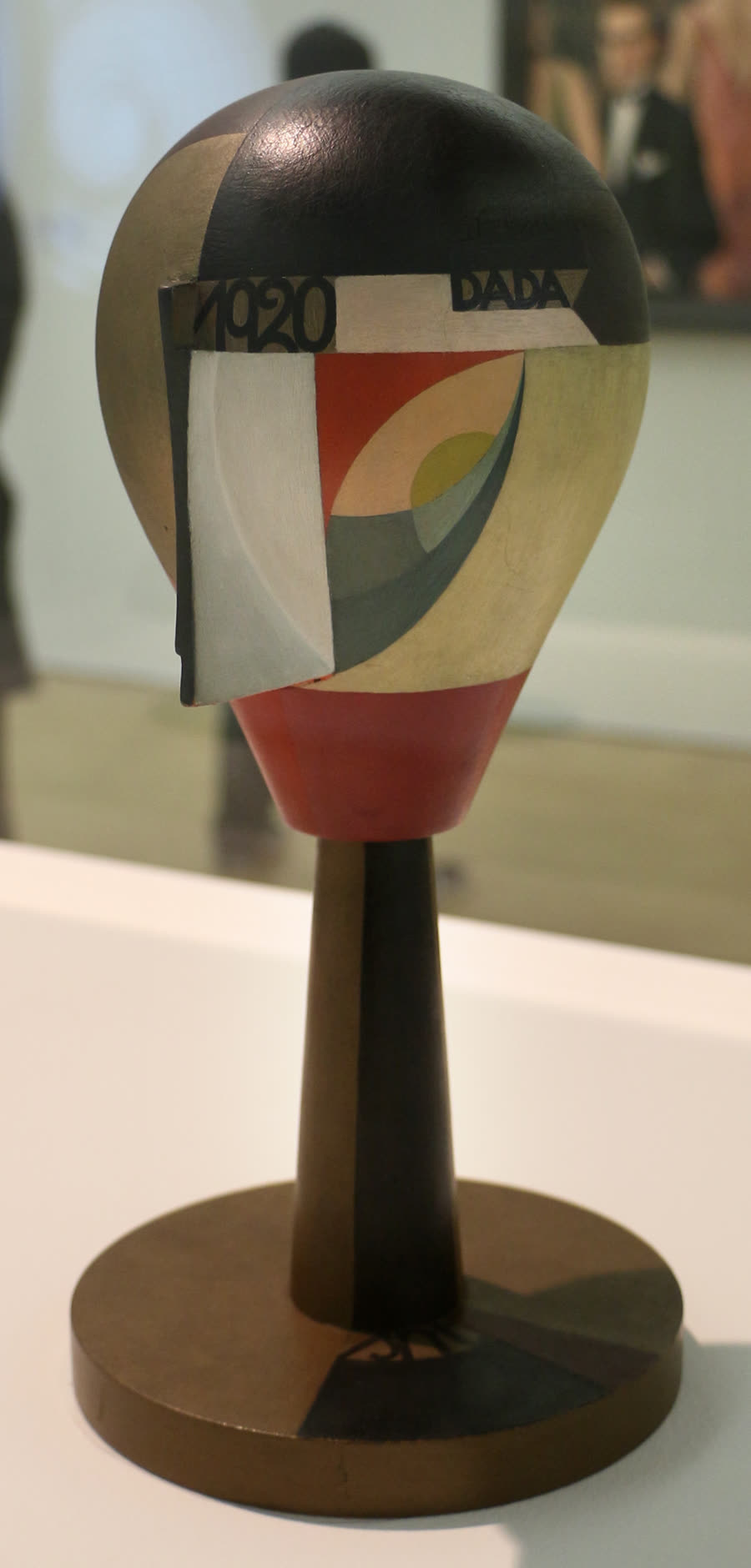
Image context: the cover uses a real museum photograph of a 1920 Dada head rather than a flat reproduction of a late painting. That choice fits the article's argument because the heads are where several of Taeuber-Arp's deepest commitments meet at once: turned wood, painted surface, decorative accent, bodily suggestion, and an object that hovers between use and sculpture.[5][6]
The grid began as a textile fact, not as a cold theory
One reason Taeuber-Arp's abstraction feels different from stricter modernist legend is that it begins with fabric and handwork rather than with the heroic blank canvas. In MoMA's audio for Vertical-Horizontal Composition from around 1917, curator Anne Umland points out that Taeuber-Arp grew up in the St. Gallen region of Switzerland, famous for textiles, and attended a progressive Arts and Crafts school in Germany.[2] For a textile designer, Umland says, everything begins with the support fabric itself: vertical and horizontal threads, essentially a grid.[2]
That detail is decisive. It means the grid in Taeuber-Arp is not first a philosophical reduction or a manifesto pose. It is a working condition. It belongs to materials that already have structure, to cloth that must be stitched, to objects that might be touched, turned, or used.[2][3] MoMA's Cushion panel audio makes the same point from another angle: the work was designed as a functional object, yet it is also a compelling abstract composition, and Taeuber-Arp wanted to make "living things" tied to movement, manipulation, and spatial experience.[7] Abstraction, for her, is not a retreat from life. It is a way of patterning life.
This is the first major correction an artist profile has to make. Taeuber-Arp did not move upward from craft into real art. She used textile intelligence to show that abstraction could already be exact, rigorous, and modern before it ever claimed high-medium purity.[1][2]
Dada gave that order a stage, not a permission slip
The next turn is Zurich Dada, but even here the usual shorthand can mislead. Dada did not rescue Taeuber-Arp from order. It gave her a setting where order could become unstable, theatrical, and harder to classify.[3][4] MoMA's audio for the 1920 Head calls the Dada heads "indeterminate objects": part sculpture, part object, part mannequin head, part mask.[3] That indeterminacy is not incidental. It is central both to Dada's suspicion of fixed cultural categories and to Taeuber-Arp's own practice.
The official Sophie Taeuber-Arp foundation page on Tête dada sharpens the point further. It describes the so-called heads as a direct connection between applied and fine art, made from machine-turned wooden elements that Taeuber-Arp painted and sometimes embellished with beads or other decorative materials.[5] Some were even apparently used as hatstands.[5] That single fact is enough to break the old hierarchy. These are modern sculptures, portrait parodies, decorated objects, and potentially useful household things at the same time.
Once that is clear, the heads stop looking like a charming Dada sideline. They become key works. The pointed nose, jewelry-like accents, monochrome surfaces, and abstracted eyes do not cancel one another out; they let anonymity and personhood flicker together.[3][5] The objects are funny, elegant, slightly severe, and bodily without becoming naturalistic. They show Taeuber-Arp refusing the choice between ornament and form, or between design intelligence and sculptural seriousness.
Bodies, puppets, and rooms were all part of the same project
The body never leaves this art, even when the imagery gets more geometric. MoMA's exhibition materials note the famous 1917 photograph thought to show Taeuber-Arp dancing at the opening of Galerie Dada in Zurich.[1] Dance matters here not as biographical color but as structural evidence. Her abstraction was made to move with and around bodies from the beginning, not just to hang in front of them.
The 1918 marionettes for King Stag push that logic further. In MoMA's audio for Deramo, The King, Laura Braverman explains that Taeuber-Arp designed marionettes and stage sets for the production, and that even though the organizers thought the puppets were too modern, Dada writers and artists praised them quickly.[4] What matters in that account is not simply the success story. It is the form of the work. These are abstracted figures built for performance, relation, and narrative movement. The same artist who made a cushion panel and a Dada head could also make a king, a stool, a stage, and a whole visual language for bodies in motion.[4]
That continuity helps explain why later interiors and architectural projects do not feel like a departure. MoMA's retrospective page insists on the full trajectory: murals, stained glass windows, furniture, interiors, and buildings belong inside the same career arc as textiles, objects, paintings, and relief sculptures.[1] Read properly, those later works do not show an artist diluting abstraction for decoration. They show an artist enlarging its address. Taeuber-Arp wanted pattern, geometry, and color to organize lived space itself.
Why her modernism still feels less exhausted than most
What survives most powerfully in Taeuber-Arp is not the old modernist promise of purity. It is the opposite promise: that rigor can stay open to use, pleasure, tactility, and movement.[1][2][5] This is why her art does not feel trapped in one exhausted debate about whether design counts as art, or whether women in the avant-garde were unfairly assigned to "minor" media. Those historical questions matter, but her work already answers them. It answers by showing that a cushion can think, a head can perform as sculpture and object, a puppet can advance abstraction, and a room can become a geometry someone actually inhabits.[1][2][3][4][5]
MoMA's exhibition text says that for Taeuber-Arp abstraction was always connected to everyday lived reality, where objects are used, spaces are moved through, and artworks are experienced rather than merely classified.[1] That line gets to the core of her achievement. She made abstraction less like a tribunal and more like an environment. It could be worn, handled, staged, walked through, and looked at from different distances without surrendering discipline.
That is the stronger way to place Sophie Taeuber-Arp in modern art. She is not important because she smuggled craft into a fine-art story. She is important because she exposed how narrow that story was. Her work keeps demonstrating that geometry can still touch the hand, that pattern can carry a body, and that modernism becomes more persuasive when it learns how to live in ordinary space.[1][2][3][5]
Sources
- MoMA, "Sophie Taeuber-Arp: Living Abstraction" - exhibition page outlining her path from applied-arts teacher and Dada participant to designer of interiors, buildings, murals, stained glass, and geometric abstraction.
- MoMA Audio, "Sophie Taeuber-Arp. Vertical-Horizontal Composition. c. 1917" - curator notes on textile structure, the grid, and Taeuber-Arp's early abstract method.
- MoMA Audio, "Sophie Taeuber-Arp. Head. 1920" - curator notes describing the Dada heads as indeterminate objects between sculpture, mask, mannequin head, and everyday object.
- MoMA Audio, "Sophie Taeuber-Arp. Deramo, The King (marionette for King Stag). 1918" - notes on the Zurich marionettes, stage design, and the Dada reception of the puppets.
- Sophie Taeuber-Arp Foundation / Database, "Tête dada" - object entry explaining the heads as a direct link between applied and fine art, made from turned wood, paint, and decorative additions.
- Wikimedia Commons, "File:Sophie taeuber-arp, testa dada, 1920, 02.JPG" - source page for the real museum photograph used as the article image.
- MoMA Audio, "Sophie Taeuber-Arp. Cushion panel. 1916" - notes on functional objecthood, bright abstraction, and Taeuber-Arp's desire to make "living things."