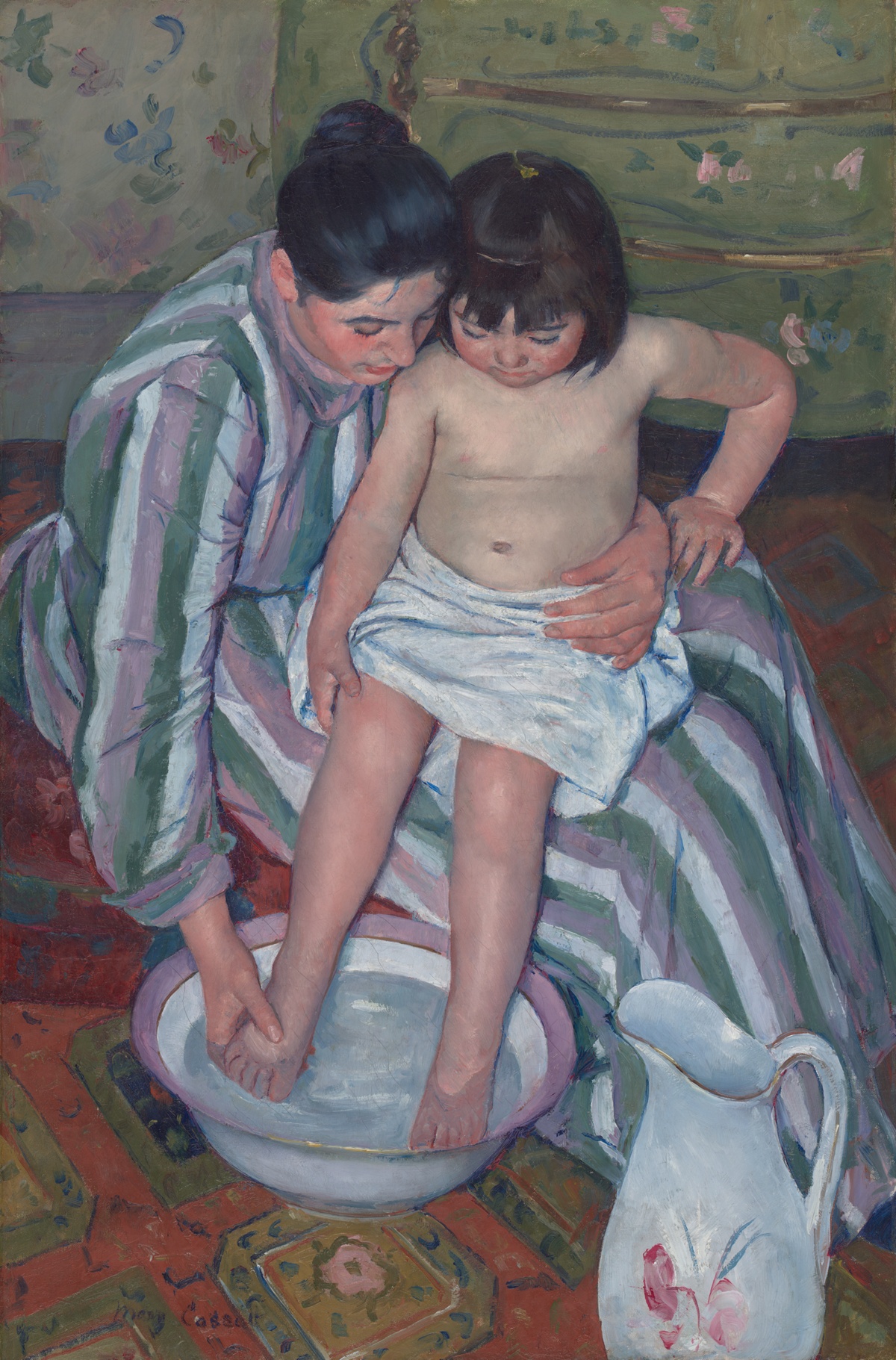
The Child's Bath is so loved that it can start to look easier than it is. Many viewers remember the painting as a scene of maternal tenderness, and that tenderness is real. But Mary Cassatt did not leave the feeling loose. She built it. A caregiver bends over a child, a white basin catches both feet, a tall pitcher waits at the lower right, and a striped dress spreads across the picture until touch begins to look like a formal system rather than a private mood. The painting works because affection has been turned into arrangement.[1][2][3]
That is what makes the picture more modern than its reputation sometimes suggests. The Art Institute of Chicago's object page and curatorial essay both place the work after Cassatt's excitement over a major exhibition of Japanese prints in Paris in 1890, and both stress that the 1893 canvas extends that investigation across media through flattening, pattern, and bold design.[1][2] The museum's American-art overview says the work derives its cropped forms, outlines, and compressed perspective from Japanese woodblock prints.[3] Seen from that angle, The Child's Bath is not simply a sentimental icon of motherhood. It is a highly composed experiment in how a daily task can be made pictorially rigorous.
Image context: the cover uses the Art Institute of Chicago's open-access image of The Child's Bath because this article turns on the painting's physical organization. The basin, the striped cloth, and the lowered faces all need to be seen at once for the argument to hold.[1]
The room does not recede; it tilts toward the wash basin
One of the strongest things Cassatt does is deny the viewer a comfortable distance. In the Art Institute's curatorial essay, the high horizon line makes the carpeted floor seem to stand upright rather than recede gently into a room.[2] The American-art overview makes the same point more bluntly: flattened perspective is one of the work's defining devices.[3] Instead of opening deep space, the picture presses the eye down and inward.
That pressure makes the basin feel less like an accessory than like the painting's anchor. The child's legs drop directly into it, the caregiver's hand reaches into it, and its pale oval becomes the one cool, stable pool inside a field of angled fabric and bent bodies. Even the white pitcher at the lower right repeats the basin's ceramic presence, as if the act of washing had generated its own local architecture. Cassatt turns the scene into a choreography of downward motion: heads incline, shoulders slope, knees fold, feet enter water.
Because the space does not open outward, the viewer ends up almost kneeling with them. There is no window, no horizon, and no anecdotal furniture to dilute the act. The room has been edited until washing becomes the whole event.
Stripes and patterns keep tenderness from dissolving into vagueness
The painting's emotional charge also depends on how much pattern it can bear without going slack. The Art Institute calls the canvas a bold experiment of color, line, and form, and that description matters.[2] The striped dress does not merely clothe the caregiver. It fills the painting with repeated verticals and diagonals that hold the adult body together while simultaneously surrounding the child in a soft but insistent lattice. Floral wallpaper and the patterned carpet continue the same logic. The scene is intimate, yet almost nothing in it is visually casual.
This is why the picture never drifts into sugary atmosphere. Cassatt uses decoration as structure. The child's skin looks tenderer because it is set against cool water, white cloth, firm outlines, and the disciplined alternation of green, lavender, and white in the dress.[1][2][3] Pattern does not distract from care. It gives care a tempo.
The compression is crucial here. Cropped forms and bold outlines, as the Art Institute notes, keep the bodies close to the picture plane.[3] The viewer is not asked to admire a generalized ideal of motherhood from afar. The viewer is made to track how bodies fit together: lap, arm, shoulder, foot, bowl, towel. That nearness is why the scene feels both affectionate and unsentimental.
The hands divide care into holding and washing
The painting would mean something different if it were only an embrace. Cassatt makes sure it is also work. The Art Institute's object page points to the caregiver's cheek brushing the child's shoulder, the encircling arm, and the child's hand on the adult's knee as signs of emotional bond.[1] Those details matter, but the scene holds because another hand is busy at the foot in the basin. One arm steadies; the other performs the task.
That division keeps the painting honest. Care is neither abstract virtue nor theatrical sacrifice. It is a repeated physical practice carried out at close range with attention, weight, and patience. The child is not displayed like a cherub. The body slumps slightly forward, one leg extended, the towel slipping, the whole pose caught between compliance and ordinary restlessness. Meanwhile the adult leans low enough that the face nearly joins the child's shoulder. Touch here is practical before it becomes symbolic.
The Art Institute essay also notes that the adult figure may be a nurse but is more likely the child's mother, and that scenes of child care had special topical force in the 1890s as maternal participation in everyday care was newly emphasized.[2] That context sharpens the painting's seriousness. Cassatt is not offering a vague timeless Madonna. She is painting a modern domestic ritual with labor still visible inside it.
Japanese print logic enters the nursery without turning it exotic
Cassatt's modernity becomes clearest when the painting is set beside her printmaking. The National Gallery of Art's story on Cassatt's color prints describes the 1890 Japanese woodcut exhibition in Paris as a revelation that pushed her toward flat forms, strong lines, and the technically ambitious Set of 10.[4] The Gallery's page for The Bath shows one of those 1890-91 prints, made in drypoint, soft-ground etching, and aquatint, as part of the same cluster of bathing and mother-child subjects.[5]
That sequence matters because The Child's Bath does not imitate Japanese art at the level of costume or anecdote. It borrows pictorial logic. Elevated viewpoint, cropped edges, emphatic contour, and the refusal of deep recession all move from print thinking into oil painting.[1][2][3][4][5] Cassatt uses those devices to reorganize an ordinary interior until the act of washing becomes almost monumental in its concentration.
This is why the picture lasts. It gives domestic care the density of a modern composition without hardening it into doctrine. The image feels calm, but it is built from strong decisions. Bowl, pitcher, stripes, carpet, bent necks, and bracing hands all cooperate. Tenderness remains, but it remains because form keeps carrying it.
That is the deeper achievement of The Child's Bath. Cassatt made one of the nineteenth century's most recognizable images of care, but she did it without relying on softness alone. She made intimacy structural. The painting's beauty comes from how completely it understands that washing a child is a matter of design as much as devotion.[1][2][3][4]
Sources
- The Art Institute of Chicago, "The Child's Bath" - object page with date, medium, image record, and notes on emotional bond, Japanese-print influence, and the painting's flattened picture plane.
- Annelise K. Madsen, "Cassatt's Modern Vision of the Everyday: The Child's Bath," The Art Institute of Chicago - curatorial essay on the high horizon line, patterned surface, domestic ritual, and Cassatt's 1890 turn toward Japanese aesthetics.
- The Art Institute of Chicago, "American Art" - collection highlight describing The Child's Bath as a masterwork built from cropped forms, bold patterns and outlines, and flattened perspective derived from Japanese woodblock prints.
- National Gallery of Art, "Mary Cassatt, the Daring Printmaker" - essay on Cassatt's response to the 1890 Japanese woodcut exhibition, her Set of 10 color prints, and the strong-line, flat-form logic behind them.
- National Gallery of Art, "The Bath" - object page for Cassatt's 1890-91 print, included here as the key printmaking antecedent to the later oil painting's bathing motif and Japanese-inflected design.