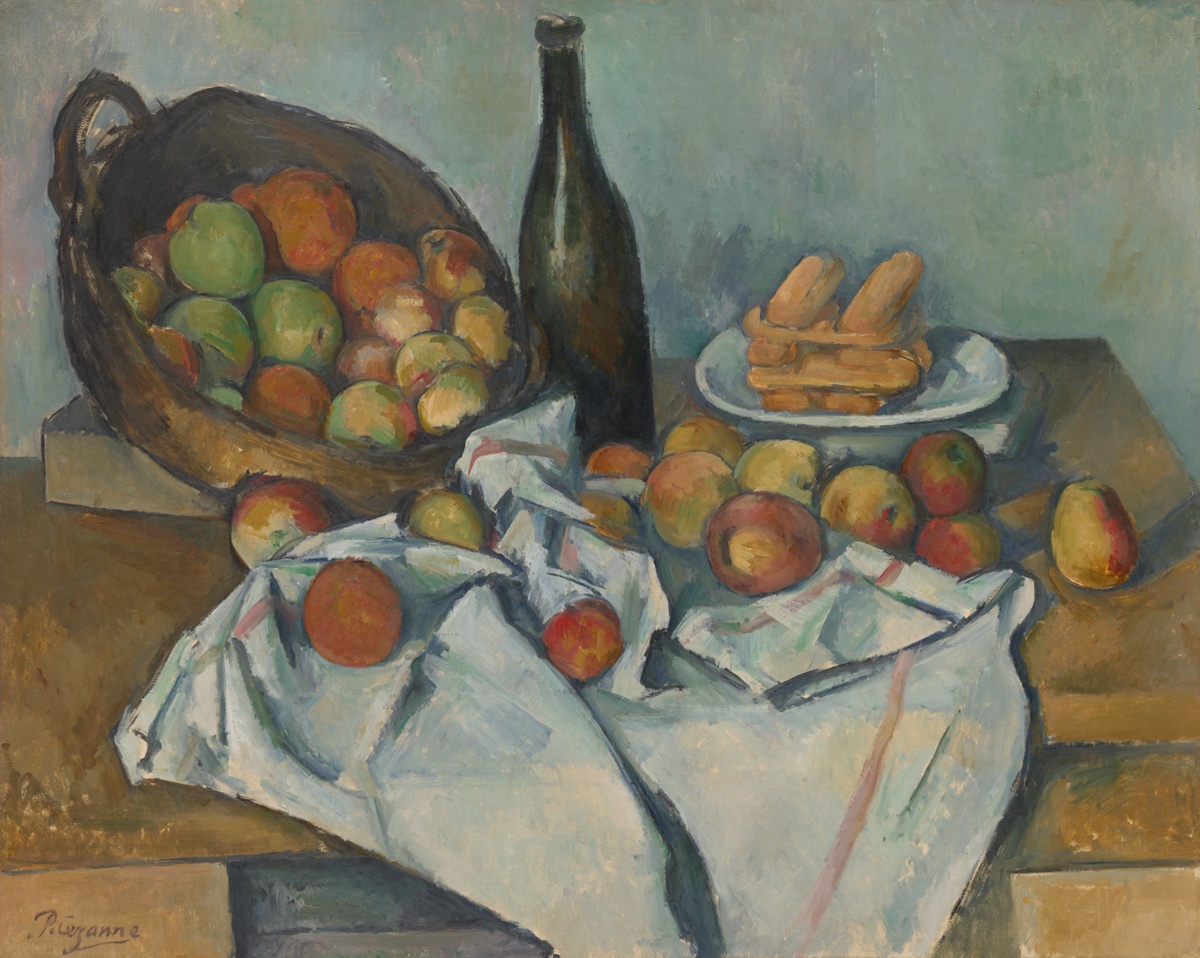
At first glance, Paul Cézanne's The Basket of Apples looks as if it should collapse.[1] The basket pitches forward, the bottle seems to lean rather than stand, the plate at right sits on a table whose edges do not quite agree with one another, and the white cloth bunches into folds so thick they nearly behave like carved matter.[1][2] Yet nothing falls. That is the painting's deeper achievement. Cézanne does not use distortion as a joke against realism. He uses it to build a different kind of order, one in which balance is produced by tension among parts rather than by obedience to a single stable viewpoint.[1][3][4]
That is why the picture still feels so fresh. The Art Institute's object page calls the table an "impossible rectangle with no right angles" and notes that the basket seems balanced by the bottle and the cloth's thick, sculptural folds.[1] The phrase "balanced by" is the key. This still life is not a collection of objects arranged inside neutral space. It is a negotiated structure. Cézanne lets each object insist on its own presence, then forces the whole arrangement to hold together anyway.[3]
Image context: the cover uses the Art Institute of Chicago's public-domain image of the painting itself because this essay depends on the picture's own physical logic. The argument lives in the slanted tabletop, the basket's forward pitch, the bottle's corrected lean, and the cloth that behaves less like linen than like weight.[1][2]
The table is wrong in a productive way
The famous tilt of Cézanne's table is often treated as if it were simply an assault on perspective.[1][3] That is too crude. The Metropolitan Museum's overview of Cézanne says that in still lifes he ignored the laws of classical perspective so that each object could remain independent while the relation between objects took precedence over traditional single-point space.[3] Put that next to the Art Institute's description of the impossible tabletop and the painting starts to clarify.[1] Cézanne is not failing to make a convincing table. He is refusing to let the table dominate the terms of seeing.
The front edge slopes one way, the rear edge another, and the right side does not settle into a neat geometric box.[1][2] That instability changes the viewer's job. Instead of entering the picture through one secure visual system, we are made to keep remeasuring everything: how the basket sits, whether the bottle is upright, how far back the plate actually is, whether the apples in front are sliding or resting. The picture remains readable, but only by staying active. Balance here is perceptual labor.
That labor is central to Cézanne's modernity. The National Gallery of Art says that in still life after still life he searched for harmony and balance in form and color.[4] The Basket of Apples shows that harmony for him did not mean smooth agreement. It meant a harder equilibrium reached through mismatch.
The bottle is not a neutral object; it is the picture's spine
The bottle looks so ordinary that it is easy to underestimate what it does. Placed between the basket and the plate, it acts as a dark vertical hinge in a composition otherwise full of diagonals, curves, and soft folds.[1][2] Without it, the whole arrangement would likely spill outward. The basket lunges leftward and forward; the pastries and plate hold the right side; the bottle keeps those two zones from flying apart.
The Art Institute's technical article makes this even more interesting. Infrared reflectography revealed that Cézanne first placed the leaning bottle differently and also drew the front edge of the table in another position before adjusting both as he painted.[2] That matters because it shows the instability was not casual. It was tuned. The bottle's exact angle belongs to a sequence of corrections by which Cézanne tested how much imbalance the composition could sustain before it lost coherence.[2]
So the bottle is not simply one more still-life prop beside fruit and pastry. It is the painting's spine, but a spine under pressure. It appears almost upright, yet not rigidly so. The slight lean lets it answer the table's slippage instead of denying it. In a more conventional still life, verticals reassure us by standing outside the system of doubt. Here the bottle participates in the doubt and becomes stronger for it.
The cloth keeps the painting from falling off its own edge
The white cloth does as much structural work as the bottle, perhaps more. On the object page, the Art Institute calls its folds "thick" and "sculptural."[1] That is exactly right. The cloth does not drape delicately. It bunches, braces, spreads, and catches. It receives the apples in the foreground while also anchoring the basket above them.[1][2]
The technical study deepens that reading. The conservators note that the cloth is not truly white at all, but a carefully calibrated range of pale pink, yellow, blue, green, and gray built from multiple pigments.[2] They also note that the red vermilion border was added in late stages and often follows its own course across the crumpled surface.[2] This is a crucial Cézanne move. The cloth creates local planes, but it also breaks them. Color helps describe form, then refuses to let form close too neatly.
That is why the cloth feels heavy rather than decorative. It behaves almost like an earthwork in miniature, a mound across which apples can rest and slide at the same time. If the basket pitches forward, the cloth supplies the counterweight. If the table edge becomes unreliable, the cloth invents another terrain inside the picture. Cézanne turns fabric into a second architecture.
The apples hold their own one by one
The apples matter not only as a traditional still-life motif but as discrete units of firmness. The technical article notes how Cézanne models their round forms through solid, opaque strokes of green, orange, yellow, and red.[2] The Met's account of Cézanne's still lifes similarly stresses that he lets objects keep a kind of independence within the picture field.[3] In The Basket of Apples, those two facts meet. Each apple has weight, contour, and chromatic authority; none dissolves into generalized abundance.
That independence is one reason the tipped basket does not become melodrama. The apples are many, but they do not read as a flood. They read as a series of distinct bodies held inside a precarious arrangement. One sits near the far right edge of the table, another presses into the cloth, others crowd inside the basket's rim.[1][2] The eye moves apple to apple the way it moves between the bottle, plate, and table edge: by relation, not by illusionistic depth alone.
This is where Cézanne's oft-repeated "distortion" becomes a more exact achievement. He is not breaking space for expressive chaos. He is redistributing certainty. The table can be uncertain because the apples are firm. The bottle can lean because the cloth thickens into support. The basket can tip because the whole painting has been rebuilt around a harder, stranger balance.[1][2][3][4]
That is the lasting force of The Basket of Apples. Cézanne makes a still life that never quite sits still. Its order comes from adjustment, counterweight, and active relation. The picture feels unstable because stability has been relocated from geometry to judgment. Nothing is where classical perspective says it should be, and everything is exactly where Cézanne needs it to be.[1][2][3]
Sources
- The Art Institute of Chicago, "The Basket of Apples" - official object page with work description, c. 1893 dating, the "impossible rectangle," and the note that the basket is balanced by the bottle and sculptural cloth folds.
- Kim Muir, Giovanni Verri, Maria Kokkori, and Clara Granzotto, "Cezanne's Still Lifes under the Microscope," The Art Institute of Chicago - conservation article on the initial sketch, revised bottle and table edge, chromatic structure of the cloth, and color creating and breaking illusion.
- James Voorhies, "Paul Cézanne (1839-1906)," The Metropolitan Museum of Art - overview explaining that Cézanne's still lifes let objects remain independent while their relationships take precedence over classical single-point perspective.
- National Gallery of Art, "Cezanne's Still Lifes" - educational essay noting Cézanne's repeated search for harmony and balance in form and color through still-life arrangements.