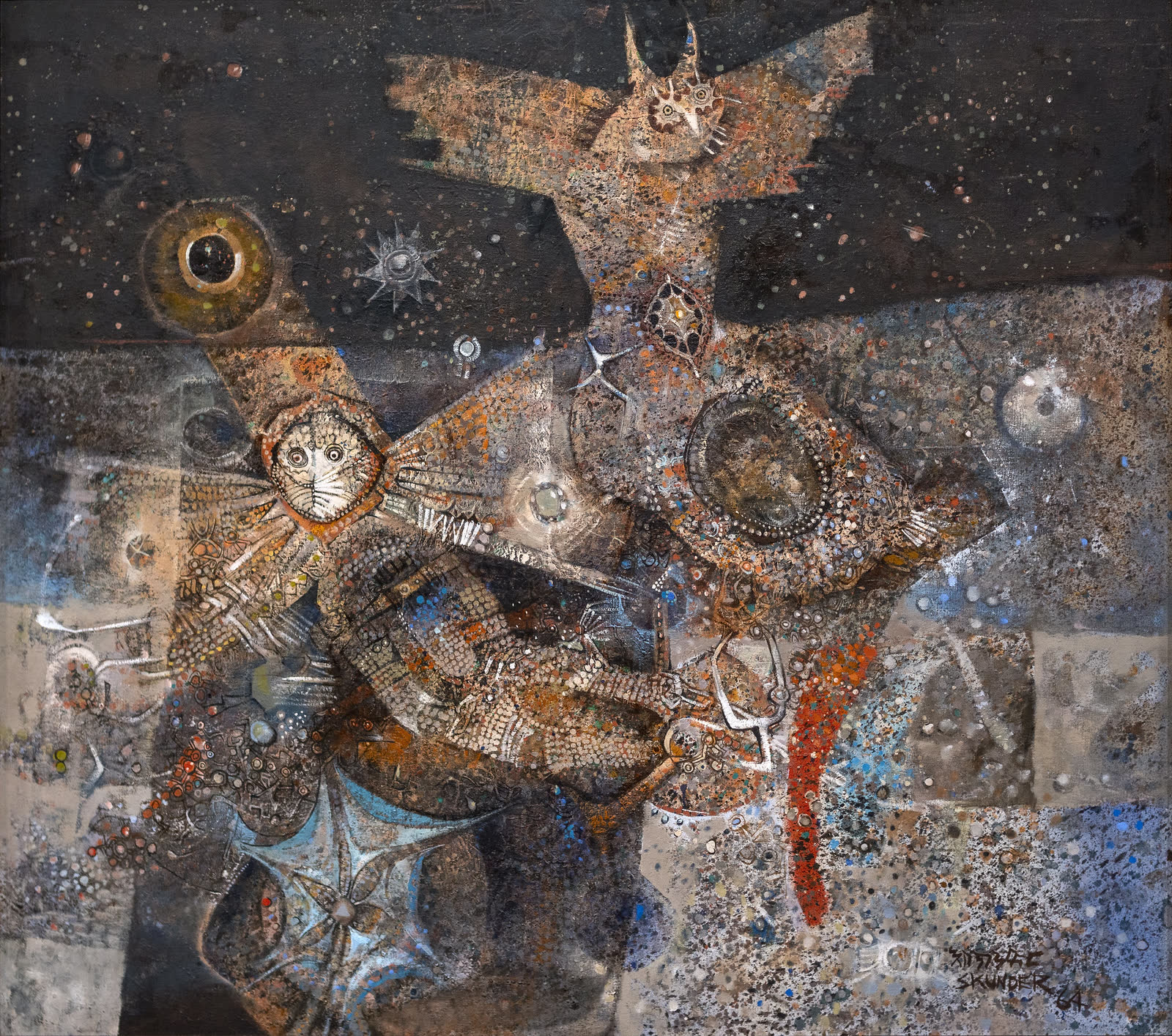
Image context: this is a photograph of the actual painting, which belongs to the North Carolina Museum of Art, not a reconstruction. Its full view matters: the narrow horizontal division, the two creatures that cross it, and the packed lower field are the work’s visual argument.[1][2]
The first line to find in Skunder Boghossian’s Night Flight of Dread and Delight is almost the quietest thing in it. A pale horizontal boundary runs across the canvas, separating a dark, freckled upper expanse from a lower region so crowded with marks that it seems to have its own weather. The line promises order: above and below, air and ground, one world and another. Then two winged beings break the rule.
One has the blunt, watchful face of a cat; the other suggests an owl. Their eyes arrive before their bodies do. Wings and patterned interiors carry them upward, but neither creature fully leaves the compressed field beneath. They are not silhouettes floating against a neutral sky. Each is a small environment made of spots, bands, membranes, eyes, and talisman-like signs. Around them, biomorphic forms gather and disperse; flecks in the darkness read by turns as stars, dust, spray, or paint insisting on its own material life.[2]
Painted in 1964, the work is oil and collage on canvas, roughly five feet across, and belongs to the North Carolina Museum of Art.[1] Those facts establish an object. They do not yet explain its peculiar pressure. The painting becomes legible only when its boundary stops looking like a divider and starts acting like a threshold. Boghossian built two zones so that crossing between them could become the subject.
The horizon fails at its only job
A conventional horizon helps a viewer stand somewhere. It coordinates sky with land, distance with foreground, and the eye with a stable position. Boghossian’s line does none of that reliably. There is no landscape to enter and no measurable distance to cross. The upper zone opens out, yet its mottled surface keeps it close to the canvas. The lower zone feels dense, but it does not settle into solid earth. It is more like a reservoir of forms waiting to hatch, surface, or change state.
The two winged figures make that uncertainty active. They pass through the line without tearing it, as if the boundary were permeable all along. Their movement is upward, but the picture refuses the easy symbolism of escape. Both remain tethered to the visual language below: the same granular marks, internal patterns, and shifting contours circulate through creature and ground. What crosses the border carries its earlier world inside it.
This is why the painting’s division creates continuity rather than simple opposition. Sparse and dense, dark and ochre, open and congested remain different, but they share a grammar. Small marks glint on both sides. Curves answer curves. The upper darkness is not empty, and the lower mass is not inert. Boghossian makes the eye travel repeatedly across the line until “above” and “below” become less useful than emerging and submerging.
Dread and delight occupy the same creature
The title offers another pair that looks tidier than the painting allows. Dread might belong to the darkness and delight to flight; fear might sit below while release waits above. Yet no such allocation holds. The creatures are buoyant and alarming at once. Their wide eyes can signal vigilance, revelation, or panic. Their wings promise motion, while their patterned bodies feel loaded with memories and forces too complex to shed.
That doubleness began in a real journey. Boghossian traveled from France to the United States in 1964 to marry Marilyn Pryce, a civil-rights activist he had met in Paris. The flight across the Atlantic was deeply turbulent; he made Night Flight in Alabama during the months following their August wedding in Tuskegee.[1][2] Anticipation and physical terror therefore entered the work together. Delight was not what came after dread. Both were present in the same crossing.
The North Carolina Museum of Art places the painting only months after the Civil Rights Act became law and reads its supernatural beings in relation to African literature, including the writing of Amos Tutuola.[1] That setting widens the emotional range again. A marriage journey into the American South could carry intimacy, danger, political commitment, and the charged possibility of a new Black international community. The painting does not reduce those conditions to an emblem. It gives them a shared atmosphere.
Even the collage contributes to this refusal of clean emotional categories. Collage announces that an image has been joined from different pieces; it makes attachment, edge, and interruption part of the surface. Here, a flight between continents is not represented by a smooth panorama. It is assembled as a field in which dissimilar fragments keep their friction while forming one world.
Surrealism becomes a route, not an address
Boghossian’s own route resists a one-way story of artistic influence. Born in Addis Ababa in 1937, he received an Ethiopian government scholarship in 1955 and studied in London before moving to Paris in 1957. There he remained until 1966, learning and teaching while participating in circles that joined painters, jazz musicians, African and diasporic writers, and thinkers associated with Négritude. He returned to Addis Ababa to teach, then settled in the United States and taught for decades at Howard University.[2][4]
Paris mattered, but it was a meeting point, not the origin of everything the painting knows. Boghossian encountered the work of Wifredo Lam and Roberto Matta and found in Surrealist fragmentation and metamorphosis a way to press different systems of thought into new relations.[2][3] He was also looking to Ethiopian Orthodox painting and healing scrolls, wider African cosmologies and sculptural forms, the political language of Pan-Africanism, and modern Black literature.[2]
The distinction is crucial. If Night Flight is described only as an Ethiopian artist adapting European Surrealism, its traffic runs in one direction and Paris remains the permanent center. The painting proposes something less hierarchical. Forms, ideas, and people move through Addis Ababa, London, Paris, Tuskegee, New York, and later Washington. Each encounter changes the next. Kate Cowcher’s study of Boghossian treats this mobility as part of Ethiopia’s internationalist position in the 1960s, when an artist’s worldly presence could also help imagine the nation as a center rather than a margin.[5]
The 2021–22 exhibition Surrealism Beyond Borders made the same historiographic correction at museum scale. The Metropolitan Museum of Art presented Surrealism as an interrelated network shaped by exchange, colonialism, independence, exile, and displacement, and singled out Night Flight as a fusion of Black diasporic experience with possibilities Boghossian found in Lam and Matta.[3] The painting did not need that exhibition to become global. The exhibition needed paintings like this one to show that Surrealism had always moved through more than one world.
Pattern is not a dictionary
Close looking can tempt a viewer to turn every mark into a code: this sign must mean one tradition, that animal another, each shape a stable entry in a cultural glossary. Boghossian blocks that approach by making his forms porous. The cat-faced and owl-like figures are recognizable enough to command attention, but their bodies do not stay zoological. Internal bands, eyes, curls, and cells make them part animal, part diagram of energy, part inhabited terrain.
Smarthistory uses the term “afro-metaphysics” for Boghossian’s effort to picture realities beyond ordinary perception through Pan-African spiritual, historical, and visual knowledge.[2] The useful part of that term is not that it supplies a master key. It names a practice of relation. Boghossian did not line up Ethiopian, West African, literary, and Surrealist references for separate identification; he subjected them to transformation inside the same pictorial pressure.
Ethiopian healing scrolls offer an especially revealing comparison. Traditionally made as long, narrow objects of parchment bearing writing and protective imagery, their stacked fields and watchful figures organize spiritual force through sequence. The Metropolitan Museum’s account of Boghossian’s later The Cross, the Church, and the Butterfly shows how deliberately he returned to their format, materials, stylized patterns, and devotional charge.[6] In Night Flight, the connection is less literal but still structural: repeated signs seem to protect, activate, and bind the creatures rather than merely decorate them.[2]
That is also why the eyes matter so much. They do not provide psychological portraits. They puncture the surface as concentrated acts of looking, reversing the usual relation between spectator and picture. We scan the darkness for a stable world; the winged beings have already found us. The painting makes vision feel reciprocal and slightly unsafe.
The Atlantic is not the empty part
The upper field can initially look like relief from the density beneath it. Knowing the work’s origin makes that apparent emptiness harder to trust. This is an Atlantic sky remembered from inside a frightened body. It also belongs to a historical ocean whose crossings cannot be separated from forced movement, colonial power, diaspora, and the modern political networks built in their wake. Smarthistory connects Night Flight to Boghossian’s related 1964 work Ghosts of the Atlantic Ocean and reads the two as distinct meditations on personal passage and the deeper trauma of the Middle Passage.[2]
That context should not turn every dark fleck into a fixed historical symbol. The painting is stronger because it holds scales together without making them identical. One rough flight is not the transatlantic slave trade. One artist’s marriage journey is not a diagram of the Black Atlantic. But a personal crossing can awaken the history sedimented in a route, especially for an artist whose life joined African, European, and American intellectual worlds.
Boghossian leaves the sky speckled and active. Empty space would allow the flying bodies to detach themselves from history. His darkness instead has texture; it presses back. The creatures rise through an atmosphere already occupied by matter and memory. Their flight is possible, but never weightless.
A painting that keeps the border open
The most radical feature of Night Flight of Dread and Delight is not that it reconciles its opposites. It does not. Earth and sky retain their line. Dread never becomes delight, Africa does not dissolve into Europe or America, and spiritual form is not translated into a single modernist language. Boghossian keeps the differences visible while denying them the last word.
Return to the two creatures. They cross in company, but not in formation. Each carries its own face and patterned interior. They make passage look collective without making it uniform. Below them, the dense field remains generative; above, darkness remains charged. Nothing in the picture says that arrival will be easy or that movement will leave the traveler unchanged.
The horizon’s failure is therefore the painting’s success. A border has been drawn clearly enough to feel, then breached without being erased. Boghossian turns that breach into a visual model for living between worlds: not purity, not frictionless mixture, but forms remade through difficult contact. The night flight delights because another world can be entered. It produces dread because no crossing is innocent, and no traveler arrives empty.
Sources
- North Carolina Museum of Art, “Night Flight of Dread and Delight” — official collection record with work metadata, provenance, and the museum’s current gallery label
- Perrin Lathrop, “Pan-Africanism and Skunder Boghossian’s Night Flight of Dread and Delight,” Smarthistory (2021) — close visual analysis and research on the painting’s Atlantic journey, Paris networks, Pan-African context, literary references, and healing-scroll vocabulary
- The Metropolitan Museum of Art, “New Way of Looking at Surrealism, Focusing on the Worldwide Sweep of the Movement” (September 28, 2021) — official Surrealism Beyond Borders release situating the painting within Black diaspora and a transnational account of Surrealism
- National Museum of African Art, “Ethiopian Passages: Dialogues in the Diaspora” — official exhibition biography tracing Boghossian’s study in London and Paris, return to Addis Ababa, and later teaching at Howard University
- Kate Cowcher, “A Postcard from Addis: Ethiopian Modernism(s) in the World,” University of St Andrews Research Portal (2021) — scholarly chapter record and abstract on Boghossian, mobility, and Ethiopia’s internationalist modernism
- The Metropolitan Museum of Art, “Skunder Boghossian: The Cross, the Church, and the Butterfly” — collection entry documenting the artist’s sustained engagement with Ethiopian healing scrolls, liturgical art, layered materials, and spiritual imagery