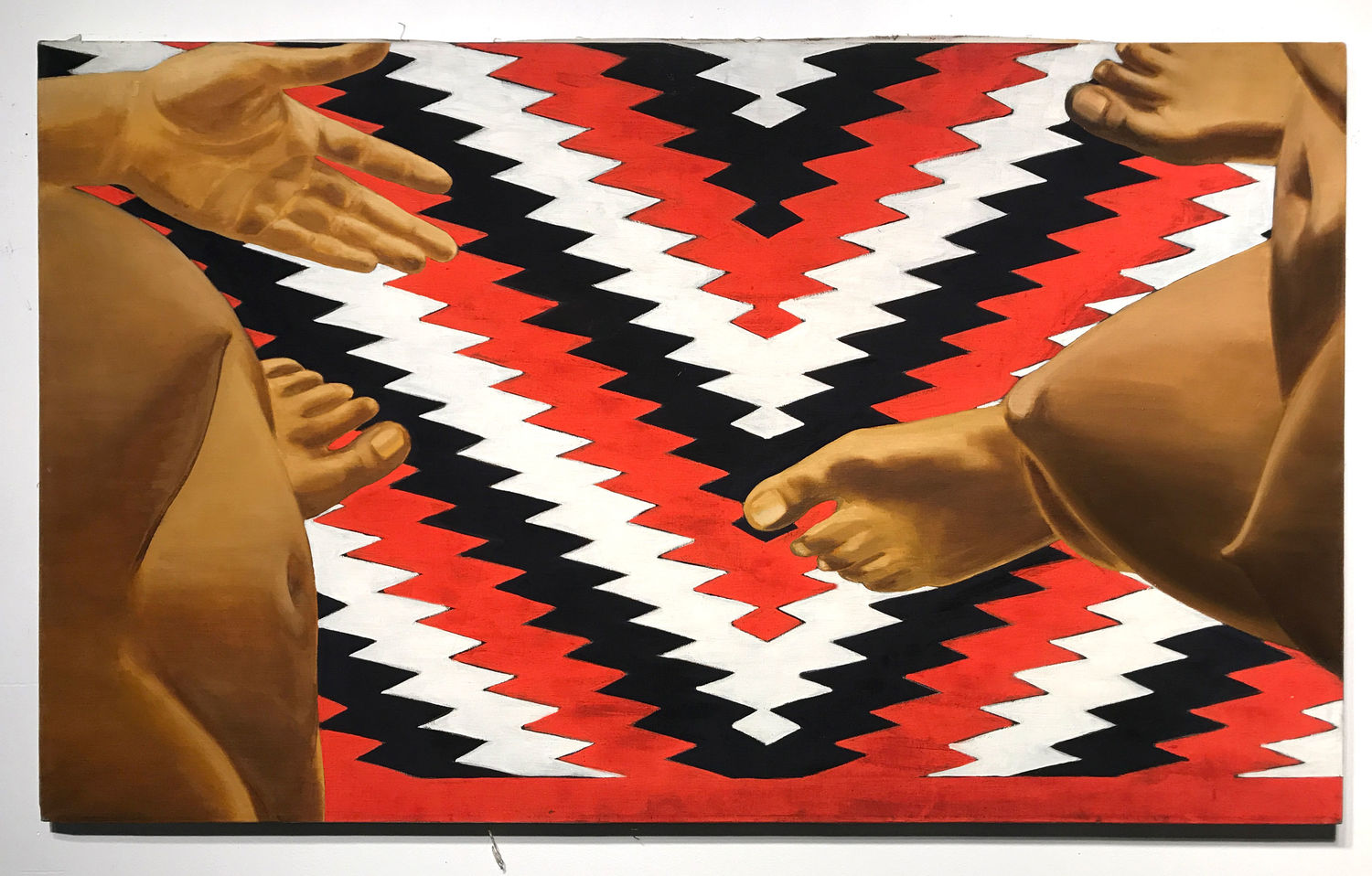
Image context: this is a museum-hosted photograph of Hurtado's actual 1970 painting, not a reconstruction. The work's low, embodied viewpoint is its subject: fragments of hands, feet, and torso press in from the edges while the patterned floor holds the center.[2]
Look for Luchita Hurtado's face in Untitled (1970) and the search will take you past the painting. No head presides over the composition. Hands, feet, and rounded expanses of brown skin enter from four sides, interrupting a red, black, and white field of zigzags. The pattern is sharp enough to establish a plane, yet the bodies refuse to settle into one orientation. The picture does not place a model over there and a spectator safely here. It gives us a position inside the looking.[2]
That change of position is Hurtado's decisive move. Across more than eight decades of painting and drawing, she shifted among biomorphic abstraction, figures, words, landscape, and ecological protest. The styles vary so widely that a retrospective can initially resemble a group show. What holds the work together is less a signature look than a recurring question: where does the self end and the world begin? In the strongest pictures, the answer is never a clean border. A body becomes a viewpoint, a floor becomes an environment, a sentence becomes a portrait, and skin opens onto sky.[1][4]
Hurtado became widely visible only near the end of her life. That fact can turn her into a reassuring story about an overlooked artist finally discovered in her nineties. It is also a dangerous simplification. Recognition came late; the art did not. Her paintings had been testing how a person inhabits a body, a home, and a planet long before institutions learned to arrange those experiments into a career.[1][4]
A private practice beside famous circles
Hurtado was born in Maiquetía, Venezuela, in 1920 and moved to New York in 1928. As a young woman she studied art, worked in fashion illustration and commercial display, and moved through New York, Mexico City, the San Francisco Bay Area, and eventually Santa Monica. Her social world included Mexican modernists, Surrealists, members of the Dynaton circle, writers, dancers, and designers. Those associations are biographically real, but they can reproduce the very problem that kept her art peripheral: she becomes the person who knew other artists rather than the artist whose work requires looking.[1][2][3]
The practical setting of her practice tells a more revealing story. Hurtado often worked when domestic rooms became available—at night, after others slept, or in temporary spaces. In the Mill Valley house where the Dynaton artists gathered, she painted separately in the dining room after the day had quieted. She secured a Santa Monica studio with a closing door in 1961, an event the official chronology records as a genuine liberation. When her family moved to Santiago, Chile, in 1968 for Lee Mullican's university appointment, she used a closet as a studio and continued the downward-looking self-portraits there.[1][3][6]
It would be too neat to claim that confinement automatically produced innovation. A lack of space is still a lack. Yet Hurtado did not disguise the conditions of looking. The stripe of light beneath a closet door, the rug underfoot, the toy left on the floor, and the hand occupied by a match all entered the paintings. Constraint was not converted into a heroic origin myth; it remained visible as space, time, and pressure.[1][3][5]
The face leaves, but the point of view stays
Hurtado's late-1960s and early-1970s “I Am” works begin where a conventional self-portrait usually stops. A mirror portrait offers a face already turned into an image. Hurtado instead looked steeply down her own body. Breasts, stomach, knees, hands, and feet arrive foreshortened against patterned floors, baskets, fruit, string, glasses, cigarettes, and children's objects. The body is not arranged to be assessed from across a room; it is encountered through the artist's own optical position.[1][2][4]
This is why the missing face does not make the works anonymous. A face is only one way of proving that a particular person is present. Hurtado substitutes a coordinate: here is where I stand; this is what enters my sight. When viewers occupy that coordinate, they do not simply look at her body. They borrow her act of looking. The paintings make perspective ethical before it becomes symbolic, because seeing requires taking up someone else's place without pretending it was ours all along.[2][6]
The patterned floor is essential to that exchange. In Untitled (1970), its zigzags are neither neutral backdrop nor decorative craft reference. They create a visual beat that skin interrupts. Hard angles meet curved limbs; repeated red, black, and white forms meet bodies that cannot be repeated so cleanly. The floor measures position while the figures complicate it. Hurtado makes embodiment legible as a disturbance in an already organized field.
Some works multiply the body rather than isolate it. In a 1971 self-portrait, two foreshortened figures face one another across a tiled floor and a child's toy car. Hurtado later could not say with certainty whether both figures were versions of herself. That uncertainty matters more than a definitive identification. The self is no longer a single face that guarantees unity; it can be an encounter, doubled across the same lived space.[5]
The room is not outside the art
Domestic detail in these paintings has sometimes been read as evidence of the life that delayed Hurtado's career. The stronger reading is that it changes what counts as a career's material. Toys, woven surfaces, fruit, smoke, doors, and available floor space are not biographical debris surrounding an autonomous artwork. They are how time becomes visible inside it. The image holds the maker's body together with the room that permits, crowds, or interrupts her work.[1][2][6]
The distinction became politically sharper in the early 1970s. Hurtado joined conversations among women artists in Los Angeles and helped organize the Los Angeles Council of Women Artists. At a 1971 gathering, June Wayne challenged her introduction as “Luchita Mullican,” prompting Hurtado to state her own name. The anecdote risks becoming a tidy feminist awakening scene, but its real force lies in the link between naming and circulation. Hurtado had long made art; the collective gave her another structure in which to show it as hers. In 1974, she presented her first solo exhibition at the Woman's Building's Grandview One gallery.[1][3][5]
That sequence complicates the idea of visibility. Hurtado was not invisible to herself, nor was she entirely outside artistic networks. What changed was the public grammar around the work: her own name, a community of women makers, an exhibition space, and an audience prepared to understand domestic experience as something other than the opposite of serious art.
“I am” becomes material
Hurtado did not keep self-portraiture tied to anatomy. Around the same period, she began treating the words “I am” and “yo soy” as portraits. Letters stretched across canvases, condensed into marks, or disappeared into abstraction. For a group shown in 1974, she cut some painted canvases into strips, rearranged them, and sewed them together. In Self Portrait (1973), the sentence that would later title her retrospective—“I Live I Die I Will Be Reborn”—survives inside the composition without remaining easily readable.[1][3][4]
The operation is more than a verbal statement dressed as painting. Hurtado turns identity into a material procedure. A sentence names the self, but cutting breaks its confident continuity. Sewing does not restore the original order; it makes a new surface whose joins remain part of what the sentence means. The portrait is therefore neither a stable likeness nor a slogan. It is an assertion that can withstand fragmentation without pretending fragmentation never happened.
There is a precise continuity between these word paintings and the downward-looking bodies. Both push the conventional portrait away from external description. “I am” is grammatical first person. A body seen from its own eyes is optical first person. Hurtado makes each form of first person strange enough that it must be experienced rather than merely recognized.
From body landscape to sky skin
During the 1970s, Hurtado's point of view changed direction and scale. In the “Body Landscapes,” breasts and stomachs assume the contours of hills and desert terrain. In the “Sky Skin” paintings, ochre bodily edges frame saturated blue openings, sometimes crossed by floating feathers. The gaze that had traveled downward now turns upward, but the body remains the picture's threshold. Earth, flesh, and sky meet without becoming interchangeable.[1][2][3][4]
Taos helped sharpen this vocabulary. Hurtado and Mullican returned there through the 1960s and 1970s, eventually establishing a second home. The landscape mattered, as did the first widely circulated photographs of Earth seen from space. Yet the paintings do not offer a detached planetary view. Their scale runs in the other direction: the planet is approached through skin, gravity, weather, and the vulnerable fact of having a body.[1][3][4]
That distinction kept her ecological work from becoming a generic worship of nature. In later paintings, human figures merge with trees, reproductive forms join flowers and fruit, and urgent text enters the surface. The self is enlarged into an ecological relation, not erased into it. Hurtado's recurring first person—painted body, coded “I,” shadow, landscape—provides the ground for responsibility. A person can answer to the world because she is within it, not because she stands above it.[1][4]
Late recognition is not late arrival
The Hammer Museum included Hurtado prominently in Made in L.A. 2018. The following year, at ninety-eight, she received her first solo exhibition in a public institution when I Live I Die I Will Be Reborn opened at London's Serpentine Galleries; it later traveled to LACMA. Those exhibitions did not reveal a single neglected style. They revealed continuity across drastic changes of style: the self repeatedly tested as figure, viewpoint, word, material, and environment.[1][2][4]
This is why “rediscovery” is an inadequate last word. It directs attention toward the institution doing the finding and away from the artist who kept working. Hurtado's career asks a more uncomfortable question: how can an artist remain close to major cultural networks, sustain a serious practice for decades, and still be seen mostly in relation to other people's names? Her answer was not a retrospective complaint. It was already inside the paintings. She made the viewer occupy a position that art history had avoided.
Return to Untitled (1970). The face is absent, but presence is not. Bodies enter from the margins and the floor becomes a shared visual field. No single edge gets to declare itself the top. Hurtado's self-portraiture begins there, in the refusal to separate who sees from what is seen. The self is not an image waiting across the room. It is the place from which a body, a sentence, and a world come into relation.
Sources
- Los Angeles County Museum of Art, “Luchita Hurtado: I Live I Die I Will Be Reborn” — institutional exhibition guide covering Hurtado's biography, materials, looking-down self-portraits, language paintings, “Sky Skin” works, and ecological activism.
- Hammer Museum, “Luchita Hurtado,” Made in L.A. 2018 — museum profile, work metadata, and the photograph of Untitled (1970) used as this article's cover.
- Estate of Luchita Hurtado, “Timeline” — detailed chronology of studios, travel, the “I Am” paintings, feminist organizing, sewn language works, Taos, and exhibition history.
- Serpentine Galleries, Luchita Hurtado: I Live I Die I Will Be Reborn exhibition guide, 2019 — curatorial survey of the artist's eighty-year practice from early abstraction through body, language, “Sky Skin,” and environmental work.
- Catherine Wagley, “The Way Men Never See Women,” Flash Art, 2018 — critical account of Hurtado's self-observed figures, domestic settings, doubled bodies, and the 1972 Invisible/Visible exhibition.
- Elisa Wouk Almino, “Luchita Hurtado's Persistent Perspective,” The New York Review of Books, 2020 — critical essay on Hurtado's studios, family life, downward viewpoint, and the viewer's embodied relation to the self-portraits.