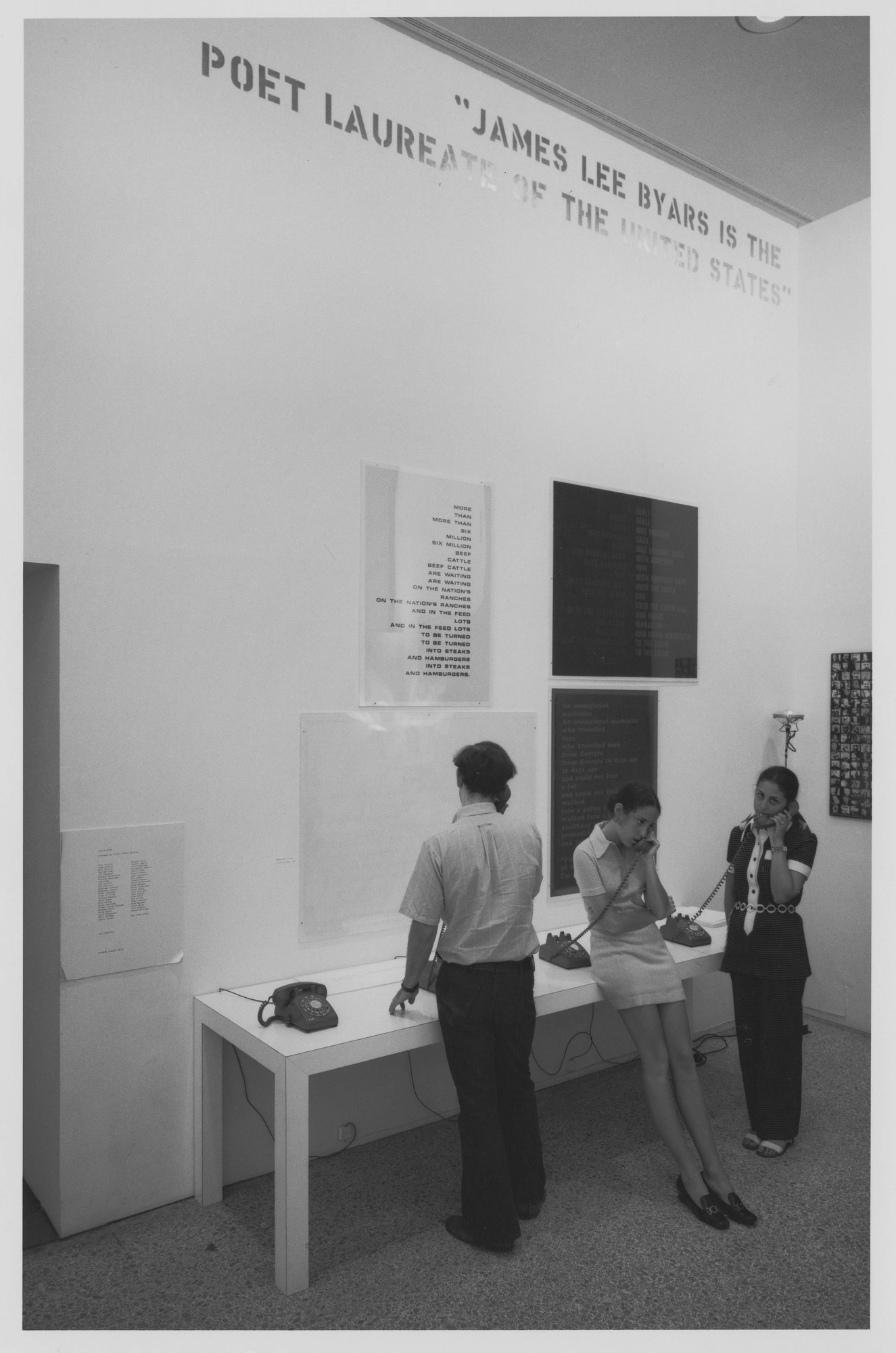
Image context: James Mathews's 1970 installation photograph shows the work doing what it was built to do. Three visitors listen separately through ordinary rotary handsets; the art is not a picture of communication but a live arrangement of bodies, machines, recorded voices, and choices. This is a documentary photograph of the actual MoMA installation, not a reconstruction or generated visual.[4][6]
Nobody in the photograph looks at the artwork.
One visitor faces the wall. Another leans against the long white telephone table, head tilted toward a receiver. A third stands at the end of the row, listening with her free arm folded across her body. They share a gallery but not a soundtrack. Above them, words have been stenciled near the ceiling; below, black rotary phones sit among typed lists and poems. The room looks less like a stage than a waiting area in which every call has become private.
John Giorno's Dial-A-Poem began in 1968 and took its first large public form at the Architectural League of New York in January 1969. Giorno and sound engineer Bob Bielecki assembled ten telephone lines and industrial answering machines. A caller could dial one advertised number at any hour and receive a recorded work, selected by the system from contributions by 35 poets, artists, and musicians.[2][3]
That description can make the project sound like a charming ancestor of an audio app. It was stranger and more exact. Dial-A-Poem divided agency between caller and machine: you decided when to enter, but the telephone decided whom you met. It took poetry out of the book without simply moving a reading onto radio. The network, the random encounter, the busy signal, the daily tape change, and the pressure of a handset against one listener's ear all became parts of the form.
A switchboard can be a composition
For MoMA's 1970 exhibition Information, the machinery was explicit. The museum's master checklist records twelve Centrex lines, twelve automatic answering sets, twelve jack connectors, and four telephones in the gallery. The same poems could also be reached from outside the museum through a public number. Giorno changed the program daily.[4]
The count matters because the piece did not reside in any single object. A gallery phone was only one entrance. The answering sets and tapes sat elsewhere; telephone switching joined a caller to one available line; publicity carried the number beyond the building. The work therefore occupied a distributed circuit whose parts did different jobs. An advertisement created expectation. A finger initiated the call. Network equipment made a selection. A taped voice delivered the encounter. Hanging up ended it.
This was composition by routing. Giorno did not determine the order in which one listener would hear a series of poems, because one call yielded one recording. Nor did the caller browse a visible catalogue. The project arranged a pool of voices and a rule for reaching them, then allowed thousands of individual sequences to form through repeated calls.[2][3]
Chance here was neither mystical nor free of design. Giorno chose contributors, recorded them, assigned tapes, refreshed the program, and built the technical conditions under which surprise could occur. The machine selected within an authored field. That distinction keeps Dial-A-Poem from collapsing into a novelty jukebox: randomness did not erase curation; it made curation arrive as an event.
The caller controlled the door, not the room
The interface offered an unusually precise bargain. Unlike radio, it did not require a listener to arrive at a scheduled hour. Unlike a record, it did not offer a track list, ownership, or a replay button. Unlike a poetry reading, it did not gather an audience around a visibly present performer. The caller controlled the beginning and could hang up, but could not command a particular voice.
Giorno understood redialing as part of the experience. If one selection bored a caller, the caller could disconnect and try again, possibly reaching John Cage, William S. Burroughs, John Ashbery, Bernadette Mayer, Anne Waldman, or another contributor.[3] Rejection did not sit outside the artwork as failed attention. It became a gesture the system anticipated.
That small asymmetry—choice of access, chance of content—gave the work its rhythm. Every ring promised abundance, while every connection narrowed that abundance to one voice. A busy signal narrowed it further to none. SFMOMA reports that more than one million calls reached for the original ten lines during a little over four months; Giorno Poetry Systems describes demand so intense after newspaper publicity that enormous numbers of callers met busy signals.[3][7]
Scale therefore produced both the project's triumph and its most revealing limit. The phone number made poetry available beyond the gallery, free at the point of listening, but the available circuits rationed that access. Popularity did not make the work frictionless. It made waiting, retrying, and failure audible. Long before digital platforms trained users to treat instantaneous retrieval as natural, Dial-A-Poem exposed access as something made from finite capacity.
A mass audience arrived one ear at a time
The telephone also changed what “public” meant. Giorno used a mass communications network, yet the final encounter was acoustically narrow. MoMA's account notes that callers listened at home or discreetly from offices. The receiver did not broadcast a poem into a shared room; it delivered a voice into the caller's immediate personal space.[2]
Mathews's photograph makes that paradox visible. Three people occupy the installation together, but each body closes around a separate line. Their gazes drift because the important action cannot be seen. The coiled cords keep them physically attached to a common table while the handsets construct three temporary listening rooms.[6]
This intimacy was not a soft decorative effect. It altered the authority of the recording. A disembodied voice on a loudspeaker addresses anyone within range. A telephone voice seems to answer you, even when it was taped months earlier and heard by thousands of other callers. The familiar etiquette of the call—lift, listen, respond or disconnect—made a stored performance feel like a present encounter.
The work exploited that sensation without pretending the exchange was mutual. The poet could not hear the caller. The caller could not speak back through the recording. Dial-A-Poem occupied the charged space between conversation and broadcast: technologically one-way, psychologically addressed.
The archive was an argument, not a neutral library
What came through the line unsettled the category promised by the title. The 1970 MoMA press release grouped the roughly two-minute selections under found, Black, New York School, chance, and pop poetry. Giorno Poetry Systems records an even wider field that included Buddhist mantras, political speeches, and an excerpt from Cage's 4′33″, alongside poems in more familiar forms.[3][5]
Placing those recordings behind the same number did not claim that every contribution sounded alike. It claimed that the distribution system could make them neighbors. A Black Panther speech, an experimental poem, a mantra, and a conceptual silence entered one changeable program. Giorno described the total work as a collage made from other poets, revised from day to day.[5]
That curatorial act was political in two linked senses. First, the roster admitted voices and kinds of speech that conventional literary publishing or polite broadcast channels could exclude. By 1970 the program included antiwar activists and members of the Black Panther Party, as well as poets associated with experimental New York scenes.[1][3][7] Second, the work used the ordinary telephone network—the infrastructure of routine business and domestic life—as its carrier. Radical content did not require the caller to find a specialist bookshop or enter an avant-garde venue. It could arrive through the same object used to call work, family, or the weather.
MoMA's contemporary press release made the larger exhibition logic plain. Curator Kynaston McShine described artists looking toward communications media because they wanted to reach audiences larger than the established contemporary-art public.[5] In Information, that ambition appeared alongside ballots, mail, news material, documentation, and other works that treated the movement of information as a subject and a medium.[6] Dial-A-Poem was unusually literal: it did not represent circulation. It circulated.
Yet the system was not independent of the powers it repurposed. It depended on corporate phone infrastructure, working lines, charges, publicity, maintained machines, and continual recording labor.[2][3] Its apparent simplicity at the receiver was achieved by displacing complexity backstage. That is one reason the 1970 photograph remains valuable: the neat row of phones is only the visible edge of a cumbersome apparatus.
The machine changed; the encounter survived
When Giorno returned to Dial-A-Poem in 2012, he and Bielecki condensed the system. A rotary-phone edition held 200 digitized recordings by 80 poets in a sound-file player inside each telephone. Picking up the handset still triggered a randomly delivered poem, but a live bank of external answering machines was no longer necessary.[1][3]
MoMA now dates its collection work 1968/2012 and preserves four telephones alongside original answering machinery, reel-to-reel recorders, a microphone, and printed and handwritten ephemera.[1] That inventory treats Dial-A-Poem as both an experience that can be activated and a technological history that must be remembered. The computer inside a later phone can reproduce the encounter; the old machines explain what the encounter once cost to make.
The update also clarifies which features Giorno considered durable. The storage medium could move from reel-to-reel tape and answering set to digital files. The interface could remain an ordinary telephone. Most importantly, the listener still initiated contact without choosing the result. The machine still answered with somebody else's voice.
Something was lost in that condensation. The original hotline could meet a caller wherever a telephone was available, while a self-contained museum phone returns the experience to a designated object in a designated place. The later sculpture preserves random access and intimate listening but cannot fully recreate the geography, congestion, billing, or remote reach of the 1969–70 network. This is not a flaw in the edition so much as evidence that media artworks have more than one kind of identity: hardware can be rebuilt, an interaction can be restaged, but an infrastructure belongs to its historical moment.
Look again at the photograph. There is no heroic machine, only a table, cords, printed sheets, and people listening. The technological achievement hides behind an almost banal gesture. That banality is the work's sharpest decision. Giorno made the telephone into an art medium without asking it to stop looking like a telephone.
Dial-A-Poem did not merely deliver poems more efficiently. It composed distribution itself: who could enter, what they could choose, what remained withheld, how a public became a succession of private listeners, and how a voice could feel personally present while traveling through a mass system. You placed the call. The artwork chose who answered.
Sources
- The Museum of Modern Art, “John Giorno: Dial-A-Poem, 1968/2012” — official collection record with medium, component inventory, edition metadata, and curatorial account.
- Erica Papernik-Shimizu, “The Revolutionary Phone Line That Expanded Poetry's Reach,” MoMA Magazine (April 14, 2023) — curatorial history of the hotline, its network setting, listening intimacy, and later forms.
- Giorno Poetry Systems, “Dial-A-Poem: History” — the artist's foundation on the 1969 apparatus, contributors, random playback, demand, political range, and 2012 update.
- The Museum of Modern Art, Information master checklist (1970), pp. 8–9 — primary exhibition record specifying twelve Centrex lines, answering sets, jack connectors, four gallery phones, public access, and daily program changes.
- The Museum of Modern Art, “Giorno Dial-a-Poem,” press release no. 69-A (July 21, 1970) — contemporary account of the program, selection categories, listening format, and Giorno's collage concept.
- The Museum of Modern Art Archives, “Information Streams,” MoMA through Time — exhibition context and provenance for James Mathews's 1970 installation photograph, IN934.10.
- Gillian Edevane, “John Giorno's Dial-a-Poem Still Brings Poetry to the Masses,” SFMOMA (July 2020) — museum account of the 1969 launch, call volume, political recordings, and collection afterlife.