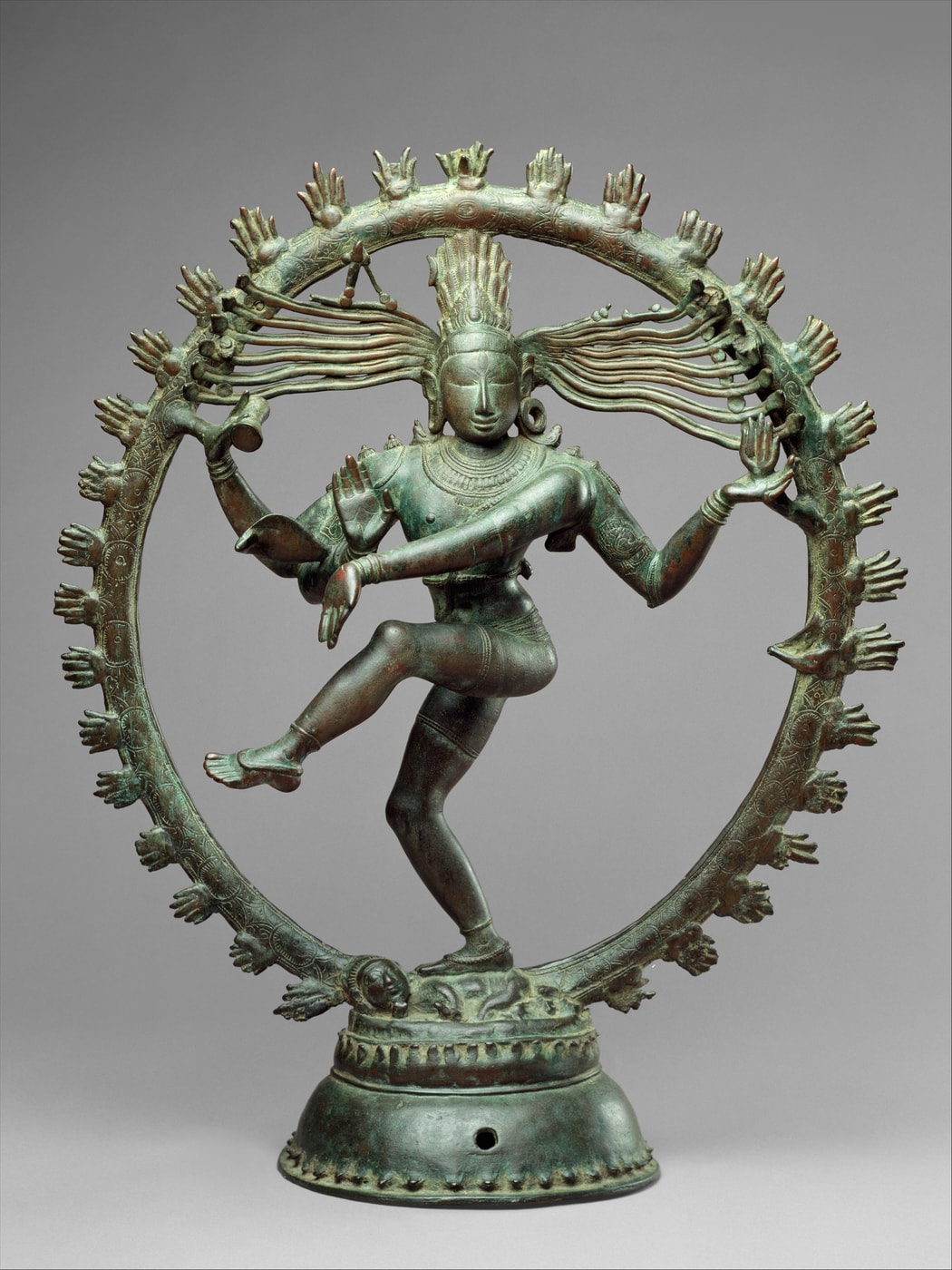
Everything around Shiva's face seems to be moving. Hair spreads sideways, arms reach into the surrounding space, and a lifted leg crosses the body. Small tongues of flame prick the outer ring. Yet the face remains composed. The more insistently the sculpture sends the eye outward, the more remarkable that quiet center becomes.
This Shiva as Lord of Dance, or Nataraja, belongs to the Metropolitan Museum of Art. Made in Tamil Nadu during the Chola period, around the late eleventh century, the copper-alloy figure stands 68.3 centimeters high.[1] Its scale allows an intimate encounter with an image whose subject is the activity of the universe.
The contrast between the spreading movement and the settled expression offers a way into the work. Follow it long enough and the dance becomes more than a display of divine energy: it addresses the person standing before it.
The circle keeps the movement in view
The flaming ring gives the figure a continuous boundary. Within it, the spaces between arms, legs and hair remain open. Those gaps matter as much as the metal. They let each gesture stay legible, even as the limbs overlap and pull attention in different directions.
Look at the hair beside the head. Its lateral spread makes a broad interruption across the upper part of the circle. Below, the lifted leg produces another strong crossing. Between these movements, the torso bends through a narrower passage. The composition can feel expansive and gathered at once: each outward reach has a return route toward the body.
The face offers a different pace of looking. After tracing the sharp flames and long limbs, the eye arrives at a compact area where comparatively little seems to happen. I read that restraint as essential to the sculpture's force. A grimace of effort would make the dance look like an ordeal. Here, the face lets its immense activity seem sustained without strain.
Four hands, one encounter
The hands make the dance's meaning specific. In Shiva's upper right hand is the damaru, the drum associated with the first sound of creation; in the upper left is the fire of destruction. His front right palm offers protection from fear. The front left hand directs attention toward the raised left foot, a place of refuge. Beneath the planted right foot lies the small figure of apasmara, embodying illusion or ignorance.[1]
These meanings unfold through the placement of the limbs. Creation and destruction occupy opposite sides of the figure, available to the eye together. The nearer hands bring that immense pairing into a more personal register. One faces outward toward the viewer; the other redirects the gaze down through the sculpture.
Art historian Vidya Dehejia explains that hand gestures, or mudras, communicate the meaning of divine images. The raised, outward-facing palm is abhaya, the gesture of protection.[2] Knowing this changes the encounter with the open hand. Its stillness becomes an address. It offers reassurance inside a composition that also contains fire.
The two feet intensify the distinction. One bears down; the other is free of the ground. The eye can follow the downward hand toward the lifted foot and then notice the pressure beneath the supporting leg. In that short passage, the sculpture joins release to the overcoming of ignorance. The asymmetry gives the viewer a sequence to follow without breaking the unity of the dance.
A cosmic dance with an earthly place
The image also belongs to a particular religious and political landscape. The Smithsonian's account locates Nataraja's sacred dance at Chidambaram, a temple city in the Tamil region. For the Cholas, this was Shiva's earthly home and the site of his dance of bliss. Shiva held a central place in royal authority, and Nataraja became closely associated with Chola power.[3]
That setting gives the circle a history as well as a cosmic meaning. The form emerged within relationships among rulers, temples and worshippers. Its apparent completeness should not tempt us to treat it as a universal symbol detached from those relationships.
Chidambaram supplies context for Nataraja's significance; it does not establish the original location of this particular bronze. The sources used here do not identify the Met sculpture's first temple. Keeping that limit clear leaves room to understand the tradition without inventing a journey for the object.
When the image went outside
A museum photograph makes the sculpture available for unusually patient inspection. It also removes much of the setting in which images of this kind were encountered. The Smithsonian describes Chola bronzes as portable embodiments of deities, carried out of temples during rituals and festivals. They could be dressed in silk and adorned with jewelry and flowers.[4]
Imagine the consequences for looking. Fabric and garlands would change the visible outline. Carrying the image would give literal movement to a body already represented in motion. The clear gaps that are so easy to study in the photograph belonged to an object that could be encountered amid other materials, other bodies and changing light. This is a way to think about the tradition, rather than a reconstruction of a documented procession involving this bronze.
Processions also extended the opportunity for darshan, seeing and being seen by the deity, beyond restricted temple interiors.[4] The Smithsonian's discussion of worship emphasizes the eyes as a point of direct contact between devotee and deity, within rituals engaging sound, scent, touch and light.[5]
That context brings us back to the face with a different understanding of its quiet. In a formal reading, it steadies the composition. In a devotional encounter, looking also involves the possibility of being seen. The outward-facing palm and the composed features belong to that relationship.
Return to the photograph and follow the long sweep of the limbs once more. The sculpture allows the eye to travel almost everywhere before returning it to the head. The fire remains; so does the open hand. Its reassurance has meaning because the dance continues.
Sources
- The Metropolitan Museum of Art, “Shiva as Lord of Dance (Nataraja),” accession 1987.80.1 — object identification, dating, dimensions, iconography and collection photograph.
- Vidya Dehejia, “Recognizing the Gods,” The Metropolitan Museum of Art, February 2007 — hand gestures and the meaning of the protective outward-facing palm.
- Smithsonian National Museum of Asian Art, “The Origins of Shiva Nataraja” — Chidambaram, the dance of bliss and the image's association with Chola authority.
- Smithsonian National Museum of Asian Art, “Processional Images” — portable bronzes, adornment, access to temple images and darshan.
- Smithsonian National Museum of Asian Art, “Hindu Belief & Practice” — sensory worship and the importance of visual contact with the deity's eyes.