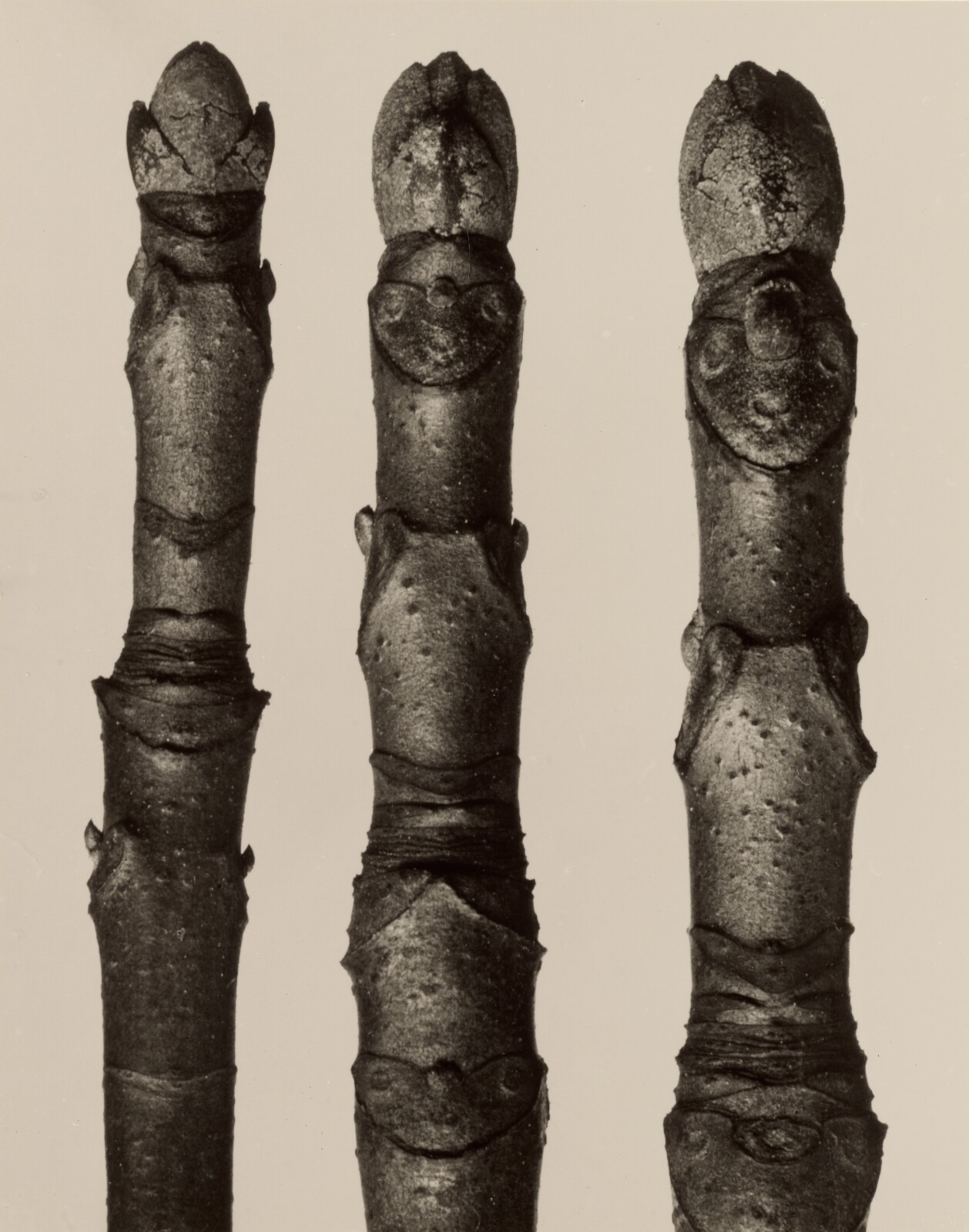
Three shoots stand upright against an empty background. They are close enough to form a group, separate enough to be inspected one at a time. Their stems look weighty; their buds have the compactness of carved finials. Before the title identifies a plant, Karl Blossfeldt’s Aesculus parviflora offers something like a small gathering of sculptures.[1]
The photograph’s pleasure lies in that hesitation. We can recognize plant matter and still feel that we are looking at objects made for display. Blossfeldt has given these fragments an audience, an orderly space, and time to hold our attention. The Getty dates the gelatin silver print reproduced here to 1928, the year his first book, Urformen der Kunst (Art Forms in Nature), appeared.[1][2]
A row that rewards comparison
Begin with the gaps. Each shoot has a little room around it, so the background becomes a means of separating forms. We can follow a contour without losing it among leaves or neighboring branches. There is no view into a garden, no weather, no horizon. The image asks us to move across the row and compare.
That movement changes what we notice. At first the three upright forms seem to repeat a single idea: stem, swelling, tip. Then the differences begin to matter. The left shoot is comparatively slender, its pointed bud rising highest. A deep vertical seam divides the central bud; the one at the right appears fuller and tilts away from the row’s strict upright rhythm. Lower down, dark bands encircle the stems like collars. Oval patches and tiny pits interrupt their surfaces. Repetition supplies a common measure against which each specimen becomes particular.
The lower edge contributes to their strange authority. The stems continue beyond the frame, withholding their points of support. They seem to rise into view rather than rest on a tabletop. At the same time, the surrounding blankness makes their isolation unmistakable. This is a presentation, and its restraint helps us forget how decisively it has been arranged.
I read their monumentality as an effect of proportion within the picture. The shoots occupy enough of the frame for small ridges and overlapping surfaces to demand sustained attention. A tiny plant part can look massive when there is nothing familiar beside it to restore ordinary scale. We know what it is before we recover how small it might be.
A classroom behind the camera
Blossfeldt’s interest in such forms grew out of teaching. Trained as a sculptor, he worked with Moritz Meurer, who investigated relationships between natural forms and art. From 1898 to 1930 Blossfeldt taught in Berlin, accumulating plant photographs as models for his students. His camera became a tool for bringing small structures within reach of close study.[2]
Photography also answered a practical problem. Hanako Murata’s study for MoMA explains that fresh specimens were difficult to gather and liable to wither. Photographs preserved forms that would otherwise disappear before they could be used again in a classroom.[3] The stillness of this row therefore has a history of usefulness. A student could return to the same edge or swelling, compare it with another, and work from it at a convenient scale.
That purpose gives the image a different character from a passing encounter outdoors. Blossfeldt makes attention repeatable. The plant’s setting has fallen away, while the information useful to an artist studying form has become unusually conspicuous. The photograph offers a lesson through its arrangement before anyone supplies an explanation.
There is a limit to the lesson. Similarity between a bud and an architectural ornament can be a productive way of looking; the resemblance alone does not establish where a particular human design originated. The picture encourages us to discover connections. Its precision can make those connections feel inevitable even while our own visual memory is helping to produce them.
Precision has a maker
The smooth background and clear contours might suggest that Blossfeldt simply put a specimen before a camera and let it speak. Conservation research makes that impression more interesting. Murata documents adjustments to negatives and prints, including chemical treatment, pencil, and brushwork. Background blemishes could be removed and plant edges reinforced. The consistent appearance of the finished photographs depended on decisions throughout their making.[3]
Those findings concern the material examined in her study; they do not establish which interventions, if any, occur on the Getty print shown here. They do establish why we should be cautious about equating a precise photographic style with an untouched image.[3]
Even without attributing any retouching to this object, we can see the composition doing its work. The empty field removes competing claims on our attention. The upright arrangement turns fragments into a group. The tonal differences make surfaces readable. The photograph’s apparent simplicity is full of choices about what a viewer should be able to see.
A photograph becomes a page
The image also exists as a photogravure in Urformen der Kunst. The National Gallery of Art catalogs that 1928 impression as part of the portfolio, with an image measuring 26 by 19 centimeters.[4] It is a different physical object from the Getty’s gelatin silver print. A shared composition can travel through distinct materials and settings, each giving the encounter a different scale and rhythm.
Publication expanded the classroom’s reach. Gallerist Karl Nierendorf exhibited Blossfeldt’s photographs in 1926 and helped bring the first book into print two years later. By 1929 the work appeared in major photographic exhibitions, including Film und Foto.[2] Images developed for the study of natural form had acquired a place in discussions of modern photography.
Return to the three shoots after that history, and their arrangement feels newly generous. It gives an ordinary fragment the space usually reserved for something precious. Yet the longer we look, the less interchangeable the specimens become. Their shared posture draws us in; their small irregularities keep us there. Blossfeldt’s lesson survives in that movement of attention, from the commanding row to the stubbornly individual plant.
Sources
- The J. Paul Getty Museum, “Aesculus parviflora,” 1928, accession 84.XM.142.8, on Google Arts & Culture — identification, medium, date, and museum image.
- Mitra Abbaspour, “Karl Blossfeldt,” MoMA, Object:Photo, 2014 — sculptural training, teaching, publication, and exhibition history.
- Hanako Murata, “Material Forms in Nature: The Photographs of Karl Blossfeldt,” MoMA, Object:Photo, 2014, pp. 1–5 — classroom origins and examination of negatives, prints, and retouching.
- National Gallery of Art, “Aesculus parviflora,” 1928, accession 2006.133.34.13 — the photogravure impression in Urformen der Kunst, its medium and dimensions.