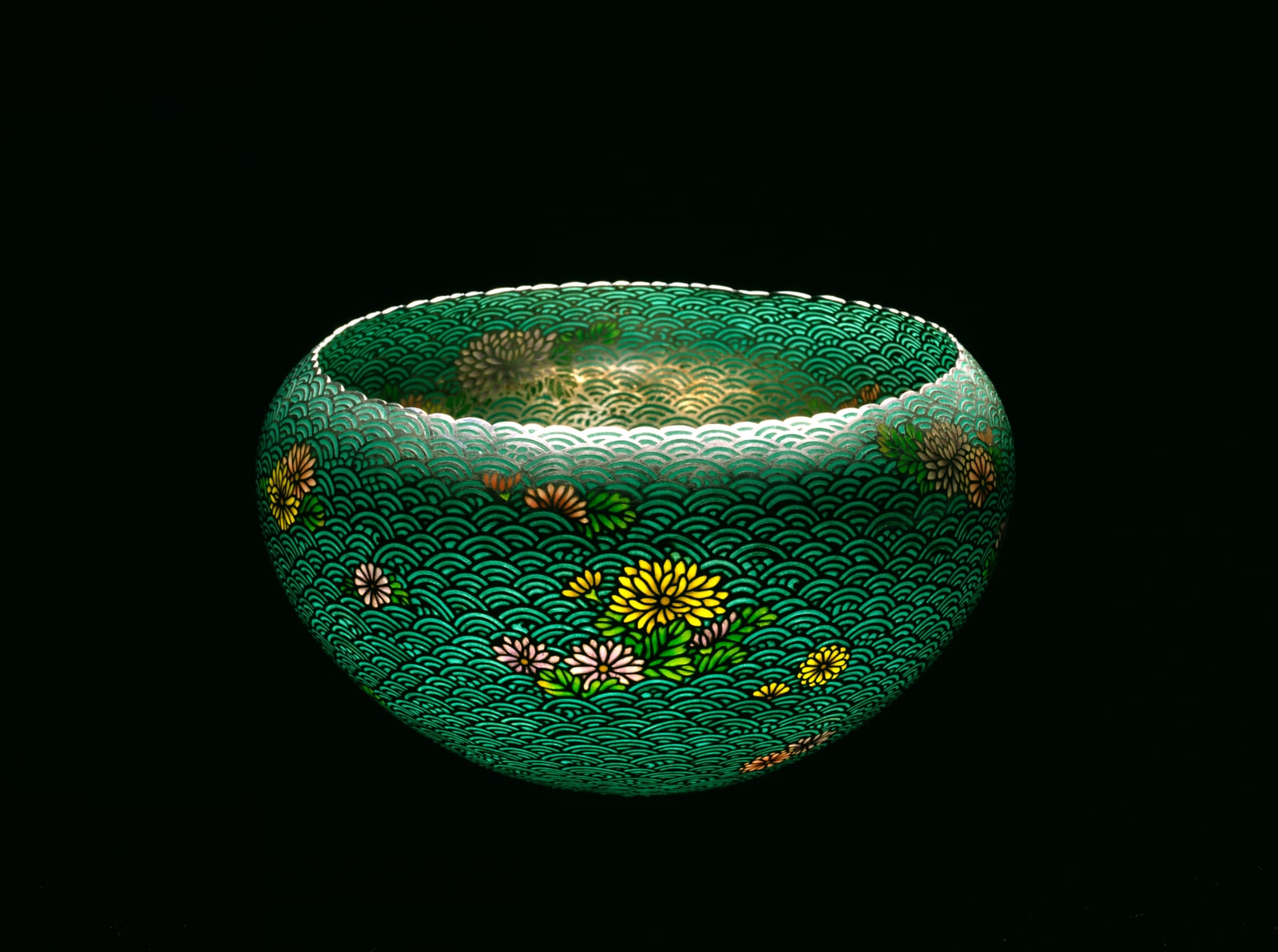
Chrysanthemums float across the rounded sides of Namikawa Sōsuke's Bowl with Chrysanthemum Blossoms. Yellow, pink and purple flowers interrupt green foliage and curling waves. Made around 1900, the silver-and-enamel bowl is only 20.8 centimeters across, yet its decoration suggests water continuing beyond the rim. The Walters Art Museum records its purchase by Henry Walters at the Paris exposition of 1900.[1]
The unexpected feature is a path through its walls. Light can pass through the colored enamel, making the flowers luminous.[1] This is plique-à-jour: enamel held within a metal framework without a permanent backing behind the translucent cells. The V&A loosely translates the name as “letting in daylight.”[2] For the maker, that inviting phrase contains a difficult question. How do you build a colored surface whose finished effect depends on leaving its back open?
A support that can leave
Many enamel techniques begin with a metal surface that remains underneath the glass. In cloisonné, wire partitions attached to that surface define the colored areas. Plique-à-jour preserves the small compartments but opens a route for light through them.[2] The distinction matters more than whether an object has bright colors or a delicate network of lines.
One solution is to supply a backing during manufacture and remove it afterward. The Gemological Institute of America's account describes powdered enamel placed in cells supported by copper foil or a similar metal. Once the enamel has been fired, the backing is detached or dissolved.[3] Something essential to making the object is deliberately absent from the result.
That sequence changes how to look at a finished piece. A translucent petal can seem effortless, as if color had simply settled between its outlines. Behind that appearance lies a separation of jobs: the temporary support helps the material reach its finished state; the surviving framework holds and defines it afterward. The missing metal is part of the achievement.
This is an account of one route to plique-à-jour, not a reconstruction of Sōsuke's workshop procedure. The Walters catalogue establishes the bowl's materials, appearance and history, but does not describe its complete manufacturing sequence.[1] Looking closely can reveal the open-backed effect; it cannot, by itself, recover every step that produced it.
A surface suspended between edges
Another route makes the problem of suspension especially clear. The Toledo Museum of Art describes it through André Fernand Thesmar's Bowl with Anemones, dated 1900. This much smaller vessel, 9.1 centimeters in diameter, has a gold filigree framework and translucent enamel.[4]
According to the museum, the framework is shaped and assembled on an iron form. Its openings receive ground glass mixed into a glue-like medium. Surface tension holds the liquid mixture across the spaces, which the museum compares to the behavior of soap bubbles. Firing then produces the solid enamel.[4] The comparison helps explain the precarious intermediate state: before there is a finished wall, material has to stay suspended between its boundaries.
Toledo also notes the skill involved in producing shading and several colors within a single compartment.[4] This is an important freedom. The metal outline need not dictate one flat patch of color. A maker can work within a cell as well as around it, giving a small flower more variation than its enclosing geometry might suggest.
The two methods make different arrangements for support. Both end with glass occupying spaces through which light can travel. Knowing the difference prevents a tempting mistake: assuming that every open-backed enamel must once have had a metal sheet peeled away from it.
Where the light comes from
Transparency also makes display part of the experience. The Alliance for Metal Clay Arts Worldwide points out that an enamel brooch or pendant resting against the body cannot reveal transmitted light in the same way as a form with open space behind it. It also stresses careful planning of the openings, since poorly conceived structures can lead to cracking.[5] The airy effect has practical conditions.
For a viewer, this suggests a more attentive way of looking. Follow the metal boundaries first, then consider the light reaching the colored cells. A dark area does not necessarily mean dark enamel: what lies behind the object, and where illumination enters, also matters. The V&A describes plique-à-jour's glow changing with the strength of the light.[2] A photograph records one arrangement of those conditions.
Return to Sōsuke's bowl with that limitation in mind. Its flower-and-wave pattern can be enjoyed as a continuous image, but the technique invites a second reading, cell by cell. Each opening makes a small negotiation between support and transparency. The bowl keeps its curved outline while allowing daylight to enter the decoration. Its delicacy becomes more compelling once we understand what had to hold together for that passage to remain open.
Sources
- The Walters Art Museum, Namikawa Sōsuke, “Bowl with Chrysanthemum Blossoms,” about 1900, accession 44.546 — materials, dimensions, imagery and acquisition history.
- Victoria and Albert Museum, “A guide to metalworking techniques” — cloisonné and plique-à-jour sections, including the open backing and changing light.
- Gemological Institute of America, “The Art of Enameling: The Techniques,” January 14, 2015 — temporary metal backing and its removal after firing.
- Toledo Museum of Art, André Fernand Thesmar, “Bowl with Anemones,” 1900, accession 2005.43 — gold framework, surface tension and color variation within cells.
- Alliance for Metal Clay Arts Worldwide, “Using Enamel,” January 12, 2021 — plique-à-jour design constraints and the effect of an object's placement on transmitted light.
- Wikimedia Commons, “Namikawa Sosuke — Bowl with Chrysanthemum Blossoms — Walters 44546 — Profile” — Walters Art Museum photograph and matching object identification.