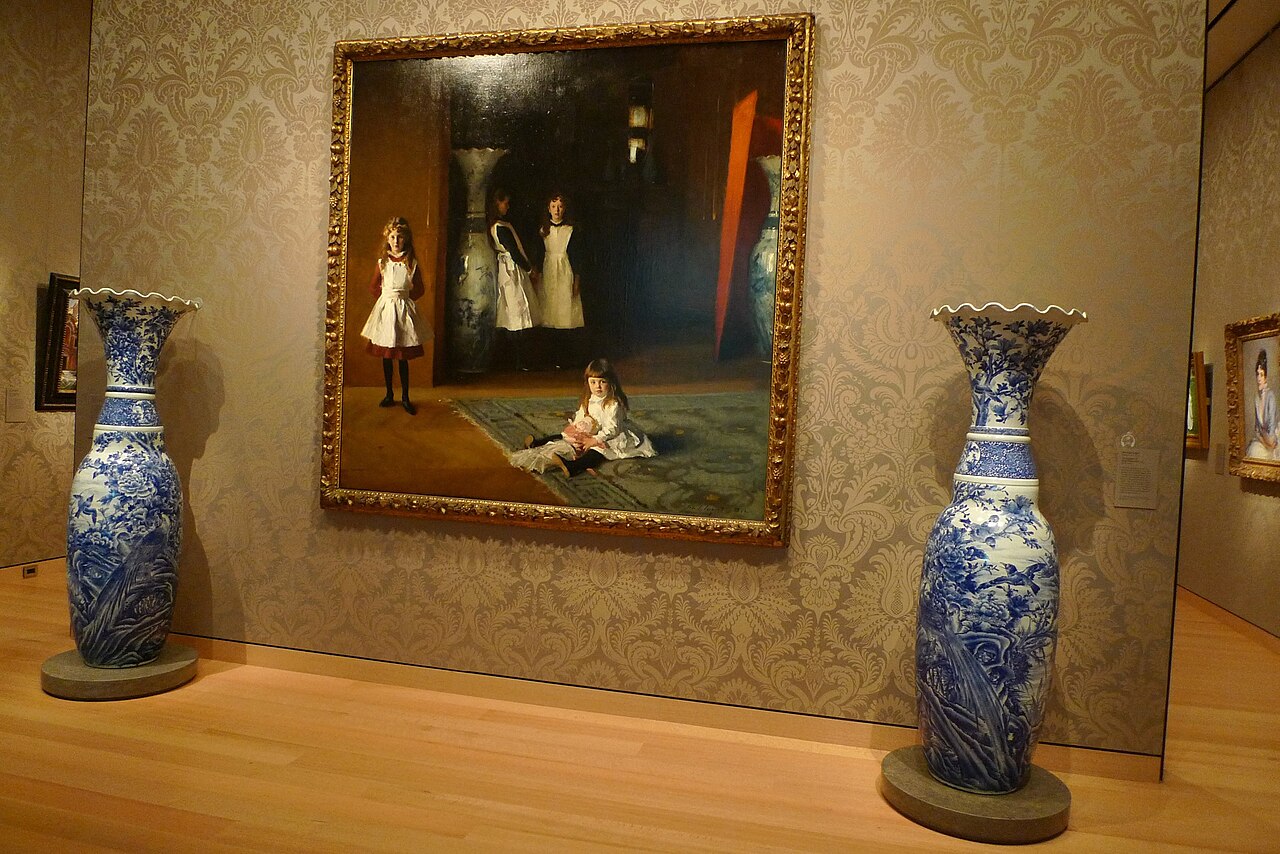
John Singer Sargent's The Daughters of Edward Darley Boit begins like a portrait commission and then quietly refuses to behave like one. Four sisters are present. Their family name is in the title. The painting was made in 1882, in oil on canvas, and the MFA shop record gives its imposing near-square scale: 87 3/8 by 87 5/8 inches.[2] Yet the first thing the picture asks the viewer to study is not a face. It is the space between faces.
That empty middle is the painting's engine. Sargent could have lined up Mary Louisa, Florence, Jane, and Julia as a prosperous expatriate family wanted to be remembered: coherent, legible, socially settled. Instead, he lets the foyer swallow the usual portrait logic. One child sits forward in bright white. One stands at the right edge, half independent and half stranded. Two older girls recede into the back of the room, where their white pinafores catch light but their features begin to dissolve. The result is not a family arranged for inspection. It is a family dispersed across thresholds.
The cover photograph matters because it shows the painting with two tall blue-and-white vases standing beside it in the MFA gallery.[1] They are not incidental props in the museum room. They repeat the strange scale play inside the painting, where vessels nearly rival children as presences. Sargent makes the girls visible by making them compete with things, doorways, darkness, and the ceremonial hush of a foyer. That is why the picture feels less like a record of childhood than like childhood being absorbed by a house.
A Portrait That Won't Gather
The first test of a group portrait is usually cohesion: who belongs to whom, who claims the center, how the sitters produce a shared social fact. Sargent breaks that test almost immediately. The youngest child, Julia, is closest to us and most available, but she is not enough to unify the canvas. Her black shoes, white pinafore, and seated pose give the foreground a point of entry. Still, she does not pull the others toward her.
The right-hand sister stands near a vertical edge, framed by dark space and a glowing garment. She has the authority of a portrait subject but not the comfort of a family participant. Behind her, the two older girls occupy a different pictorial climate. One stands almost like a pale column. The other is tucked into the far darkness, present but withheld. Sargent lets their separation do the psychological work that gesture usually does.
This is why the empty center is not merely modern composition. It is a social fact made visible. The space does not simply open the painting; it interrupts the family. If a conventional portrait says, "Here we are," Sargent's painting says, "Here are four conditions of being seen." The sisters share a room, clothing type, family name, and commission, but not a common emotional surface.
The Vases Are Almost People
The two monumental vases are the painting's most unsettling companions. The Smithsonian American Art Museum summary of Erica Hirshler's lecture notes Hirshler's phrase "four girls and five vases," counting the two six-foot Japanese vases and three more in the dim background.[4] The phrase is funny because it is true: the objects do not stay safely in the background of family life. They stand, watch, flank, and measure.
That object pressure changes the girls. The children do not dominate the room; they are scaled against it. In the gallery photograph, the actual vases beside the painting make the effect more literal.[1] They turn the museum wall into an extension of the pictured foyer, so that the viewer understands how hard it is to separate the portrait from the household display system around it.
The vases also complicate age. In a child portrait, adults often disappear so children can become the subject. Here, adult taste remains everywhere: imported ceramics, dark thresholds, polished interiors, the family apartment as stage. The girls are young, but the room is old with collecting, money, and inherited social codes. Sargent lets childhood sit inside that apparatus without sentimental rescue.
White Paint, Dark Room
The white dresses are Sargent's most brilliant trap. They promise innocence and visibility, then prove that visibility is uneven. The forward child is lit enough to seem reachable. The standing sister at right gleams against shadow. The two girls in back show how white can fail to clarify. Their clothing catches the light, but their bodies withdraw into the room's deeper register.
This is where Sargent's virtuosity becomes more than bravura. The painting is full of painterly confidence, but the confidence is used to produce uncertainty. White paint does not flatten the sisters into matching decorative units. It tests how different white becomes when it sits on the floor, turns near a doorway, passes into shadow, or becomes a distant vertical flash.
The room's darkness is just as active. It is not a theatrical backdrop placed behind the girls to dramatize them. It is a competing subject. It gives the painting its emotional temperature: quiet, ceremonial, slightly unreachable. The darkness does not threaten the children in any melodramatic sense. It does something subtler. It makes them partial.
Velazquez Without A Court
Hirshler's MFA publication page describes the painting as crossing boundaries between portrait and genre scene, formal arrangement and casual snapshot.[3] That boundary-crossing is why the painting can look both official and interrupted. It is a commissioned family portrait, but it does not present a polished family performance. It is an interior scene, but no ordinary household episode unfolds.
Sargent's relation to Velazquez helps explain the tension. The Smithsonian account of Hirshler's lecture points to Las Meninas as a crucial old-master source and notes that Sargent drew from old masters, Japanese prints, and photography rather than from one neat lineage.[4] The comparison is useful only if it stays precise. Sargent does not simply borrow a dark room and a child at the center. He borrows the idea that looking can become the subject of the picture.
In Las Meninas, court hierarchy, painter, mirror, princess, attendants, and viewer lock into a dazzling system of attention. In Sargent's painting, the system loosens. There is no sovereign center. There is no court machinery to explain why the child matters. There is only a family foyer and four girls arranged so that each one seems to have a different relationship to being looked at.
That looseness is the modern part. The picture keeps the scale and ambition of grand portraiture while letting ordinary family psychology remain unresolved. Sargent does not translate the Boit sisters into allegory. He lets them stay awkwardly, beautifully particular.
The Gift And The Mystery
The painting's later history has a neat institutional ending: the MFA shop record identifies it as a gift of Mary Louisa, Julia, Jane, and Florence Boit in memory of their father, Edward Darley Boit.[2] The Smithsonian account adds the charming summary that the girls first lent the work to the MFA and later gave it to the museum.[4] But the painting itself resists a neat family ending.
That resistance is not gossip about the sisters' lives. It is a formal fact. Sargent gives us no easy answer about whether the room protects the children, isolates them, dignifies them, or turns them into family possessions. The painting's force lies in how many of those readings remain available at once.
The smallest child looks outward. The older girls drift inward. The vases stand with almost comic solemnity. The empty center keeps refusing to fill. Sargent's achievement is not that he made a child portrait mysterious by withholding information. It is that he made mystery out of visible arrangement: scale, spacing, light, object, edge, and depth.
The painting still feels alive because it does not solve childhood into charm. It lets childhood be public and private, staged and accidental, cherished and unreadable. Sargent made a family portrait around an empty center, and the center remains empty because the painting's deepest subject is not what the Boit sisters looked like. It is how difficult it is for any portrait to gather four separate lives into one room and call that unity.
Sources
- Wikimedia Commons, "File: John Singer Sargent's Daughters of Edward Darley Boit (5522944301).jpg" - real gallery photograph used for the cover image, with file metadata, date, source, author, and license notes.
- MFA Boston Shop, "Sargent The Daughters of Edward Darley Boit" - museum product/object page with medium, dimensions, credit line, accession number, and collection attribution.
- Museum of Fine Arts, Boston, "Sargent's Daughters: The Biography of a Painting" - MFA Publications page for Erica E. Hirshler's study, including the book's scope and summary of the painting's boundary-crossing form.
- Smithsonian American Art Museum, "Erica Hirshler: Looking at John Singer Sargent" (September 30, 2010) - lecture summary with object details, Boit family context, vase discussion, Velazquez reference, and acquisition note.