Do Ho Suh's fabric architecture looks weightless only until you start naming what has been copied. The walls are translucent. The colors can be almost candy-bright. The rooms fold toward drawing, ghost, garment, and stage set. But the technique is exacting: corridors, staircases, door handles, switches, radiators, intercoms, and outlets are measured, sewn, mapped, suspended, and made walkable. The surprise is not that architecture can become soft. The surprise is that softness can keep so much architectural information.
That is why Suh's medium matters. The Smithsonian American Art Museum describes his "fabric architecture" as immersive architectural installation made from ethereal fabric, tied to memory, migration, identity, and home.[1] Tate's 2025 Walk the House exhibition likewise frames the viewer's experience as moving through passages and thresholds rather than simply looking at sculpture from outside.[2] Suh's work asks a technical question with emotional consequences: what has to be preserved for a room to remain a room after it has lost its mass?
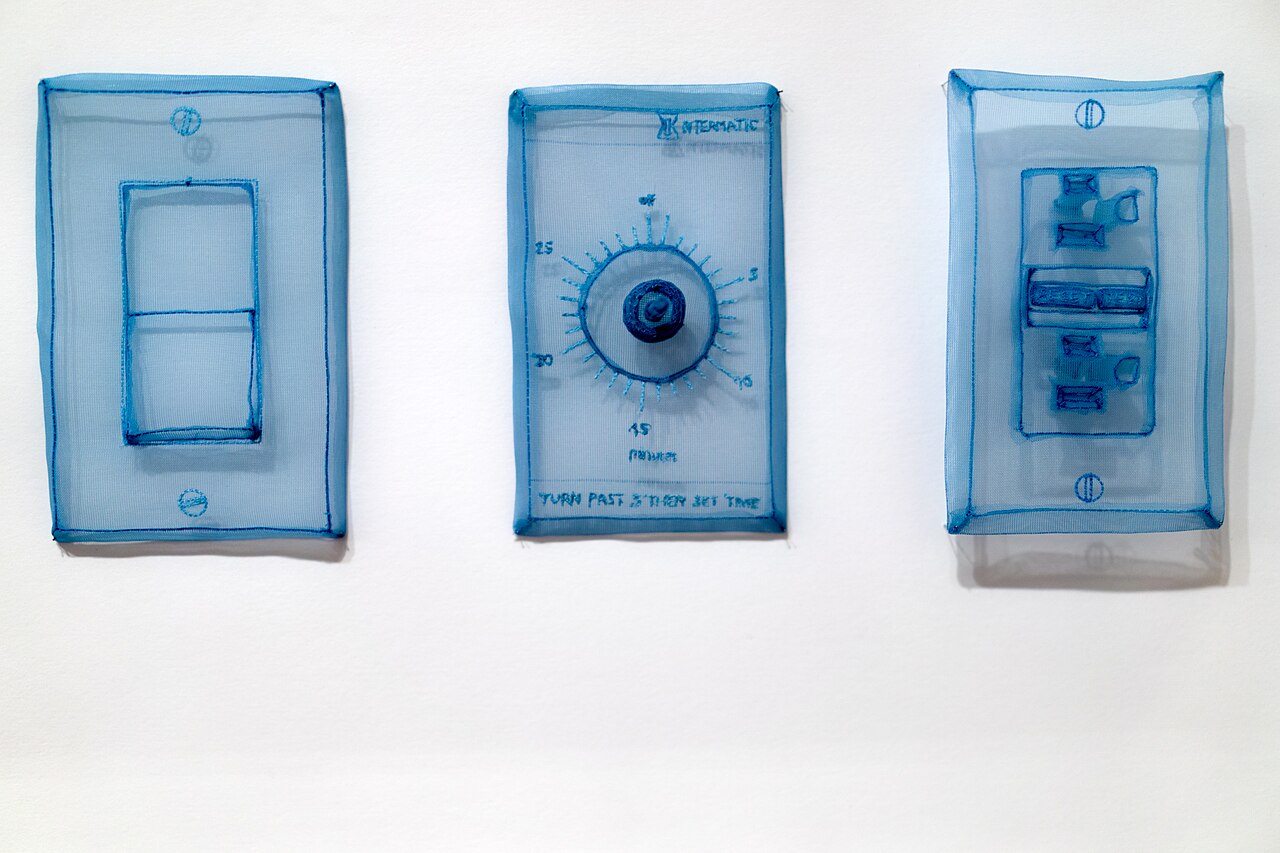
The cover image gives the method away at the scale of the hand. Three blue fabric controls hang on a white wall: a light switch, a timer-like dial, and an outlet. They are not useful appliances. They are not abstract symbols either. They sit in the narrow middle where memory usually lives, in the daily choreography of pressing, turning, plugging in, waiting, reaching without looking. The photograph is a close-up of pieces made by Suh, identified on Wikimedia Commons as sewn fabric details photographed by Lorie Shaull in March 2018.[5] It is a small image for a large body of work, but it is the right image because Suh's rooms depend on this kind of fidelity.
The Building Becomes A Skin
Suh's fabric rooms do not reproduce architecture as structure. They reproduce architecture as skin. That distinction explains much of their emotional force. A conventional architectural model usually miniaturizes the building and keeps its geometry. Suh often keeps the scale of the lived environment while changing its substance. His domestic spaces can be entered, but they do not protect, conceal, or bear weight in the ordinary sense. They make the shell of a home visible as a membrane.
The Smithsonian's account of Almost Home says the works combine traditional Korean sewing techniques with 3-D modeling and mapping technologies, and notes Suh's phrase "suitcase homes" for works light enough to be installed almost anywhere.[1] That phrase can sound charming, but it is also a precise technical proposition. A house normally defeats portability. It is fixed by foundation, utility lines, land, law, money, and neighborhood. Suh's fabric method separates the recognizable interior from those heavy systems and lets the room travel as an afterimage.
This does not make the work nostalgic in a simple way. Nostalgia often smooths the past into atmosphere. Suh's technique does the opposite. It keeps the awkward bits: junction boxes, hinges, seams, railings, vents, built-in cabinets, control panels. The more banal the feature, the more convincing the memory. A doorway is an obvious threshold; a thermostat is a better test. If the thermostat survives the translation into fabric, the room is no longer being remembered as a postcard. It is being remembered as a set of repeated bodily negotiations.
Art21's interview on Seoul Home/L.A. Home/New York Home/Baltimore Home/London Home/Seattle Home is useful because Suh discusses place as something formed through displacement and training, not as a stable origin story.[3] The title itself keeps adding addresses, as if home were a sentence that refuses to end. In that context, fabric is not a decorative alternative to steel, wood, plaster, or brick. It is the medium that lets one address pass through another without erasing it.
Sewing As Measurement
The works can look dreamlike from a distance, but the construction logic is closer to measurement than fantasy. A fabric door handle has to know the door. A translucent staircase has to remember pitch, landing, and height. A sewn outlet plate has to remember the ordinary rectangle on the wall and the exact kind of attention it rarely receives when it is functional.
This is where Suh's medium joins craft and surveying. The Smithsonian text names both traditional sewing and 3-D modeling; the productive tension is between hand and scan, soft cloth and hard data.[1] Sewing is not a sentimental afterthought. It is the line-making system that turns domestic measurement into sculpture. Every seam is both contour and evidence. It says: this thing was looked at long enough to be remade.
The technique also changes how a viewer behaves. In a fabric corridor, you do not read the work like a facade. You read it as a body would read a place: through approach, passage, hesitation, and peripheral detail. Tate's exhibition language about passages and thresholds matters because Suh's installations are built around transitions.[2] He is less interested in the heroic room than in the connective tissue of living: halls, stairs, doors, landings, entryways, small fixtures, and boundaries between one domestic zone and another.
That connective focus gives the work its quiet politics. Migration and displacement are often represented through maps, crowds, borders, documents, or dramatic departure. Suh shifts the emphasis to the portable interior. What follows a person across cities is not only language, passport, family story, or legal status. It is also a remembered ceiling height, a door position, the way a light switch sat under the fingertips in a previous apartment.
Transparency Is Not Disappearance
The translucent fabric can tempt a viewer to treat Suh's rooms as fragile ghosts. That is partly right, but it is not enough. Transparency in these works does not make the home disappear. It lets multiple homes occupy the same visual field. A wall can be present and penetrable; a door can be exact and unusable; a room can be physically large and materially thin. The viewer sees through the architecture, but the architecture does not stop mattering.
This is why the works reward slow looking. Their color and scale provide the first sensation; their details provide the second. The Guardian's 2025 interview describes Suh's long engagement with homes in Seoul, New York, and London, and reports his own account of memory as central to the work.[4] The article also connects the fabric method to the intangible quality of remembered places: material fragility becomes a way to picture memory without turning it into mere illustration.[4]
The best fabric details refuse to become metaphors too quickly. A switch is still a switch. A knob is still a knob. The object has not been upgraded into a grand symbol; it has been slowed down until its ordinary role becomes visible. That is the discipline of Suh's method. He does not need to tell the viewer that home is constructed from memory. He reconstructs the minor interfaces through which memory enters the hand.
ArtAsiaPacific's overview of Suh's essential works emphasizes that his translucent fabric, silk, and nylon installations reconstruct spaces where he has lived and examine home, migration, memory, and impermanence.[6] That summary helps locate the technical pattern across decades of practice. Suh's art returns again and again to the problem of how a person carries place without owning it in the usual architectural sense. His answer is neither pure documentation nor pure fiction. It is a portable duplicate that admits its own incompleteness.
Why The Technique Holds
The power of Suh's fabric architecture is that it treats home as a record of use rather than a stable container. Houses and apartments are usually described through plans, square footage, market value, neighborhood, and style. Suh's objects push toward a different inventory: which surfaces were touched, which thresholds were crossed, which details stayed in memory after relocation, which pieces of a room can be carried by remaking them.
That is why the work can be beautiful without becoming easy. The fabric seduces, but the replication insists. Each translucent object says that memory is not vague because it is emotional. Memory can be brutally specific: the switch plate, the outlet, the hallway, the molding, the staircase, the intercom, the hinge. The softness of the medium does not reduce the precision of the object; it makes precision vulnerable.
Suh's technique finally changes the status of architecture itself. Architecture is usually the thing that stays when people leave. In these works, the person leaves and the architecture follows, translated into cloth, seam, color, and air. The result is not a substitute home. It is a way of seeing how home persists after it stops being habitable: as a skin, a route, a touch memory, a set of domestic coordinates folded into the body.
That is the lesson in the small blue controls. They do not light a room, regulate heat, or power an appliance. They do something stranger. They preserve the gestures by which a room once answered back.
Sources
- Smithsonian American Art Museum, "Do Ho Suh: Almost Home" - exhibition page on Suh's immersive fabric architecture, sewing methods, mapping technologies, and "suitcase homes."
- Tate Modern, "The Genesis Exhibition: Do Ho Suh: Walk the House" - exhibition page framing Suh's fabric architectures around passages, thresholds, and movement through space.
- Art21, "'Seoul Home/L.A. Home' - Korea and Displacement" - interview with Do Ho Suh about place, training, and the 1999 multi-city home installation.
- Sean O'Hagan, "'Memories of these places never leave you': artist Do Ho Suh and the fabric of home." The Guardian, April 13, 2025.
- Wikimedia Commons, "File:Do-ho Suh Details.jpg" - photographic source page for the sewn blue fabric details used as the article image.
- ArtAsiaPacific, "The Essential Works of Do Ho Suh" - overview of Suh's major projects and recurring use of translucent fabric, silk, and nylon to reconstruct lived spaces.