Nadar is easiest to remember as a great nineteenth-century portrait photographer. That is true, but it is too modest. Gaspard-Felix Tournachon, who worked under the name Nadar, made the photographic portrait into a social event, a studio performance, and a public identity system at once.[2][3] His sitters included writers, actors, painters, musicians, politicians, and friends from the Parisian worlds that were teaching modern celebrity how to look serious without looking official.[2][3][5]
The stronger point is that Nadar understood photography before photography had settled into one job. It could be likeness, evidence, advertisement, memoir, experiment, and joke. It could sell a studio, preserve a face, stage an aeronaut, document the catacombs, or help artists and writers recognize themselves as public figures.[2][3][5] His career matters because he treated the camera less as a machine for copying people than as a machine for making public presence feel new.
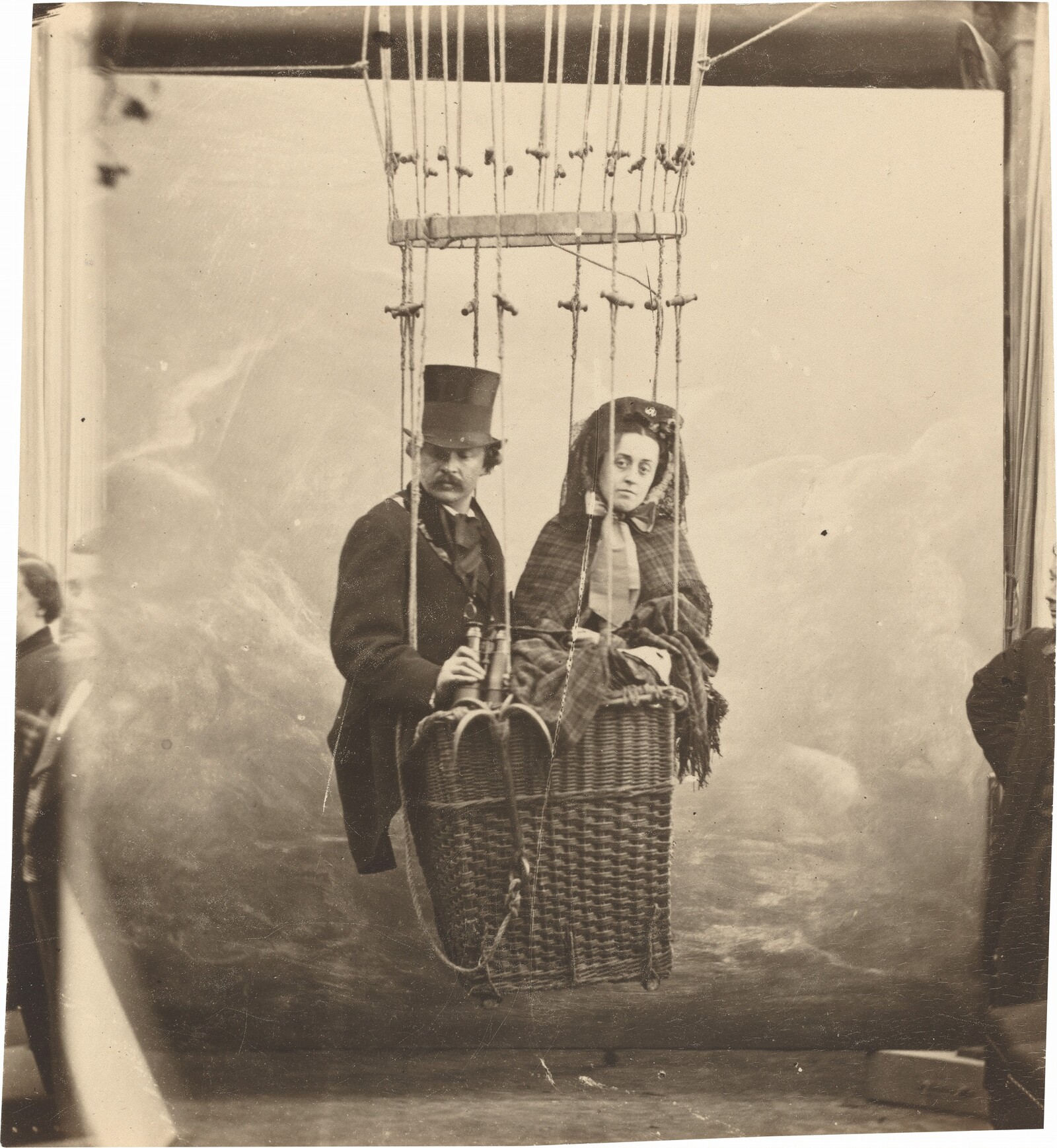
The image used here makes that double movement visible. In Self-Portrait with Wife Ernestine in a Balloon Gondola, Nadar appears in a basket with binoculars while Ernestine looks toward us, the gondola hanging only a few feet above a studio floor before a painted backdrop.[1] The joke is obvious once you notice it: this is flight performed indoors. But the performance is not fake in a simple sense. It advertises a real obsession with balloons, aerial navigation, risk, and spectacle, while using the studio to make that obsession legible as an image.[1][3][4]
A Portrait Studio With A Public
Nadar began as a writer, caricaturist, journalist, and bohemian presence before he became a photographer.[2][3] That prehistory matters. A conventional portrait studio could supply respectable likenesses. Nadar brought a caricaturist's feeling for face, a journalist's sense of circulation, and a networker's understanding that Parisian cultural life ran on visibility. His self-invention was not just biographical color. It was the medium.
His portraits are powerful because they strip away much of the furniture that nineteenth-century studio photography often used to prove status. The best-known Nadar look is spare: dark ground, controlled light, direct pose, few props, a face allowed to carry the social argument. BnF's account of the Nadar exhibition stresses the legacy of portraiture in the family workshop and the intimate character of some portraits made possible by Felix Nadar's friendships with figures such as Gustave Dore and Baudelaire.[3] The Guardian's republication of a 1976 essay makes the same visual point from the viewer's side: the portraits are memorable for their directness, restraint, and lack of clutter.[5] The point is not that friendship automatically makes art better. It is that Nadar's studio could turn familiarity into a photographic method.
This is where his portraiture becomes modern. He did not simply show famous people as famous. He often made them appear temporarily unarmored: not private in the sentimental sense, but present in a way that resists courtly distance. The subject remains recognizable as a public figure, yet the photograph asks the viewer to meet a thinking person rather than a rank. That balance between accessibility and distinction is one reason Nadar's portraits still feel alive.[2][3]
Publicity As Performance
The balloon-gondola portrait sharpens a side of Nadar that pure portrait praise can miss. He was not only making other people visible; he was also designing the legend of Nadar. The Commons record for the National Gallery of Art work identifies it as a gelatin silver print after an image made around 1865, with Paul Nadar associated with the later print.[1] It also preserves the crucial visual fact: the basket is visibly staged in a studio.[1] That material fact is the whole mechanism.
Nadar's balloon self-imagery does not ask to be believed as documentary proof of altitude. It asks to be understood as a brand image before modern branding language existed. Binoculars, basket, wife, backdrop, costume, scale, and theatrical suspension all turn one body into a proposal: here is the photographer as explorer, impresario, husband, risk-taker, comic actor, and technician. The studio does not betray the fantasy. It produces the fantasy in a form that can circulate.
The fantasy had substance behind it. BnF's exhibition page places Nadar's aerial work among the family's technical experiments, and Public Domain Review notes his turn from portraiture toward balloons, including the enormous Le Geant.[2][3] Daumier's famous satire, Nadar Raising Photography to the Height of Art, worked because the public already understood the equation: Nadar plus balloon meant photography trying to lift itself into a new cultural altitude.[4]
That is why the gondola image is not a decorative oddity. It belongs at the center of the profile. Nadar could make a portrait of Baudelaire feel intimate and a portrait of himself in a basket feel like a manifesto. Both depend on the same skill: arranging a body so that a public role becomes visible.
The Camera Above And Below Ground
Nadar's restless technical side complicates the idea that he was only a portrait artist. Public Domain Review notes his work underground with artificial light and his ballooning ventures, including Le Geant.[2] BnF likewise frames the Nadar workshop through art, industry, science, and technical experimentation, including artificial-light photography in sewers and catacombs, submarine caisson experiments, and aerial photography.[3]
The pattern matters more than any single first. Nadar kept pushing photography into places where ordinary portrait technique could not simply be repeated. Air, underground darkness, public interview, staged self-myth, intimate studio portrait: each setting asked what kind of evidence a photograph could become. He was not systematically scientific in the later institutional sense. He was a nineteenth-century experimental personality whose projects made the medium test its own boundaries.
That testing also explains the tension in his reputation. Nadar can look like a serious artist, a showman, a businessman, a memoirist, and an enthusiast who could not leave a spectacular idea alone. The categories do not cancel each other. They are the reason the work is historically sharp. Photography entered modern culture not only through quiet aesthetic refinement, but through studios, publicity, satire, commerce, celebrity, engineering dreams, and a lot of theatrical nerve.[2][3][4]
Why Nadar Still Matters
The temptation is to say Nadar made photography artistic by giving it psychological depth. He did do that. But the larger claim is that he made photography socially fluent. He understood that a modern image had to move between intimacy and circulation. A portrait had to feel personal enough to hold attention, but public enough to travel. A self-portrait could be candid, comic, promotional, and mythic in the same frame.[1][2][3][5]
This is why Nadar belongs beside the later history of celebrity photography, not only the early history of camera technique. His portraits are not publicity stills in the twentieth-century industrial sense, but they already know that public identity is constructed through repeated images. The sitter appears as a person, but also as a role: writer, actor, artist, inventor, witness, eccentric, sovereign of a small cultural domain.
At the same time, Nadar's work keeps the construction visible. The balloon basket is plainly staged. The portraits are plainly arranged. The studio is not hidden as an invisible neutral machine. Instead, the picture's intelligence lies in how the arrangement lets a public self become believable. The art is not in pretending there is no pose. The art is in making the pose tell the truth about performance.
That is Nadar's lasting gift. He showed that photography could make modern life legible because modern life was already becoming theatrical, networked, promotional, and media-aware. The face mattered. The studio mattered. The story around the image mattered. In Nadar's hands, portraiture became a way of entering public time, and self-invention became one of photography's most durable subjects.[1][2][3][4][5]
Sources
- Wikimedia Commons, "File:Nadar, Self-Portrait with Wife Ernestine in a Balloon Gondola, c1865.jpg" - source record for the National Gallery of Art archival photograph used as the article image.
- Public Domain Review, "Photographs of the Famous by Felix Nadar" - overview of Nadar's portrait practice, artificial-light work, and ballooning persona.
- Bibliotheque nationale de France, "Les Nadar, une legende photographique" - exhibition page on Felix, Adrien, and Paul Nadar; the portrait studio; staged self-images; art, industry, science, and technical experimentation.
- Khan Academy, "Honore Daumier, Nadar Elevating Photography to the Height of an Art" - art-historical discussion of Daumier's lithograph and the cultural meaning of Nadar's balloon-photography image.
- The Guardian, "A celebration of the genius of the early photographer Nadar" - republication of a 1976 Observer essay on Nadar's portrait style, restraint, and influence.