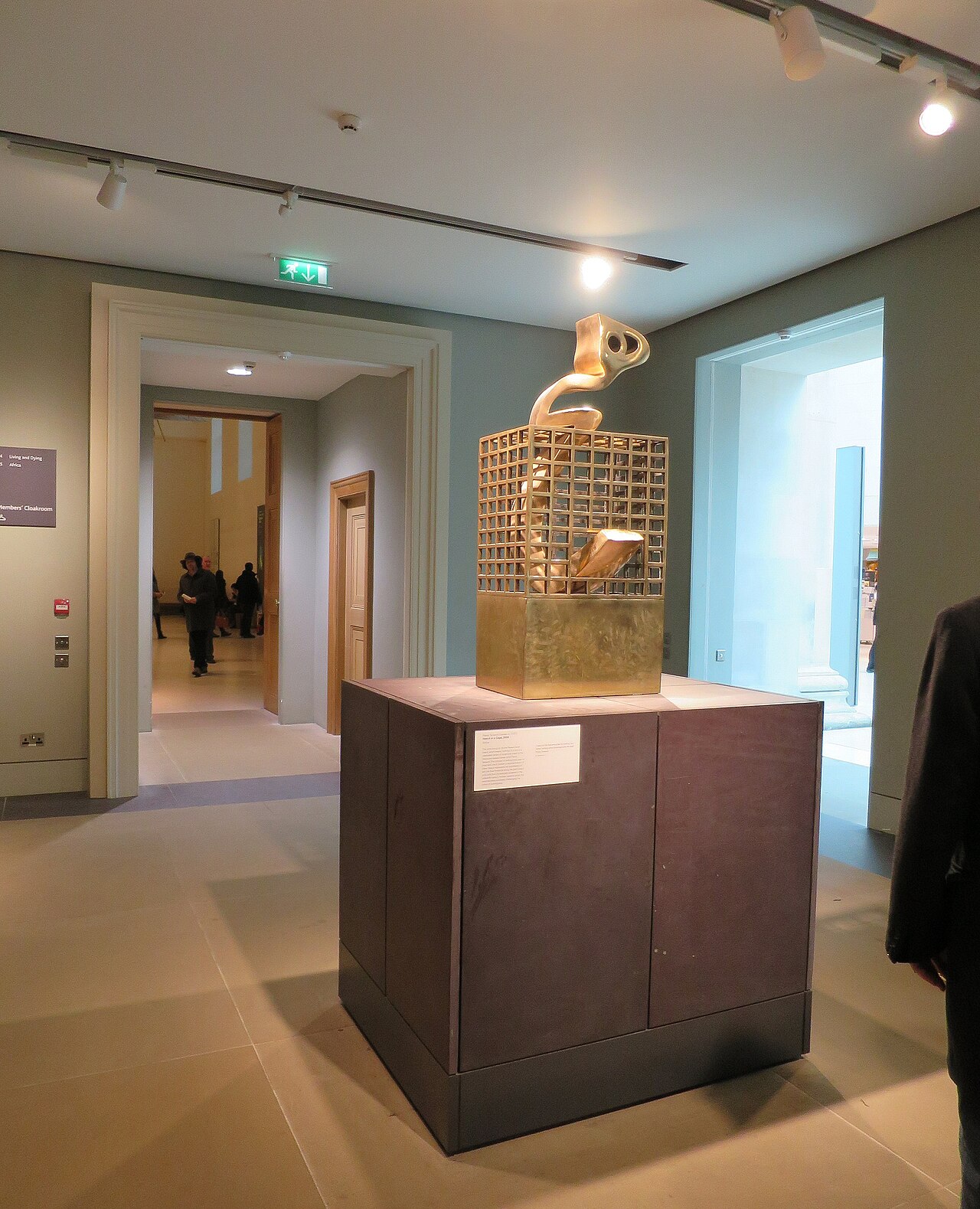
Image context: this article uses one verified gallery photograph of Parviz Tanavoli's Heech in a Cage. The bronze dates from 2005, decades after Saqqakhaneh's formative period, so it appears here as evidence of the movement's durable vocabulary rather than as a view of a 1960s exhibition. The photograph is real, accurately identified, and has not been generated or analytically altered.[6][7]
The word has shoulders. It leans into the bars, narrows at the waist, and swells again near the floor. Parviz Tanavoli's Heech in a Cage is recognizably bronze, yet its central form behaves less like a statue of something than like handwriting forced to stand upright. In Persian, heech means “nothing.” Here nothing has mass—150 kilograms of it—and a cage of its own.[6]
The sculpture was made in 2005, long after the artistic tendency called Saqqakhaneh emerged in Tehran. That distance is useful. It shows how thoroughly an experiment of the early 1960s survived as a method: take a sign already carrying religious, literary, or everyday associations; refuse to leave it as illustration; make its shape, material, and social location do new work.
Saqqakhaneh is often introduced as Iran's first modern art movement, a successful joining of local tradition to international modernism. The phrase is convenient and only partly true. Its artists issued no manifesto, did not maintain one aesthetic program, and did not all accept the label later attached to them.[3][4] Their coherence came from somewhere more interesting: a critic's metaphor, a network of schools and exhibitions, the circulation of popular objects, official patronage, and the later work of museums and historians.
To understand Saqqakhaneh, then, begin not with an “-ism” but with the public structure that gave it a name.
A fountain became a critical metaphor
A saqqakhana is a public drinking fountain associated with the memory of the Shi‘i martyrs denied water at the Battle of Karbala. It could combine a practical gift of water with a place for private devotion: a grille holding locks, flags, ribbons, or votive offerings; candles and beads; prayer pages and images. Bowls, metalwork, text, touch, and repeated acts gathered at one small urban site.[1]
The name entered art criticism around the Third Tehran Biennial. The sources do not give an identical date. The Metropolitan Museum of Art says critic Karim Emami used saqqakhana in 1963 to describe artists who had recently exhibited at the 1962 biennial; Encyclopaedia Iranica dates his first use to 1962 and identifies Hossein Zenderoudi's biennial display as the school's official beginning.[1][4] The difference is a warning against treating the movement as if it had opened on a single agreed day.
Emami's metaphor worked because the resemblance was not merely iconographic. These artists drew on talismanic seals, votive objects, locks, grilles, bowls, utensils, printed prayers, calligraphy, coffeehouse painting, textiles, and pre-Islamic forms. But the fountain also offered a social model: a public structure assembled from ordinary matter, collective memory, and intensely personal acts.[1]
That model changed what could count as material for modern art. The artists did not simply copy a shrine onto canvas. They detached signs from familiar duties and tested their formal pressure. Letters became fields of rhythm. A padlock became both found shape and cast motif. A grille could suggest architecture, enclosure, offering, or the armature of a sculpture. The everyday and devotional were not background color added to imported abstraction. They were active devices for reorganizing it.
The street did not enter the gallery unchanged
“Tradition meets modernity” makes this process sound too peaceful. It imagines two complete worlds placed side by side: an Iranian past supplying symbols and a Western present supplying form. Saqqakhaneh's artists were working inside a messier present in which schools, galleries, state cultural policy, foreign travel, mass print, devotional practice, craft, and international exhibitions already overlapped.
Zenderoudi and Faramarz Pilaram treated writing as visual matter. Their surfaces could be crowded with letters, numbers, seals, and repeated marks whose density exceeded ordinary reading. The Met emphasizes their turn toward commonplace and talismanic texts rather than only the literary calligraphy associated with elite culture.[1] Meaning did not vanish, but it stopped arriving solely through a sentence. Scale, interval, repetition, ink, and color made script operate before—or beside—decoding.
Tanavoli reached the same pressure point through bronze. In The Prophet (1962–63), he modeled drains, faucets, padlocks, lattices, and tubular sections before casting them together. MoMA's object record places those fountain-like components inside the creative circle that acquired the Saqqakhaneh name.[5] The sculpture does not depict a particular public fountain. It rebuilds the fountain's material grammar as a compact figure: conduit, barrier, vessel, lock, body.
Other practices resist any tidy calligraphic definition of the group. Sadegh Tabrizi drew on Qajar imagery, household things, and coffeehouse painting. Massoud Arabshahi looked toward rock carvings, maps, and ancient visual systems. Mansour Ghandriz pursued abstraction through textile and metalwork forms. Marcos Grigorian attached earth and straw to canvas, turning rural building matter into the surface itself.[1][4] The shared field was therefore not one look. It was a permission structure for treating culturally specific matter as a modern operation rather than a quotation from a sealed past.
This is also why the label “Spiritual Pop” is suggestive but insufficient. It catches the artists' reuse of recognizable signs at a moment when Pop elsewhere was turning mass-cultural imagery into art. Yet Saqqakhaneh's social and devotional sources were not interchangeable with a soup can or billboard. A votive lock carried histories of touch, petition, mourning, and public belief before an artist moved it into bronze. Formal reuse could redirect those associations; it could not make them culturally neutral.[4]
Institutions supplied the missing frame
If the artists did not write a common program, institutions helped their work appear together. Tehran's College of Decorative Arts combined instruction in applied arts, graphic design, and architecture with close contact with symbols and craft techniques drawn from Persian popular culture. Atelier Kaboud brought artists, architects, and writers into conversation. Five Tehran biennials between 1958 and 1966 placed the work of more than 100 Iranian artists before local and international audiences.[1]
Those settings mattered as much as stylistic resemblance. A classroom made techniques transmissible. An atelier made comparison immediate. A biennial made scattered experiments visible as a national field. Galleries and collectors then carried that field outward. Abby Weed Grey, for example, formed a major collection of modern Iranian art through direct relationships with artists, helping the works circulate in the United States and building one of the largest holdings of Iranian modern art outside Iran.[1]
Government support also increased visibility. Grants, prizes, schools, biennials, museums, and cultural sponsorship were not neutral containers around the art; they were part of the conditions that made “Iranian modernism” legible at home and abroad.[1][3] A movement presented as the spontaneous recovery of national roots can therefore obscure its infrastructure. Saqqakhaneh did draw strength from popular and devotional culture, but its public identity was also produced by modern institutions with their own ambitions.
That double movement—from street object to art object, then from loose affinity to official category—is the real drama. Locks and talismans gained new status inside paintings and sculptures. The artists, in turn, gained visibility inside a state-supported story of cosmopolitan national culture. Neither translation was innocent. Both made new work possible.
The school became clearer after the fact
The word school suggests a defined membership and a doctrine. Saqqakhaneh had neither. Encyclopaedia Iranica notes that some artists later objected to being included, even as exhibitions and formal affinities kept their names within the category.[4] Katrin Nahidi's later historiographic study pushes the problem further: Saqqakhaneh was not self-styled, and the processes of writing and exhibiting its history may have shaped the category more powerfully than sustained collaboration among the artists.[3]
This does not mean the movement was invented from nothing. Artists studied together, met, exhibited, borrowed, argued, and repeatedly approached related materials. It means that resemblance alone cannot explain why those relations hardened into the “first school of Iranian modern art.” Critics supplied a name; institutions supplied platforms; collectors supplied routes; retrospective exhibitions supplied a roster; art history supplied a beginning and an afterlife.
The chronology makes that construction visible. The Tehran biennials ran through 1966. A major Saqqakhaneh exhibition at the Tehran Museum of Contemporary Art in 1977 gathered artists under the label even though their paths had already diverged. The 1979 Revolution then ruptured the state and institutional conditions that had supported much pre-revolutionary modern art; several associated artists lived or worked abroad, and later accounts carried the movement into a new political memory.[1][2][4]
The category became cleaner as the lived scene grew more distant. That is not unique to Saqqakhaneh, but here the effect is especially revealing because the movement's supposed unity has often been asked to stand for a national modernism. A label born as a metaphor for a densely furnished public fountain became a museum room into which many unlike practices could be placed.
Nothing still carries the hardware
Tanavoli's Heech works reveal what survives when the historical category loosens. The Persian word becomes a body; calligraphic flow becomes weight; a cage makes negative space feel confined. The British Museum dates Heech in a Cage to 2005, yet the work still carries Saqqakhaneh's foundational traffic among script, common metal forms, devotional memory, and sculptural presence.[6]
It would be too easy to read the cage as a single political allegory or heech as a password with one stable translation. The sculpture is stronger because word, body, and barrier do not collapse into one another. Language remains legible as form without becoming mere decoration. The cage is both an ordinary structure and a charged limit. “Nothing” occupies space without ceasing to name absence.
That tension offers a better account of Saqqakhaneh than the polished equation of Iranian tradition plus Western modernism. The movement's artists did not retrieve a pure visual inheritance and carry it untouched into the gallery. They selected, enlarged, cast, stamped, layered, and displaced things already alive in public culture. Critics and institutions then performed another transformation, turning those varied acts into a school.
Saqqakhaneh's achievement lies inside both translations—and inside the friction between them. A drinking fountain became a name for modern art. Locks and letters crossed a threshold of cultural status. A loose scene became a historical movement. The label clarifies, but the objects keep pressing against its bars.
Sources
- Julia Rooney and Maryam Ekhtiar, “Artists of the Saqqakhana Movement.” The Metropolitan Museum of Art, April 2014 — the fountain metaphor, artists, materials, schools, biennials, patronage, and collecting network.
- Maryam Ekhtiar and Marika Sardar, “Modern and Contemporary Art in Iran.” The Metropolitan Museum of Art, October 2004 — the wider Iranian modern-art context, popular sources, galleries, Tanavoli's motifs, and the 1979 rupture.
- Katrin Nahidi, “‘Saqqakhaneh Revisited’: The Art-Historiographical Construction of a Local Modernism.” In The Cultural Politics of Art in Iran, Cambridge University Press, 2023 — critical account of the movement as a retrospective art-historical category.
- Hamid Keshmirshekan, “Saqqā-Ḵāna School of Art.” Encyclopaedia Iranica, 2009, updated 2016 — naming chronology, artists, formal traits, institutional context, disputed membership, and legacy.
- Museum of Modern Art, “Parviz Tanavoli, The Prophet, 1962/63” — official object record and gallery text on the early bronze's drains, faucets, padlocks, lattices, and relation to the Saqqakhaneh name.
- British Museum, “Heech in a Cage” — official collection record for title, artist, bronze medium, 2005 date, dimensions, weight, and Saqqakhaneh context.
- Alan Stanton, “Heech in a Cage,” Wikimedia Commons — source and rights page for the real 2016 British Museum photograph used as the cover.