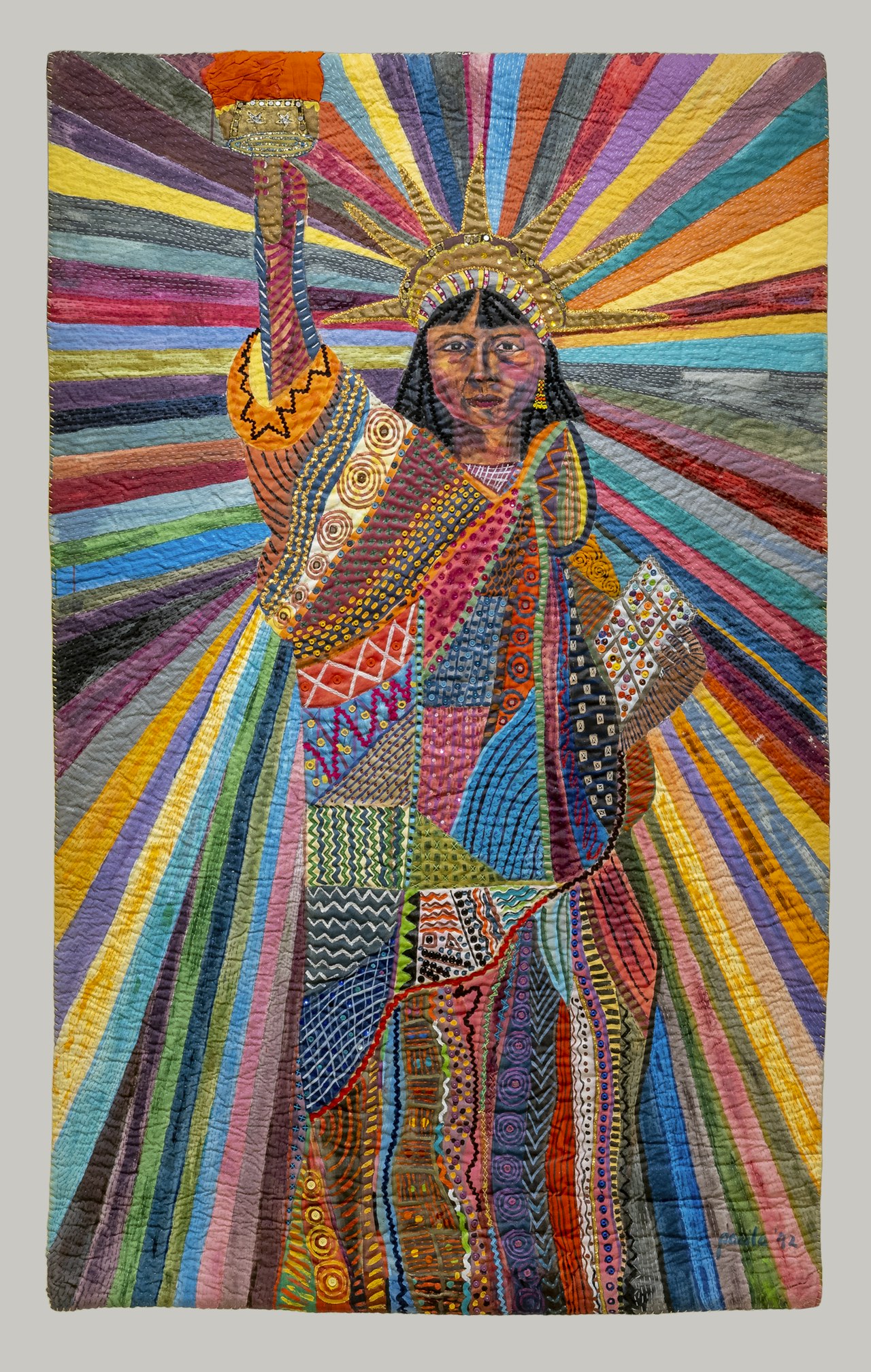
Image context: the cover is one real museum photograph of Pacita Abad's L.A. Liberty. Its full view keeps the artwork's figure, irregular textile edge, stitched surface, and radiant field visible together.[1]
In Pacita Abad's hands, Liberty does not hide how she was made.
That refusal is the quiet engine inside Pacita Abad's exuberant L.A. Liberty (1992). The familiar crown and raised flame remain, so recognition is immediate. But this Liberty is a brown-skinned woman in a gown assembled from restless fields of color. The smooth unity expected of a national emblem has become a visibly stitched, padded, ornamented surface. She is no longer only a monument onto which a nation projects its ideals. She is an image whose construction—and therefore whose capacity for revision—stays in view.[1][3]
At 94 by 58 inches—nearly eight feet tall—the work meets a standing viewer at bodily scale. It is acrylic and painted cloth, but also cotton yarn, plastic buttons, mirrors, and gold thread, all stitched onto a padded canvas.[1] Those materials do more than enliven an established emblem. They turn national symbolism into something visibly pieced, handled, and enlarged by additions. L.A. Liberty argues that belonging need not be granted by making difference disappear. Its Liberty becomes more authoritative as more colors, textures, and histories remain in view.
The face comes before the monument
Abad preserves just enough of the New York statue to make comparison unavoidable: the seven-rayed crown, the vertical torch, the long robe, the frontal pose. Yet the first encounter is not with copper, pedestal, or distant harbor silhouette. It is with a person. Liberty's black hair frames an unsmiling face modeled in rust, rose, brown, and violet; her level gaze turns the static pose into a direct encounter.
This shift from monument to person changes the work's emotional grammar. Official monuments often ask viewers to look up at an abstraction—Freedom, Republic, Victory—whose human form has been smoothed into allegory. Abad lets allegory keep a face. The brown skin is not a tint applied to an otherwise unchanged icon. It redirects whom the icon can resemble and therefore whom it may appear to welcome.[2][3]
The crown intensifies that redirection. Bands of yellow, orange, red, blue, violet, and green radiate behind the head, echoing the statue's spikes while refusing a single metallic surface. The figure seems at once crowned and sunlit, but the color is never atmospheric haze. It has been divided into strips, sewn down, and made structural. This is “a woman of color” rendered not as a slogan but as the governing fact of the entire surface.
A title with two addresses
The work began with a museum visit. In 1991, Abad went to Ellis Island and noticed how little its immigration story said about people from Asia, Latin America, and Africa. She understood that many had entered the United States elsewhere, including through Angel Island, but treated their absence from the larger public narrative as the problem. The following year she made L.A. Liberty.[2][3]
Its initials refuse to settle in one place. The Art Gallery of Ontario's exhibition text explains that “L.A.” points both to Latin America and to Los Angeles.[3] One reading expands the ancestry embodied by Liberty; the other shifts attention from New York Harbor toward a Pacific-facing, multilingual metropolis. Together they disturb the easy habit of treating one port, one period of European arrival, or one inherited monument as the complete image of American immigration.
Abad did not answer the omission with a census-like panorama. She concentrated the argument in one commanding body. The work belongs to her Immigrant Experience group, whose subjects range from detention and racial identity to mixed marriage, accents, classrooms, and Haitian refugees.[3] Against those varied lives, L.A. Liberty works less as a universal summary than as a counter-monument: an emblem altered so that histories excluded from the official frame can occupy its center.
The title also keeps the correction mobile. “Liberty” remains a national promise; “L.A.” makes that promise answer to other routes and populations. The painting does not discard the famous symbol. It takes possession of its recognizability and changes who speaks through it.
The politics are in the padding
Abad called her method trapunto painting. Beginning in 1981, she painted canvases, then stitched and stuffed them before adding beads and other objects. The Walker describes this process as a challenge to the division between fine art and forms of needlework historically pushed toward the categories of craft, women's labor, or non-Western tradition.[4] Abad's estate likewise records how a mobile practice shaped by travel brought textile traditions and techniques—including batik, tie-dye, mirror embroidery, and work with shells—into her art.[5]
In L.A. Liberty, that method gives the argument a physical structure. Padding raises the figure from the wall without turning her into conventional sculpture. Yarn draws and binds at once. Buttons punctuate the surface with ordinary manufactured objects; gold thread brings ceremonial brightness; small mirrors make illumination dependent on the room. The image does not merely depict radiance. It catches, redirects, and accumulates it.
The seams matter most. A standard monument tries to make construction disappear into unity: plates join, supports hold, and the finished emblem presents itself as whole. Abad's textile refuses that visual fiction. Its joins are part of its beauty. Different passages retain their edges while participating in one figure. The result offers a material proposition about public culture: cohesion does not require seamlessness.
That proposition is why the work's ornament cannot be dismissed as decoration laid over a political message. Abad's surface is the political message's method. Every stitch says that the image was made; every added material prevents “Liberty” from returning to a single, purified substance. The Walker connects Abad's maximalism to borloloy, a Tagalog term it loosely renders as excess ornamentation.[4] Here excess is not lack of discipline. It is a refusal to let an official symbol decide in advance how much difference it can contain.
Radiance without erasure
The torch establishes the work's old promise: illumination. Abad answers it by making the whole textile radiate. Color streams from behind the crown, gathers in the sleeve and robe, and breaks into dozens of local patterns. Yet illumination does not flatten those patterns into a uniform glow. It makes every difference easier to see. Missing histories, the painting suggests, cannot be restored by shining a brighter light on an unchanged monument. The public image itself has to be rebuilt.
That reconstruction follows Abad's own path without reducing the work to autobiography. She left the Philippines after anti-Marcos activism brought threats against her family, stopped in San Francisco in 1970, and ultimately turned from law toward art after traveling across Asia.[5][6] Her experience clarifies the stakes of L.A. Liberty, but the work exceeds the story of one migrant. The figure is larger than life precisely so that an individual face can carry a collective challenge.
The work also rejects the false choice between critique and pleasure. Its historical correction arrives through saturated color, gleaming fragments, swelling cloth, and rhythmic pattern. Visual pleasure is not evidence that the politics are shallow. It is how the painting pictures a public worth joining. Rather than asking immigrants of color to approach a fixed national ideal with gratitude and restraint, Abad lets them alter the ideal's face, wardrobe, surface, and visual language.
A monument that shows its seams
Three decades after it was made, L.A. Liberty entered the Walker Art Center's collection in 2022 and appeared in the first comprehensive retrospective of Abad's work, organized by the museum in 2023.[1][6] Institutional recognition can stabilize an artwork's place in history, but the painting's force does not depend on belated canonization. It is already about who gets to enter a public story and under what terms.
Look again at the seams. Abad could have changed the statue's complexion while preserving the illusion of an indivisible surface, producing a powerful substitution. Instead, she changed how the figure holds together. This Liberty does not only stand for a broader population. Her very construction makes plurality visible.
The visible stitches keep the claim honest. A national “we” is not discovered intact beneath the surface; it is constructed through attachments, revisions, and labor. L.A. Liberty does not promise that every difference will dissolve into harmony. It offers something more convincing: a whole whose seams remain legible, whose surface grows through addition, and whose authority depends on showing how it was made.
Sources
- Walker Art Center, “L.A. Liberty” — official collection record for the 1992 work's artist, medium, dimensions, accession, credit line, and museum image used as the cover.
- Matthew Villar Miranda, “Chronology of the Life and Work of Pacita Abad,” Walker Reader (February 23, 2023) — exhibition-catalog chronology covering the Ellis Island visit, the work's genesis, Angel Island context, and Abad's immigration-focused works.
- Art Gallery of Ontario, Pacita Abad: Exhibition Large Text — institutional guide detailing the work's materials, imagery, Immigrant Experience context, Ellis Island origin, and the double meaning of “L.A.”
- Walker Art Center, “Pacita Abad” — official artist and collection page on Abad's 1981 development of trapunto painting, its stitching and stuffing process, its relation to marginalized textile traditions, and borloloy.
- Pacita Abad Art Estate, “Pacita Abad (1946–2004)” — biography and chronology covering her political departure from Manila, San Francisco years, turn from law to painting, global travel, textile encounters, and trapunto process.
- Walker Art Center, “Pacita Abad” — official record for the 2023 retrospective, its career-spanning scope, and its presentation of L.A. Liberty.