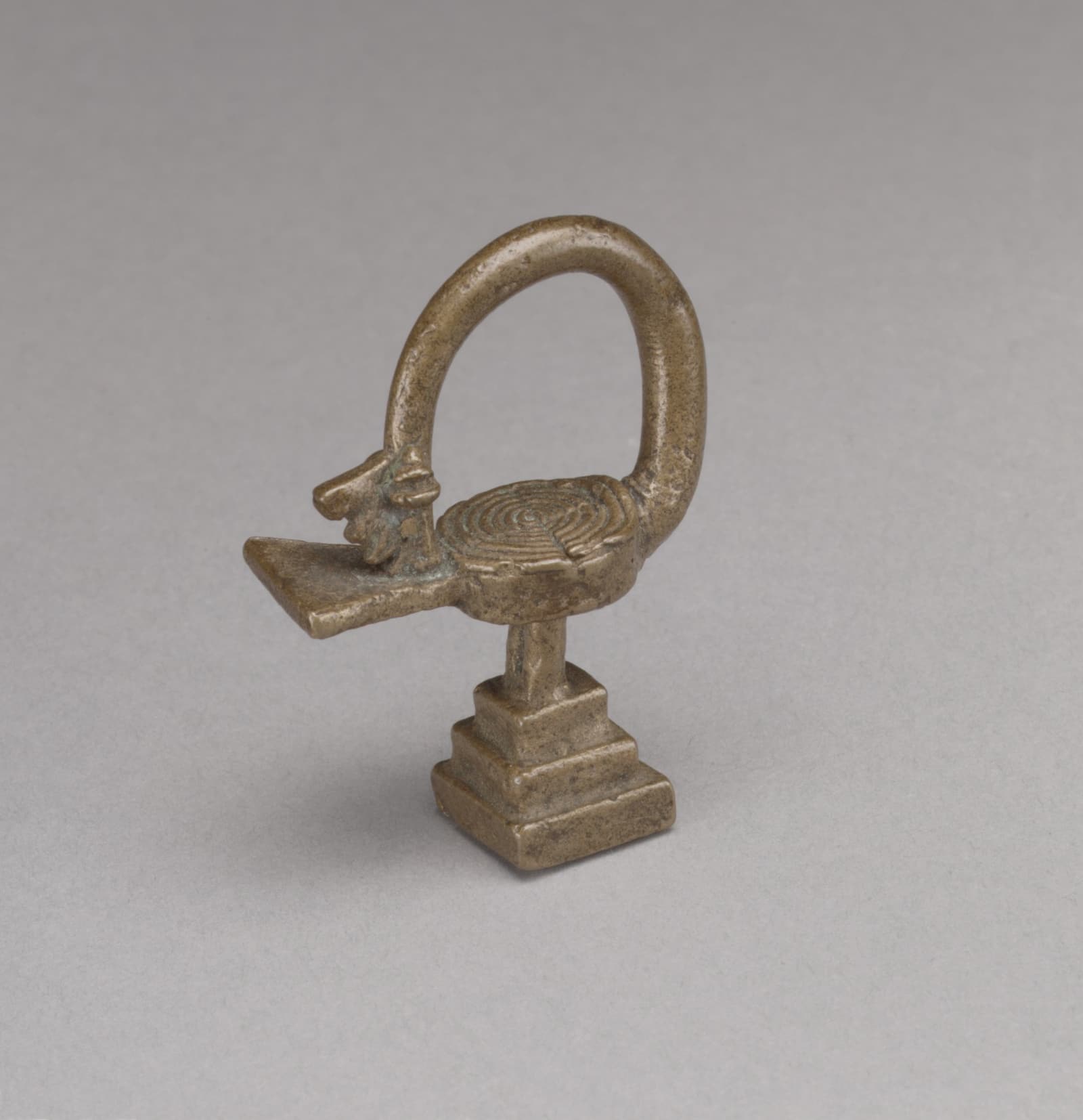
Image context: the cover is The Metropolitan Museum of Art’s verified object photograph of an 18th–19th-century Akan brass bird. The museum identifies its backward turn as sankofa, a form associated with learning from what has passed.[1]
The bird is only 1¾ inches high, but it performs a large turn. Its body points one way while its long neck bends back, bringing beak and tail into the same compact orbit. At webpage scale it can look monumental. In a hand, it would become what it is: a dense, intimate object whose meaning changes with the way it is handled.
The Metropolitan Museum of Art calls it Gold Weight: Bird (Sankofa) and connects the pose to an Akan proverb about learning from hindsight.[1] Those words offer two identities at once. “Bird” names a miniature sculpture capable of carrying a proverb. “Weight” places it inside a corpus organized around instruments expected to disappear into a numerical relation. One asks to be interpreted; the other, apparently, only has to balance.
Akan goldweights make that division impossible to maintain. Produced in the gold-trading regions of present-day Ghana and Côte d’Ivoire, these brass objects belonged to systems in which gold dust was measured with small scales and negotiated standards. Some are severe geometric blocks patterned with lines, spirals, and grids. Others take the shapes of birds, crocodiles, sandals, swords, shells, people at work, and animals in conflict. Their scale is practical, but their visual world is expansive.[2][5][7]
The easy story is that artists decorated commerce with folklore. The better story is stranger. Exact mass and open-ended interpretation could occupy the same hand. A transaction needed quantitative equivalence, but it also needed people to establish trust, negotiate a price, and read one another. A brass miniature could enter that encounter as measured matter, a display of means, a prompt to speech, or some combination of the three.
The standard arrived in a bag
Gold dust is flexible wealth and difficult money. It can be divided far more finely than a coin, but each tiny division has to be made credible. In an Asante market, buyer and seller could bring their own balances and sets of weights, then check the amount from both sides of the exchange. The equipment traveled together: scales, scoops, brushes, boxes, and a repertory of brass pieces kept in a dedicated bag.[5]
That portable kit turned measurement into a visible procedure. Price was not guaranteed by a face stamped on a coin. It emerged when particles of gold and a selected weight held the scale beam level—and when both parties accepted the standard being used. Akan measures interacted over centuries with systems linked to trans-Saharan, Islamic, Portuguese, Dutch, and British trade. The High Museum’s set of 57 goldweights corresponds to dozens of units drawn from Akan, Arabic, and European standards, a reminder that “the standard” was itself a history of contact.[7]
Crucially, visual form was not sufficient to announce value. A broad repertory of shapes coexisted with multiple systems of units, and individual pieces could be trimmed or supplemented until they met a standard. The instrument therefore split what the eye saw from what the balance established. Shape carried cultural recognition. Weight carried metrological force. Only the act of weighing disclosed how the object would function in that exchange.[2][5][7]
This is why the miniatures should not be treated as charming tokens attached to an otherwise abstract economy. They helped make the economy operable. Their ownership could signal experience and resources; their calibration made fine exchange possible; their condition recorded correction and use. A filed edge or added bit of metal was not damage in the usual sense. It could be evidence that a caster or owner had brought an individual object into agreement with a shared measure.[2][5]
Casting made every standard singular
The lost-wax process begins with a disappearance. A caster models a small form in beeswax, encloses it in clay, and fires the mold so that the wax runs out. Molten brass then enters the cavity. When the mold is opened, the model has gone and one metal object remains.[2]
That sequence is wonderfully ill-suited to the modern fantasy that standards must look identical. Each wax model could be singular, yet its brass successor still had to perform as exact mass. If the casting came out heavy, material might be cut or filed away. If it was light, metal could be added. Precision was achieved after transformation, through a trained adjustment of the object rather than through endless visual duplication.[2][5]
Casters also let the world make its own model. The Met’s 18th–19th-century bird-foot weight was formed from an actual leg rather than a sculpted wax substitute. Fired inside the mold, the organic original vanished and left its joints, claws, and scaly textures to be occupied by brass.[3] A found form had become a unique casting; the casting had become a unit; the unit could summon a proverb about authority. Technique joined observation, destruction, substitution, and calibration in one object.
This helps explain why the weights feel so alert even when they are tiny. Lost-wax casting preserves an event rather than merely reducing a subject. A shell, seed, claw, or foot is not represented from a distance; its physical structure can organize the cavity into which metal flows. In modeled figures, the pressure of fingers and tools survives at miniature scale. The result is neither industrial sameness nor casual irregularity. It is disciplined difference.
A shape could enter the conversation
The Sankofa bird does not print a sentence in brass. It makes a bodily proposition: movement continues while the head returns. The Met associates that turn with the value of retrieving knowledge from the past.[1] But the object does not behave like a flash card with one approved answer. Its bent neck creates an occasion for recognition, and the speaker or viewer has to decide how the inherited idea bears on the present.
Other figures intensify that social work. A famous double-crocodile form gives two heads and two tails a shared body. The associated proverb imagines the heads quarrelling over food even though it reaches one stomach: an image of common interest strained by individual appetite.[5] A single crocodile can carry different pressure. The University of Michigan Museum of Art links one example both to the endurance of recurring misfortune and to praise of a ruler’s capacity to inhabit more than one realm.[4] Motif is not destiny; situation activates it.
That openness matters because proverbs are not simply decorative wisdom. They allow a speaker to approach conflict indirectly, recruit shared memory, or make criticism without reducing it to blunt accusation. In a transaction, a figurative object might have offered a similarly oblique vocabulary. Scholars have proposed that selecting a particular weight could hint at a trader’s view of the bargain. The suggestion is compelling, but the surviving objects rarely preserve enough context to reconstruct a particular exchange, so possibility should not be mistaken for a transcript.[5]
The miniatures are therefore closer to prompts than codes. A code seeks one stable conversion. A proverb gains force from apt application. The person who recognizes the two crocodiles still has to judge whether the image speaks about a household, a political alliance, a quarrel, or the negotiation taking place at that moment. Visual literacy lies in choosing the relation, not merely naming the animal.
Seen this way, the scale did more than compare two masses. It staged an encounter between kinds of equivalence. Gold dust had to equal a calibrated amount. A proverb had to fit a social circumstance. The first relation sought numerical closure; the second remained deliberately arguable. Akan goldweights made room for both without pretending they were the same thing.
“Goldweight” is a useful label—and an argument
There is a catch. The most appealing account of these objects assumes that every figurative miniature carried all these functions at once: artwork, proverb, and working counterweight. Recent museum scholarship advises more care. A Met collection text updated in 2025 suggests that mainly geometric pieces did the actual weighing. Some figurative castings were adjusted to a standard, but many others may have circulated as conversation pieces or embodiments of rules, proverbs, and moral claims.[2]
That interpretation is a revision, not a settled verdict. A 2019 quantitative study kept figurative pieces outside its main analysis because their weighing role was contested, yet reported that the figurative examples it examined were calibrated as precisely as geometric ones.[8] Precision supports an intended relation to standard mass; it cannot, by itself, document how often a particular bird or crocodile entered a transaction. The crucial distinction is between calibrated for possible use and known to have been used.
That caution does not diminish the figurines. It prevents a modern category from manufacturing certainty that an object cannot support. A museum title can call something a “gold weight” because of its material, scale, collection history, and resemblance to securely functional pieces. None of those clues necessarily proves that this particular crocodile or bird repeatedly sat in a balance pan.
Nor does the evidence divide neatly into plain tools and expressive sculpture. Geometric weights carry patterns whose old numerical or proverbial associations are not always recoverable. Figurative pieces sometimes bear the additions and subtractions of calibration. Boxes could double as weights; natural objects could become molds; implements could be displayed as signs of wealth.[2][5] Function moved across forms.
The responsible response is not to replace one absolute with another. It is to keep different claims at different strengths. We can say that Akan gold-dust economies required calibrated brass weights. We can say that casters made a vast figurative repertory related to oral expression and material life. For any single object, evidence of mass adjustment, membership in a documented set, wear, acquisition history, and recorded use should determine how confidently those histories are joined.
The label becomes most useful when it remains a question: what, in this object, was being weighed?
Colonial standards displaced the balance; the form kept moving
The gold-dust system did not simply become obsolete by itself. British colonial rule reset lawful measures and accelerated the replacement of dust with coin. The Gold Coast’s 1896 annual report says a new ordinance made the imperial pound, gallon, and yard the basis of legal trade measures and created inspection and marking procedures; it does not describe a blanket crime of merely possessing an indigenous weight.[9] By 1902, another colonial report said British gold and silver coin had “almost entirely superseded” gold dust in Asante.[10]
A 2018 doctoral study from the University of Education, Winneba, dates the demonetization of gold dust and nuggets to 1889 and connects the 1896 weights-and-measures regime to the sale of many older weights to European buyers and a decline in the associated casting practice.[6] Read beside the primary reports, its broader point is stronger than the simplified claim that every weight was suddenly outlawed: colonial occupation, legal standards, and imported coin together removed the economic system in which the old sets had operated.
Once a set was broken apart, more than metrology was lost. A lone museum object may retain its mass and shape while shedding the bag it traveled in, the other standards it complemented, the owner who selected it, and the conversational setting that made one proverb more apt than another. Catalogue research can recover associations, but it can also make a fluid repertory look more fixed than it was.
Yet the form did not end with colonial prohibition. The Winneba project treated lost-wax casting and proverbial invention as contemporary practices. Working with participants in Asante communities, researcher S. Okyere-Boateng gathered 216 contemporary proverbs and produced 186 brass miniatures through the cire-perdue process.[6] Whatever one thinks of calling those new works “goldweights” after their measuring role had receded, the experiment proves that miniature form can still carry new speech. Tradition here is not the repetition of a closed catalogue. It is a method for giving present experience a memorable body.
Return, then, to the Sankofa bird. Its backward-looking head is often reduced to a slogan about honoring the past. The sculpture asks for a more demanding return. Look back far enough to distinguish a functioning standard from a museum convention, an inherited proverb from a fixed caption, and an interrupted economic system from a vanished artistic intelligence.
An Akan goldweight could make equivalence visible. A figurative miniature could make a difficult idea discussable. Sometimes one object may have done both; sometimes the category has placed those histories together after the fact. The achievement lies not in erasing that uncertainty, but in holding it as carefully as the object itself: a measured piece of brass whose meaning still will not sit still.
Sources
- The Metropolitan Museum of Art, “Gold Weight: Bird (Sankofa),” Akan artist, 18th–19th century — official object record, dimensions, image, and Sankofa interpretation.
- Enid Schildkrout, “Shells gold weight.” The Metropolitan Museum of Art, collection text updated 2025 — gold-dust systems, chronology, lost-wax casting, calibration, and the functional caveat concerning figurative pieces.
- The Metropolitan Museum of Art, “Gold Weight,” Akan peoples, 18th–19th century — official record for the bird-foot casting and its use of an actual bird leg as the mold model.
- University of Michigan Museum of Art, “Goldweight in the shape of a crocodile” — official object record and discussion of multiple proverbial and royal readings of the crocodile.
- Amelia Soth, “Gold Weights and Wind Scales in the Asante Empire.” JSTOR Daily, updated December 2025 — scholarly synthesis of market equipment, calibration, proverb use, and the double-crocodile motif.
- S. Okyere-Boateng, “Reinvigorating Asante Cire-Perdue Technique in Casting Gold Weights for Contemporary Asante Proverbs.” University of Education, Winneba, 2018 — Ghanaian doctoral research on colonial prohibitions, casting practice, and contemporary proverb miniatures.
- High Museum of Art, “57 Goldweights” — official collection record for a complete visual repertory, mixed measurement systems, trade history, and colonial displacement.
- Sébastien Crappier et al., “Les poids à peser l’or de l’Afrique de l’Ouest.” Colligo, vol. 2, no. 2, 2019 — quantitative study of 9,301 geometric pieces and the contested metrological status of figurative castings.
- British Colonial Office, Gold Coast: Annual Report for 1896, pp. 15–16 — primary description of the 1896 Weights and Measures Ordinance and its lawful imperial standards.
- British Colonial Office, Gold Coast: Annual Report for 1902, p. 16 — primary contemporary statement that British coin had almost entirely superseded gold dust in Asante.