Salt prints can look modest beside later photographic processes. They are usually matte, warm in tone, and materially close to paper rather than to glass, metal, or glossy albumen. That modesty is the point. The salt print made photography feel less like a miraculous polished plate and more like an image absorbed into a sheet. It turned the photograph into something that could live with drawing, printmaking, book pages, letters, albums, and archives.[2][3]
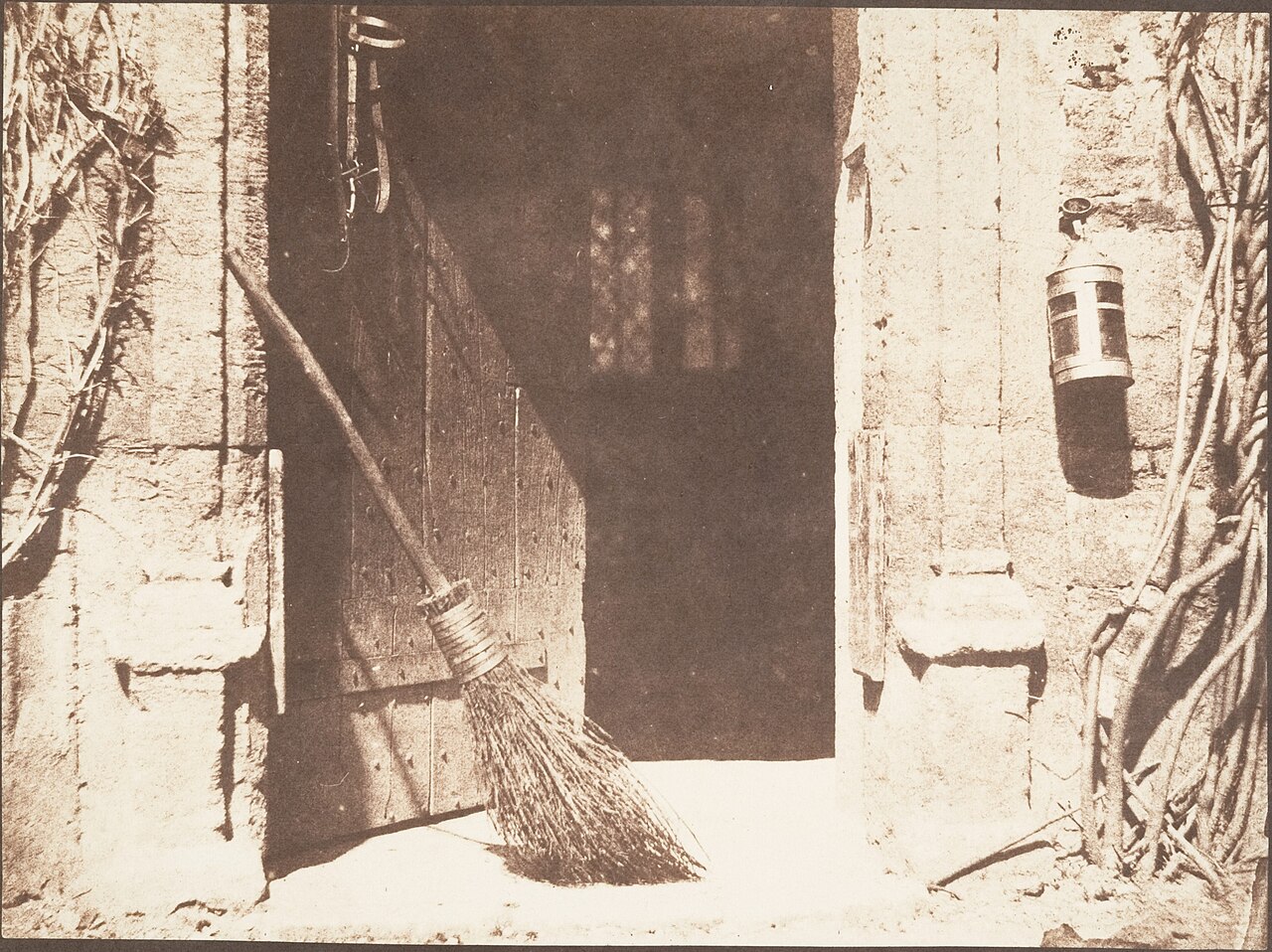
William Henry Fox Talbot's The Open Door is a useful anchor because it refuses spectacle. Made before May 1844, the Met's print shows a broom, a stone threshold, an open stable door, a hanging lantern, and a block of interior darkness.[1] Nothing in the scene declares itself grand. Talbot chose ordinary things and then asked paper, sunlight, and silver chemistry to make them newly arresting. The image is not only a record of a doorway. It is a demonstration of what paper photography could make visible: texture, shadow, domestic use, and the beauty of low drama.[1]
The image is in the paper
The basic process is disarmingly simple in outline. A sheet of good writing or drawing paper was first treated with salt solution, then sensitized with silver nitrate so light-sensitive silver chloride formed in the paper.[3][4] After drying, the sheet was placed in direct contact with a negative under glass and exposed to sunlight. The image printed out gradually, darkening under light rather than appearing through a later developer in the modern darkroom sense.[4]
That sequence changes how a salt print looks. In later albumen printing, a glossy egg-white layer could hold the image closer to the surface and sharpen the apparent detail.[4] In a salt print, the image belongs more intimately to the paper fibers. The result can seem softer and more absorbent, with a matte presence that asks the viewer to look into the sheet rather than across a polished skin.[2][3]
This is why The Open Door feels so tactile. The broom is not rendered as a crisp inventory of every straw. It arrives as a bundled texture, a fan of marks leaning into the door's darker plane. The stone blocks do not gleam. They abrade the image. The open doorway does not recede into illusionistic depth so much as thicken into brown shadow. The print's material limits are also its pictorial intelligence.[1][2]
Reproducibility changed the artistic problem
Talbot's paper-negative process mattered because it made multiple positive prints possible from a single negative. That did not make every print identical in the way later industrial photographic reproduction could. Exposure, paper choice, washing, fixing, toning, and aging all mattered. But the basic negative-positive logic gave photography a different social future from the singular daguerreotype plate.[2][4]
For art, that changed the problem. A photograph could now behave like an editioned image, a page illustration, or a circulated proof. Talbot's The Pencil of Nature, where The Open Door appeared as Plate VI, was not just a portfolio of handsome views. It was an argument that photographs could enter the history of the book and the visual archive.[6] The salt print was therefore both image and proposition: paper could carry mechanically made pictures into ordinary systems of reading, collecting, comparing, and remembering.
That helps explain why Talbot staged such an unassuming scene. A grand ruin or famous monument would have made photography look dependent on borrowed importance. The stable doorway does the opposite. It says the new medium can make a visual event out of the nearby and familiar. The broom, lantern, doorframe, and threshold become proof that photography does not merely copy subjects already certified as important. It can manufacture attention through light, framing, and reproducibility.[1]
Beautiful fading is still a technical fact
The salt print's warmth can tempt viewers into romance, but the chemistry is not sentimental. Getty's conservation guide stresses that salt prints were vulnerable to light fading and chemical instability, and that gold toning, improved washing, and later process modifications were attempts to strengthen both color and permanence.[2] The National Archives' process guide similarly identifies salt prints by visible paper fibers, matte surfaces, warm reddish-brown or yellowish tones, and deterioration that can shift the image toward yellow-brown.[3]
That means the look many viewers love is also a survival problem. Salt prints can seem atmospheric because the image has not been held in a hard, glossy layer. But the same embedded delicacy makes preservation demanding. The light that creates the print also threatens it. The paper that gives the image softness can carry impurities, processing residues, and aging behavior. A salt print therefore records two durations at once: the exposure that made the picture and the long conservation history that determines what remains visible.[2][3]
In The Open Door, this double time is almost the subject. The image is about a threshold, but it is also a threshold object. It stands between drawing and photography, between single image and reproducible edition, between domestic scene and art-historical claim, between fresh light and eventual fading. Its browns are not merely nostalgic. They are the visible consequence of a process in which silver, paper, salt, sun, and time remain entangled.[1][2]
Why the softness matters
It is easy to treat early photographic softness as a defect corrected by later technologies. Salt prints ask for a better reading. Their softness is not simply a lack of sharpness. It is a way of distributing attention across surface, support, and subject. The print does not detach the image from its carrier. It lets the carrier remain active.
That makes salt printing closer to drawing and printmaking than to the fantasy of transparent capture. The viewer notices tone, grain, absorption, and the edge between light and shadow. The image becomes a made thing, not just an extracted view. Talbot's doorway matters because it shows this without fanfare. The broom's diagonal steadies the composition. The door's open slab creates a dark field. The lantern and vines pull the eye toward the margins. The paper gathers all of this into a low, warm register where ordinary objects become pictorial decisions.[1][5]
The medium's afterlife also matters now because contemporary photography is so often judged by clarity, resolution, and frictionless duplication. Salt prints remember another bargain. They gave photography reproducibility, but not clean abstraction from matter. They made images portable, but not weightless. They let sunlight write, but they kept the handwriting of paper in the result.[2][4]
That is the deep lesson of the salt print. It did not simply precede sharper processes. It preserved a version of photography in which the support, the chemistry, and the scene remain visibly dependent on one another. The image appears because paper has been prepared to receive it. It lasts only because later hands know how fragile that reception was.
Sources
- The Metropolitan Museum of Art, collection API record for object 283068, "The Open Door" - object metadata for William Henry Fox Talbot's salted paper print from paper negative, before May 1844.
- Dusan C. Stulik and Art Kaplan, "Salt Print," Getty Conservation Institute, The Atlas of Analytical Signatures of Photographic Processes - process history, chemistry, toning, fading, and preservation context.
- U.S. National Archives, "Photographic Prints in the Still Picture Branch" - identification notes for salt prints, paper fibers, matte surface, warm tone, and deterioration.
- Victoria and Albert Museum, "An A to Z of photographic processes" - salt print process overview and comparison with later albumen prints.
- Wikimedia Commons, "File:The Open Door MET DP148629.jpg" - file page for the Met-sourced public-domain image used as the article image.
- William Henry Fox Talbot, "Plate VI. The Open Door," The Pencil of Nature - primary text for the plate's framing of ordinary subjects and early photography's artistic claim.