Claude Cahun's self-portraits still feel startling because they do not ask the old portrait question: who is this person, really? They ask a harder one: what happens when a person refuses to let the camera make identity look finished? In photograph after photograph, Cahun appears as performer, double, masked figure, dandy, mannequin, mirror image, theatrical body, or nearly abstract face. The result is not a diary of moods. It is a disciplined attack on the idea that a portrait should settle the sitter into one reliable social role.[1][2][5]
That is why Cahun belongs inside Surrealism without being reduced to Surrealism. MoMA's collection page places Cahun among terms such as photography, photomontage, self-portrait, feminist art, and Surrealism, while also listing works made with Marcel Moore, Cahun's lifelong partner and collaborator.[2] The categories are useful, but the work is stronger than any one label. Cahun used Surrealist tactics - doubling, masquerade, displaced bodies, theatrical props - not to escape the self into fantasy, but to show that the self was already a construction under pressure.
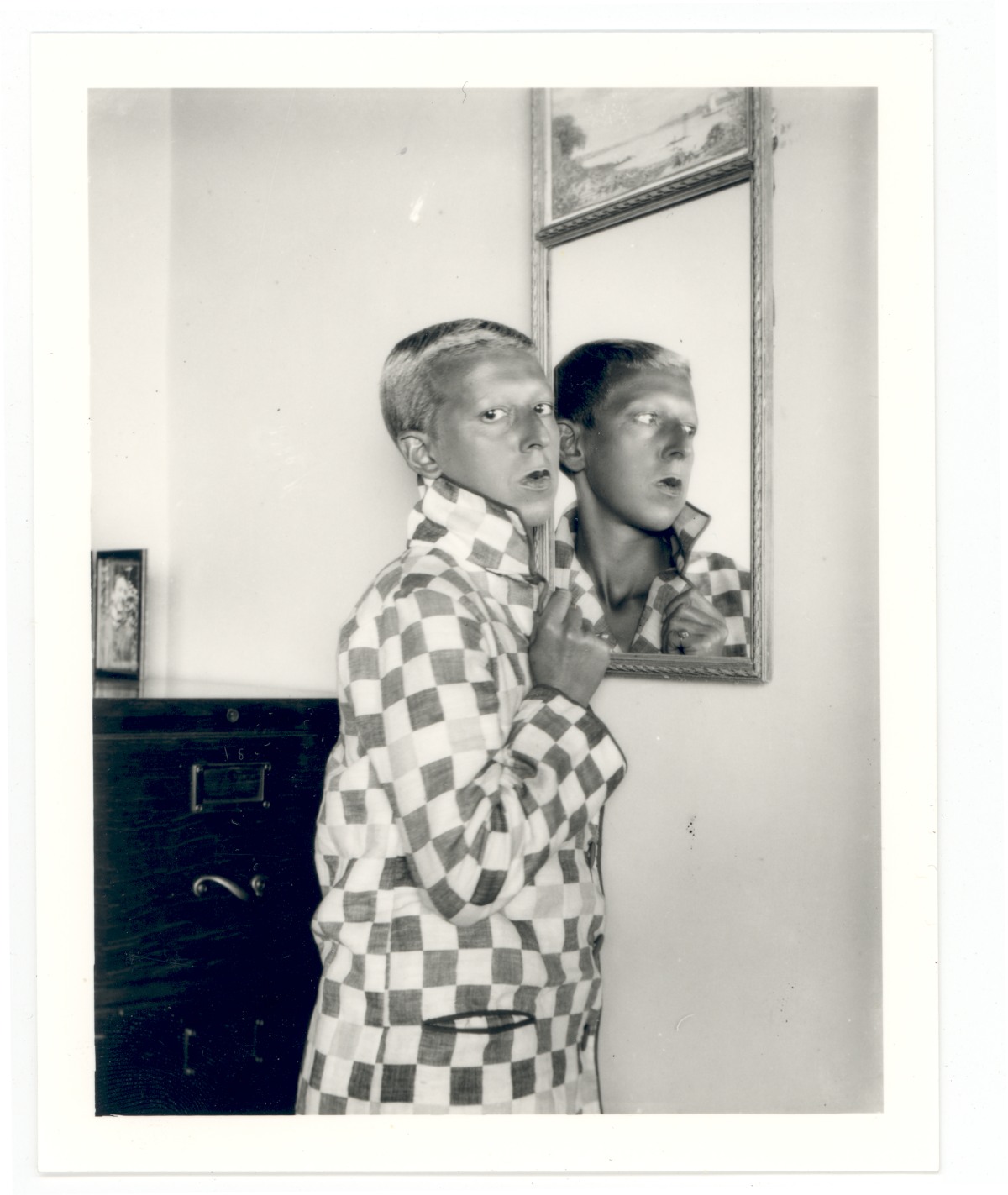
Image context: the lead image is the 1928 mirror self-portrait discussed by Jersey Heritage. It is not a generic artist portrait. It is the right visual anchor because the article's argument depends on the photograph's own mechanics: the face appears twice, the body is hidden by costume, and the stare turns looking into a confrontation rather than a passive display.[1]
The mirror does not confirm the self
The 1928 photograph from Jersey Heritage is one of the clearest entrances into Cahun's method. Cahun stands before a mirror in a long checked coat, holding the garment closed while the reflected face appears beside the frontal one.[1] Many self-portraits use mirrors to certify an artist at work: painter, brush, face, surface, witness. Cahun uses the mirror differently. It does not stabilize the image. It splits it.
Jersey Heritage's reading is exact on this point. Cahun is not simply looking at themself; Cahun is looking at us looking at them.[1] That reversal matters because it breaks the old one-way contract of portraiture. The viewer cannot sit comfortably in the position of examiner. The photograph sends the look back outward. The direct face meets us; the reflected face drifts elsewhere. The body is mostly concealed. The coat reads as garment, armor, and costume at once.
The effect is quietly aggressive. Nothing theatrical is exploding in the frame, yet the photograph refuses the ordinary rules of attractiveness, gender display, and confession. Cahun's cropped hair, covered body, and doubled face make beauty irrelevant as a final category. The picture is not saying, here is my true self beneath the costume. It is saying that costume, pose, mirror, crop, and stare are all part of how a self becomes visible.
That distinction keeps Cahun from being flattened into a simple icon of self-expression. The portraits do not merely express an identity that exists elsewhere in finished form. They stage identity as an event happening in front of the lens.
Costume was not disguise; it was method
Cahun was born Lucy Renee Mathilde Schwob in Nantes in 1894 and later adopted the name Claude Cahun, a choice that already made naming part of the work.[5] Britannica describes Cahun as a writer, photographer, Surrealist, and performance artist, and notes the long erasure before late twentieth-century rediscovery.[5] That biographical outline matters, but only if it is read through the work's formal intelligence. Cahun did not become important because the life now seems timely. Cahun became important because the photographs invented a visual language for instability before the institutions around them knew how to keep it in view.
Costume is central to that language. In Cahun's portraits, clothing rarely behaves as ordinary dress. It is a test apparatus. A coat can neutralize the body; a mask can make the face more present; a theatrical role can reveal the artificiality of roles outside the theater. National Portrait Gallery's exhibition page for Behind the mask, another mask describes Cahun and Gillian Wearing as artists who use the photographic self-image to explore identity and gender through masquerade and performance.[4] That pairing helps clarify what Cahun had already understood in the 1920s: performance is not the opposite of truth. It is one of the ways truth becomes visible.
This is why the photographs keep their force even when one does not know every literary or Surrealist reference behind them. The body in the frame is never simply presented. It is arranged, interrupted, and made strange enough that the viewer notices the arrangement. Cahun makes portraiture self-conscious without making it cold. The pictures still have pressure, wit, vulnerability, and dare. They just refuse to turn those qualities into a stable brand of personality.
Jersey Heritage's page also gives the sentence that often follows Cahun through recent interpretation: "Masculine? Feminine? It depends on the situation."[1] The line is useful because it sounds less like a manifesto than a working rule. In Cahun's images, gender does not disappear. It becomes situational, staged, angled, costumed, and contested. The photographs do not solve that tension. They keep it active.
Collaboration changes the authorship story
Any serious profile of Cahun has to include Marcel Moore, born Suzanne Malherbe. Jersey Heritage describes Cahun and Moore as lifelong companions and close collaborators who met as teenagers, lived and worked together for more than forty years, and later settled in Jersey in 1937.[1] The institution's broader collection page makes the archive's importance plain: Jersey Heritage holds the largest repository of Cahun and Moore's artistic work, including photographs, negatives, letters, diaries, manuscripts, and publications.[3]
That archive changes how the photographs should be read. Cahun often appears alone in the frame, but the work is not simply solitary self-portraiture in the romantic sense. Moore's presence, as collaborator, partner, and image-maker, complicates the idea of the lone artist inventing the self before an impersonal camera.[1][2][3] The portrait becomes relational. Someone stages, watches, frames, supports, or responds. The self is produced inside a shared working space.
This is especially important because the self-portrait has often been sold as the most private genre. Cahun's version is private and public at once. It draws on a couple's intimate language of costume and pose, then makes that language sharp enough to enter the history of modern photography.[1][3][4] The mirror picture, for instance, gains force partly because it does not feel like a casual personal experiment. It feels like a rehearsed visual proposition. The fact that a related Moore photograph was made at the same mirror, probably during the same session, makes the scene more interesting, not less.[1]
The collaboration also guards against a lazy reading of Cahun as merely ahead of contemporary identity discourse. The work is more specific than that. It belongs to a real household, a real artistic partnership, a Surrealist milieu, a Jersey archive, and a twentieth-century history of delayed recognition.[1][3][5] The portraits can speak powerfully now because they were made from concrete experiments then.
Rediscovery is part of the work's afterlife
Cahun's reputation is now strong enough that the old neglect can seem surprising. Britannica notes that Cahun was largely written out of art history until the late 1980s, and that the 1992 biography by Francois Leperlier was central to Cahun's reentry into art history and feminist art theory.[5] Jersey Heritage describes a similar rediscovery, noting the intense attention that followed Cahun and Moore's return to view among art historians and critics working with postmodern, feminist, and queer theoretical frames.[3]
That rediscovery is not a decorative postscript. It changes what the portraits can teach. Cahun's photographs were not only difficult because institutions overlooked them. They were difficult because they quietly resisted the categories that institutions often use to sort art: woman Surrealist, self-portraitist, photographer, writer, resistance figure, queer precursor, feminist icon. Each label catches something real. None is enough.
MoMA's collection page helps by keeping multiple terms in play rather than forcing one master description.[2] Cahun's work touches self-portraiture, photomontage, performance, Surrealism, and feminist art; it also includes collaborations with Moore and theatrical images that make identity feel staged rather than possessed.[2] The challenge is to let that multiplicity remain visible.
The photographs are not puzzles awaiting the correct biographical key. They are machines for keeping identity open under pressure. A mirror doubles but does not explain. A costume conceals but also reveals the rules of looking. A name changes the social frame. A collaboration unsettles singular authorship. A pose looks artificial and therefore becomes honest about portraiture's artifice.
That is why Claude Cahun still feels contemporary without needing to be simplified into present-day shorthand. The work's force lies in its refusal to let a portrait close. Cahun did not use the camera to fix the self. Cahun used it to show how many selves can gather, clash, and stare back from one small photographic surface.[1][2][3][4][5]
Sources
- Jersey Heritage, "Cahun Photographs" - object-focused essay on Claude Cahun and Marcel Moore, the 1928 mirror self-portrait, gender-neutral persona, and the photograph's direct challenge to the viewer's gaze.
- The Museum of Modern Art, "Claude Cahun (Lucy Schwob)" - collection page listing Cahun's online works, collaborations with Marcel Moore, and associated terms including photography, photomontage, self-portrait, feminist art, and Surrealism.
- Jersey Heritage, "Claude Cahun" - collection overview on the Cahun and Moore archive, its status as the largest repository of their artistic work, online access, and the pair's move to Jersey in 1937.
- National Portrait Gallery, "Gillian Wearing and Claude Cahun: Behind the mask, another mask" - exhibition page on photographic self-images, masquerade, performance, identity, and gender.
- Encyclopaedia Britannica, "Claude Cahun" - biography covering Cahun's birth name, Surrealist practice, writing, performance, historical neglect, and late twentieth-century rediscovery.