Rosa Bonheur is still introduced too often through anecdote first and achievement second. The anecdotes are real enough: trousers, celebrity, Queen Victoria's admiration, the estate full of animals, the aura of exception around a woman who made herself impossible to file neatly inside nineteenth-century French art.[1][2][4] But if those details take over, they flatten the real accomplishment. Bonheur did something harder than merely becoming famous against the grain. She made animal painting carry public weight. In her hands, cattle, horses, deer, and sheep stopped functioning as decorative rural accessories or minor salon specialties. They became the subjects through which scale, movement, labor, and authority could be rebuilt.[1][2][3]
That change becomes clearest when Bonheur is placed back inside the structures she was trying to master. The Musee d'Orsay's Rosa Bonheur exhibition notes that she wanted to establish herself as a major creative artist in a genre traditionally reserved for men and to give the noble format of history painting to animals.[2] The claim matters because it keeps Bonheur from being reduced to charm or eccentric courage. She was after rank. She wanted the format, visibility, and seriousness usually granted to grand public painting, and she pursued that ambition through subjects other artists often treated as secondary.[2][3]
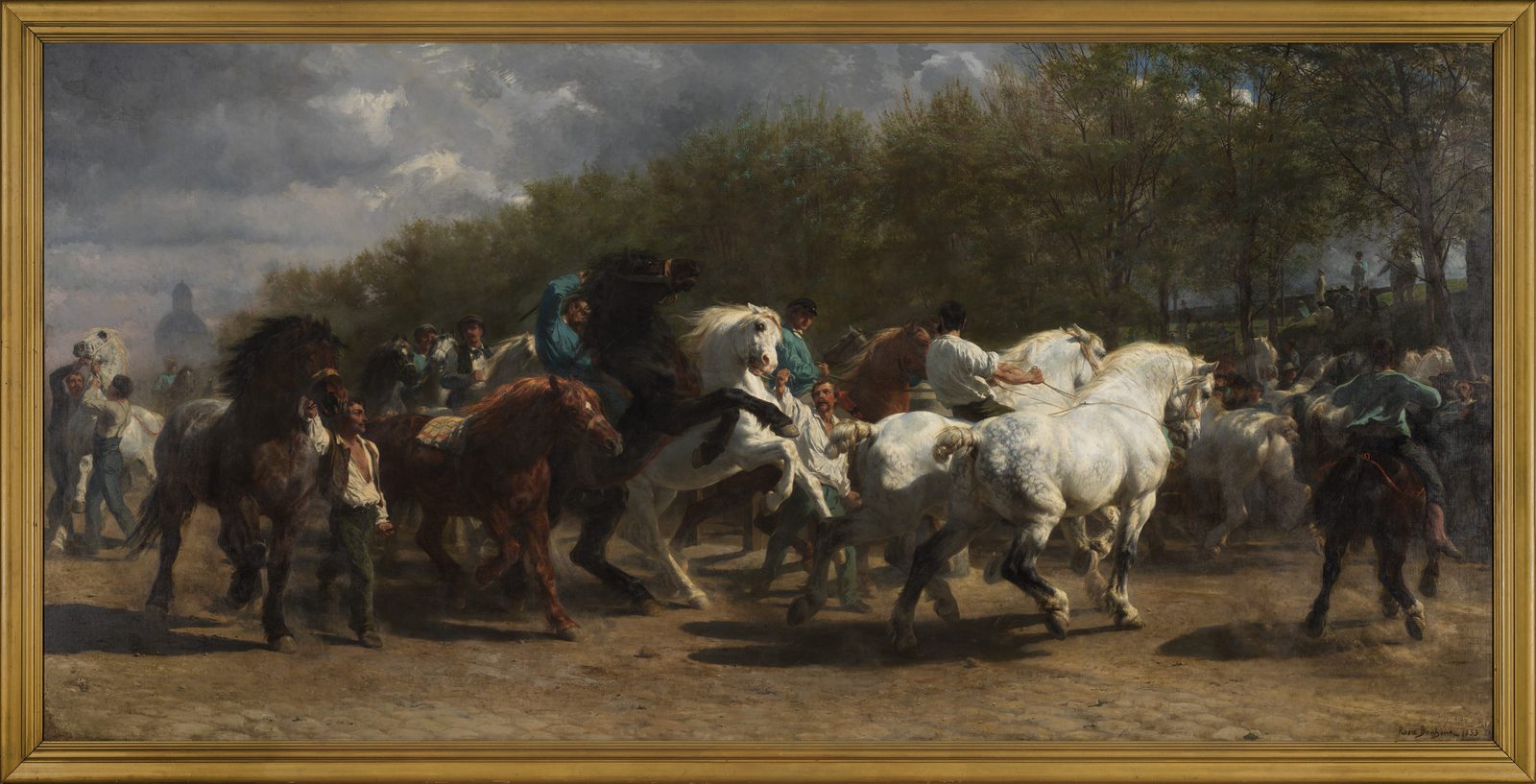
Image context: the lead image uses the painting itself rather than a portrait of Bonheur or a photograph of the chateau because the article's argument begins with scale. Before anything else, Bonheur needed viewers to feel that a market of horses could arrive with the force of a civic spectacle and a mural-sized claim on attention.[1][2]
The Horse Fair turned animal painting into a public arena
The Met's object page for The Horse Fair remains the most direct proof of that ambition.[1] The painting shows the horse market on the Boulevard de l'Hopital in Paris, with the Salpetriere visible in the background, and the museum notes that Bonheur sketched there twice a week for a year and a half while dressing as a man to discourage attention.[1] Those details matter less as biographical color than as evidence of method. Bonheur did not invent motion from studio fantasy. She built it out of repeated looking. The resulting canvas, begun in 1852 and shown at the 1853 Salon before later retouching in 1855, is more than five meters wide.[1] It behaves like a public argument about what animal painting can do.
The Musee d'Orsay sharpens that reading by placing The Horse Fair inside a tradition of monumental ambition. Its exhibition page says Bonheur painted the power of Percheron draft horses and the violence of the men around them in a realistic mode while also summoning the memory of the Parthenon friezes and competing with Romantic masters such as Gericault.[2] That is exactly the right scale of claim. The picture is not a pleasant market scene enlarged beyond reason. It is a deliberate transfer of grandeur. The handlers and horses form a circling frieze of strain, muscle, resistance, and spectacle, while the open space to the right keeps the market legible as a real social theater rather than a mythic stampede.[1][2]
The Met's audio transcript adds a useful social frame. Before automobiles, horses were still a principal means of transportation, and customers would watch trainers lead the animals in a circle from the grassy bank.[1] Bonheur does not paint an abstract emblem of animal vigor. She paints a working market in which money, labor, risk, display, and judgment all sit in the same field. That is why the painting still feels large in more than its dimensions. It converts commerce into pageant without cleaning away roughness.[1][2]
Drawing and field study kept the grandeur honest
The same Musee d'Orsay materials also explain why Bonheur's scale does not collapse into bombast. The exhibition booklet says drawing was the cornerstone of her practice and insists that the biographical lens has often overshadowed the complexity and richness of the work itself.[3] That correction is crucial. Bonheur's authority came from observation disciplined into structure. The d'Orsay exhibition page notes that she produced a multitude of preparatory sketches before beginning The Horse Fair.[2] The National Park Service article on Bonheur pushes that logic further, describing how she entered slaughterhouses, horse shows, and Paris's National Veterinary Institute for anatomical study, using an official cross-dressing permit to reach places women were usually barred from entering.[5]
Seen in that light, the famous trousers matter because they are part of an observational system. Bonheur wanted access to bodies in motion, to working anatomy, to the exact way an animal plants weight, turns a neck, resists a handler, or bunches force into a shoulder.[1][5] The result is that her animals never feel like picturesque symbols laid over a rural story. They hold their own physical logic. Even when the canvas becomes panoramic, the legs still bear weight and the heads still pull against the bit with convincing specificity.[1][2][5]
The d'Orsay booklet also helps place The Horse Fair inside a broader career pattern. In its account of Ploughing in the Nivernais, a government commission from 1848, curator Leila Jarbouai describes a quasi-panoramic format inspired by monumental friezes and history painting, but attached to a rural and political subject that also carried universal appeal.[3] That description makes Bonheur's development easier to follow. She was already using agricultural and animal subjects to test how far a supposedly lesser genre could be expanded. The Horse Fair did not appear from nowhere. It is the moment when that expansion becomes undeniable.[1][2][3][4]
Commercial success bought her a working estate, not a retreat from work
Bonheur's fame in the 1850s mattered for another reason that is easy to sentimentalize. It bought time, land, and operational control. The Musee d'Orsay exhibition page says that sales of her paintings and the distribution of prints funded the purchase of the Chateau de By at Thomery, on the edge of the Fontainebleau forest, and that she had architect Jules Saulnier build a large studio beside the main building.[2] Bonheur moved there on June 12, 1860 with Nathalie Micas and Micas's mother; the estate, described there as a true Noah's ark, allowed her to study animals daily.[2]
The exhibition booklet makes the social meaning of that purchase explicit. It notes how rare it was for a woman of humble origins in that period to buy a property with the fruits of her own labor.[3] That sentence should sit at the center of any Bonheur profile. By was not a picturesque reward tacked onto an already-finished career. It was infrastructure. It gave her a place to work away from Parisian interruption, to keep animals close at hand, and to fold drawing into everyday life rather than occasional expedition.[2][3]
NMWA's artist profile helps measure how fully that system paid off. Bonheur's reputation rose steadily through the 1840s; she won prizes at the Salon, secured the 1849 state commission that became Plowing in Nivernais, gained international acclaim with The Horse Fair in 1853, and in 1865 received the Legion of Honor from Empress Eugenie at her studio in the forest of Fontainebleau.[4] Those milestones matter, but they matter most because they stabilized a working method. Success gave Bonheur more chances to keep looking, drawing, and scaling up.
Why Rosa Bonheur still feels larger than the legend
Bonheur endures because the legend and the work are not identical. The legend says she was exceptional. The work shows how she made exception useful. She pushed animal painting into formats associated with public ambition, backed that ambition with obsessive field study, and then converted acclaim into a self-directed working estate where observation could continue without compromise.[1][2][3][5] Once those pieces are put back together, Bonheur looks less like a charming outlier and more like a rigorous strategist of scale.
That is why The Horse Fair remains the right doorway into her art, but not the whole story.[1][2] The painting proves she could command the wall. The sketches, permits, commissions, and By studio show how she earned that command.[2][3][5] Bonheur did not ask viewers to admire animals from a safe decorative distance. She asked them to grant animal life the same seriousness, mass, and formal dignity that high art had long reserved for other kinds of subjects. That wager still feels larger than most of the stories told about her, which is one reason the paintings keep outrunning the anecdotes.[1][2][3][4][5]
Sources
- The Metropolitan Museum of Art, "The Horse Fair" - object page and audio transcript covering the Boulevard de l'Hopital setting, Bonheur's year-and-a-half sketching routine, the 1853 Salon debut, the 1855 retouching, and the painting's later history at the Met.
- Musee d'Orsay, "Rosa Bonheur (1822-1899)" - exhibition presentation on Bonheur's use of history-painting scale for animal subjects, the preparatory studies for The Horse Fair, and the purchase and working life of the Chateau de By.
- Musee d'Orsay, Rosa Bonheur exhibition booklet (English PDF) - curator interview describing drawing as the cornerstone of Bonheur's practice, the quasi-panoramic ambition of Ploughing in the Nivernais, and the rarity of her purchasing By with the fruits of her own labor.
- National Museum of Women in the Arts, "Rosa Bonheur" - artist profile covering Salon prizes, Plowing in Nivernais, The Horse Fair, and the 1865 Legion of Honor visit.
- U.S. National Park Service, "A Collector's Passion for the Art of Rosa Bonheur" - interpretive article on Bonheur's anatomical field research in slaughterhouses, horse shows, and the National Veterinary Institute, and on her official permit to wear trousers for access.