
Archival films about Van Gogh often come wrapped in a trap. The camera moves through wheat, cypresses, and Provençal sunlight, the story edges back toward martyrdom, and the paintings end up looking like beautiful eruptions from a doomed private mind. The Met's In a Brilliant Light: Van Gogh in Arles, 1984 is more useful than that.[1] It opens by telling viewers to "adjust your color television carefully to Van Gogh," and the line is not a gimmick.[1] The film's real subject is calibration. It wants to reset how we see Arles itself: not as a generic site of southern radiance, but as a deliberately chosen working environment in which color, rented rooms, cheap food, street life, and a half-practical dream of collaboration all became part of the art.[1][2][4][5]
That shift matters because the Arles period is easy to flatten into productivity statistics. The film repeats the headline figure: 444 days, more than 200 paintings, more than 100 drawings.[1] Those numbers are true, but they can make the period sound like a burst of output detached from structure. What the documentary keeps restoring is structure. Around 13:36-13:59, it describes Van Gogh's idea of founding "a colony of artists in the south, a collective studio of painters," and links that dream to solidarity against poverty and bad health.[1] Once that ambition is taken seriously, the Arles works stop looking like separate masterpieces that merely happen to share a postcode. They begin to look like pieces of one experiment in how an artist might build the conditions he needed to keep working.[1][4][5]
The written record around the film makes that argument stronger. The Van Gogh Museum's page on The Yellow House (The Street) explains that after renting rooms on Place Lamartine in May 1888, Van Gogh imagined the building as an artists' house where friends could come to stay and work.[2] Letter 677 to Theo shows the same thing in more practical language: he buys beds, chairs, linen, and a mirror, imagines sunflowers on the guest-room walls, and insists that the house should have character from furniture to paintings.[4] Letter 706 to Gauguin then reveals the next step. While resting his eyes, he paints the Bedroom again as part of "my decoration once again," treating the room not as a diary page but as part of a larger environment waiting for another painter to enter.[5]
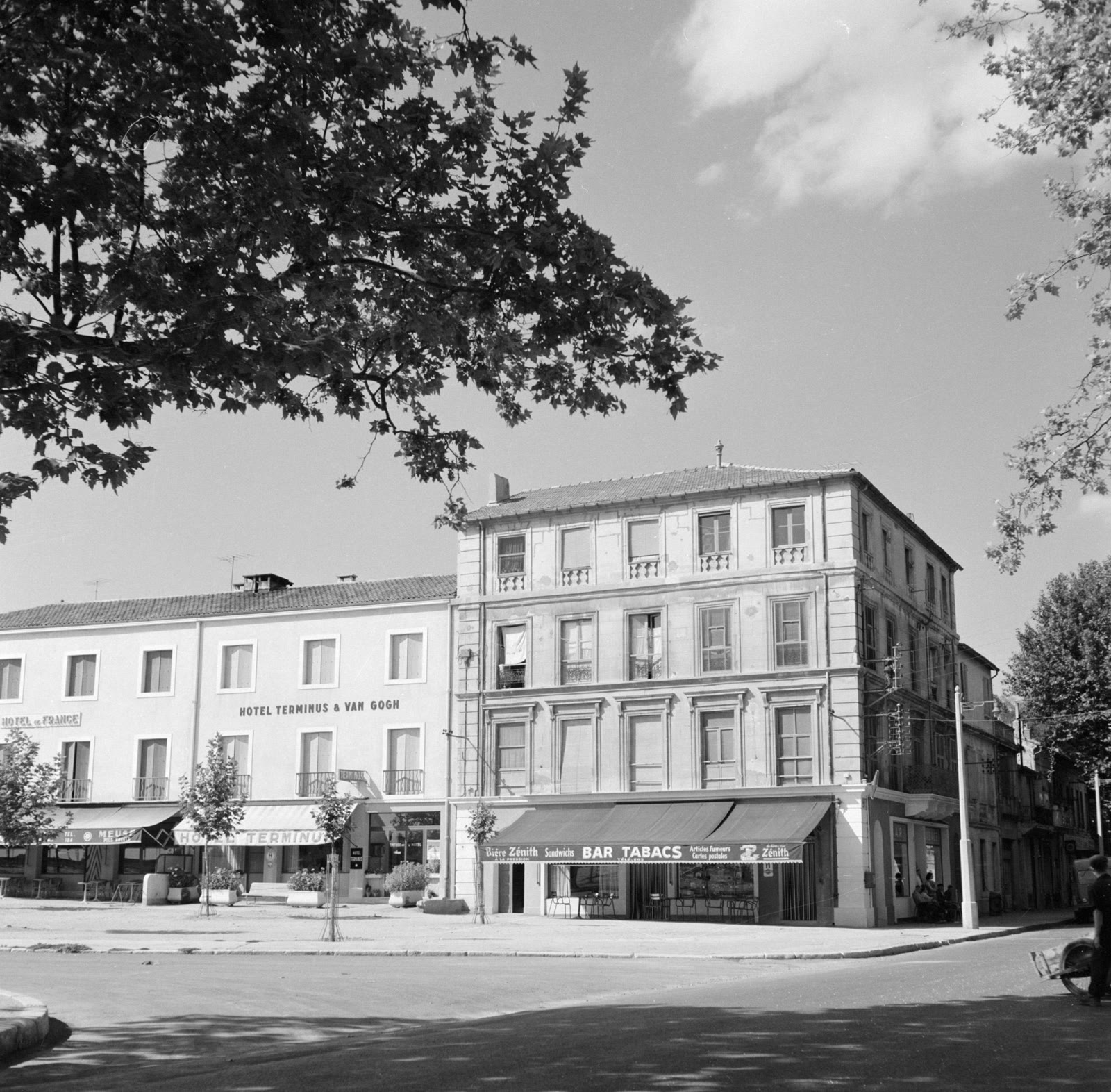
Image context: the cover uses an archival photograph of the Place Lamartine corner associated with the Yellow House. It is not a reproduction of a Van Gogh canvas, and that is deliberate. This article is about the Arles project as a real site with costs, rooms, neighbors, and later afterlives. The photograph keeps that material ground visible before the video turns it back into painted form.[6]
Historical context: Arles gave Van Gogh a working system, not just a new view
The documentary is at its best when it refuses to treat Arles as scenery.[1] During the later Paris 1886 and early Arles sections, it makes clear that Van Gogh did not go south simply to chase brightness. He went looking for a place where a different order of work might be possible. Around 13:09-13:20, the film says the landscape felt "like Holland and a warm sun," which is a useful phrase because it joins memory and change instead of treating Provence as pure escape.[1] Arles was familiar enough to be habitable and strange enough to break his Paris habits.
The film also emphasizes that he kept turning modern surroundings into subjects while leaving the obvious antiquities aside.[1] Near 32:39-32:47, it notes that he ignored the spectacular ruins and turned instead to the modern iron bridge across the Rhone.[1] That choice belongs with the Yellow House and the Night Cafe. Van Gogh's Arles is not primarily antique or picturesque. It is an everyday city of rail lines, cafes, rented rooms, and public corners where modern life can be pushed into color and form. That is one reason the documentary still feels fresh. It protects the Arles paintings from being absorbed into a vague cult of Provence.
Video provenance
The embed below uses The Met's official upload of In a Brilliant Light: Van Gogh in Arles, 1984, published in 2020 as part of the museum's From the Vaults archive series and described there as a film about Van Gogh's most productive period in Arles, with narration by Edward Herrmann and footage of Provence alongside rarely seen works.[1] That provenance matters. This is not a fan edit or a lecture clipped down for social media. It is a museum-backed archival documentary with a clear interpretive structure.
Around 26:40 to 32:00, the Night Cafe stops being a famous interior and becomes a civic drama
The Night Cafe chapter is where the film makes its strongest turn away from postcard Van Gogh. It does not present the painting as a generic fever dream or an all-purpose emblem of modern alienation. Instead, it treats the room as a cast of social positions and pressures.[1] Around 29:59-30:13, the narration recalls Van Gogh's own language about "the fiery furnace" and "the power of darkness," then immediately insists that the work also carries comedy and local theatricality.[1][4] A few minutes later, near 31:41-31:58, the film says that in the Night Cafe the big action of the evening is already over for us and remains forever frozen.[1] That is an unusually sharp museum reading. The painting is not just expressive color. It is suspended aftermath.
Yale's object page for Le cafe de nuit (The Night Cafe) supports that reading well.[3] It identifies the site as the Cafe de la Gare on Place Lamartine and notes Van Gogh's use of reds and greens to suggest "terrible human passions."[3] Letter 677 is even more pointed. Van Gogh says he tried to express a place where one can "ruin yourself, go mad, commit crimes," while also holding the scene in an atmosphere of Japanese gaiety and Tartarin's good nature.[4] The film honors that tension. It does not clean the painting up into pure tragedy. It lets melodrama, caricature, judgment, and sympathy remain in the same room.
That matters for the larger Arles argument because it shows that Van Gogh's southern project was not only about fields and orchards. He needed interiors where social life could be translated into color-pressure. The Night Cafe is one of the places where Arles becomes legible not as retreat from the world, but as a stage dense enough to hold modern unease.[1][3][4]
Around 35:57 to 36:28, the Yellow House turns a personal address into an institutional fantasy
The most important movement in the film comes when it reaches the Yellow House. Around 35:57-36:28, the narration says that this is where Gauguin would soon join Vincent, hear his dream of founding a colony of artists in the south, and be welcomed with pictures of sunflowers "all around his room, like stained glass windows in a Gothic church."[1] This is a small stretch of screen time, but it changes the scale of the Arles period. The house is no longer a picturesque residence. It becomes a proposal for an institution that never fully arrived.
The Van Gogh Museum object page makes the ambition explicit. Van Gogh called the work The Street, yet the museum explains that the real importance of the building lay in his wish to turn it into an artists' house for like-minded painters.[2] Letter 677 shows just how practical and fragile that ambition was. He cannot afford the sturdy beds he first wants, so he changes plan, buys one in walnut and one in deal, paints furniture, thinks about guest rooms, and imagines the walls filled from top to bottom with paintings.[4] That is not incidental domestic detail. It is the operating manual for the studio in the south.
The film's own structure deepens this point. It places the Yellow House after the Night Cafe, not before it.[1] That sequence matters. Van Gogh's shared-house dream does not rise out of a serene decorative impulse alone. It follows a demonstration that Arles can already be painted as pressure, vice, comedy, fatigue, and moral weather. The artists' house is therefore not a naive refuge from the city. It is an attempt to build a counter-space inside the city where painting could answer that pressure with another kind of order.[1][2][4]
Around 38:13 onward, the Bedroom reveals that the house itself had become a compositional machine
The documentary's reading of the Bedroom is the final proof that the Arles house mattered as more than biographical scenery. Near 38:13-38:33, the narration calls it "my bedroom, a simple room," but then immediately says the room is treated with a thrusting perspective "like a landscape" and adds that it is a trapezoid rather than a simple rectangle.[1] That is a remarkably useful observation. The film refuses the lazy contrast between humble subject and high emotion. Instead, it shows that even a plain interior has been reorganized into a spatial event.
Letter 706 supports the same point from inside Van Gogh's own process. He tells Gauguin that he painted the Bedroom again while resting his eyes, describing pale lilac walls, faded red floor, chrome-yellow bed and chairs, green window, and an effort to express "utter repose" through these tones.[5] The film does not contradict that claim of repose; it complicates it. Repose has to be built through a room whose perspective thrusts forward, whose geometry is slightly unstable, and whose possessions have been distributed with great care.[1][5] Calm here is composed, not found.
This is why the Bedroom belongs inside the same argument as the Yellow House and the Night Cafe. It is the interior face of the same Arles project. If the Night Cafe is social pressure and the Yellow House is institutional aspiration, the Bedroom is the private calibration chamber where that project gets turned into habit, furniture, and optical order.[1][4][5]
Why this archival film matters now
The lasting value of In a Brilliant Light is that it pulls Van Gogh's Arles period away from two weak summaries at once.[1] One summary says the south gave him better light. The other says Arles was simply where his genius burned hottest before collapse. Both are partially true; neither is enough. The film shows something harder and more human: Van Gogh trying to build a livable system for work out of rooms, streets, meals, friendship, debt, color, and the hope that another painter might join him.[1][2][4][5]
Seen from 2026, that feels newly important because the mythology of artistic isolation remains powerful. The documentary reminds us that the Arles paintings were made by someone trying to design conditions, not just endure inspiration. The Night Cafe makes city life theatrical and dangerous. The Yellow House tries to turn rent and decoration into collective infrastructure. The Bedroom reduces that infrastructure to a room whose geometry can still hold a future guest.[1][2][3][4][5] The archive matters because it keeps those ambitions visible. It lets Arles remain not only luminous, but organized, improvised, and unfinished in the most interesting way.
Sources
- The Met, "In a Brilliant Light: Van Gogh in Arles, 1984 | From the Vaults," YouTube video, published April 24, 2020.
- Van Gogh Museum, "Vincent van Gogh - The Yellow House (The Street)" - collection page on Place Lamartine, the artists' house plan, and the painting's local setting.
- Yale University Art Gallery, "Le cafe de nuit (The Night Cafe)" - collection entry on the Cafe de la Gare, Place Lamartine, and Van Gogh's color logic.
- Vincent van Gogh Letters, "677: To Theo van Gogh. Arles, Sunday, 9 September 1888."
- Vincent van Gogh Letters, "706: To Paul Gauguin. Arles, Wednesday, 17 October 1888."
- Wikimedia Commons, "File:Het 'gele huis' in Arles waar Van Gogh heeft gewoond, Bestanddeelnr 252-1880.jpg" - archival photograph of the Place Lamartine site used as the article image.