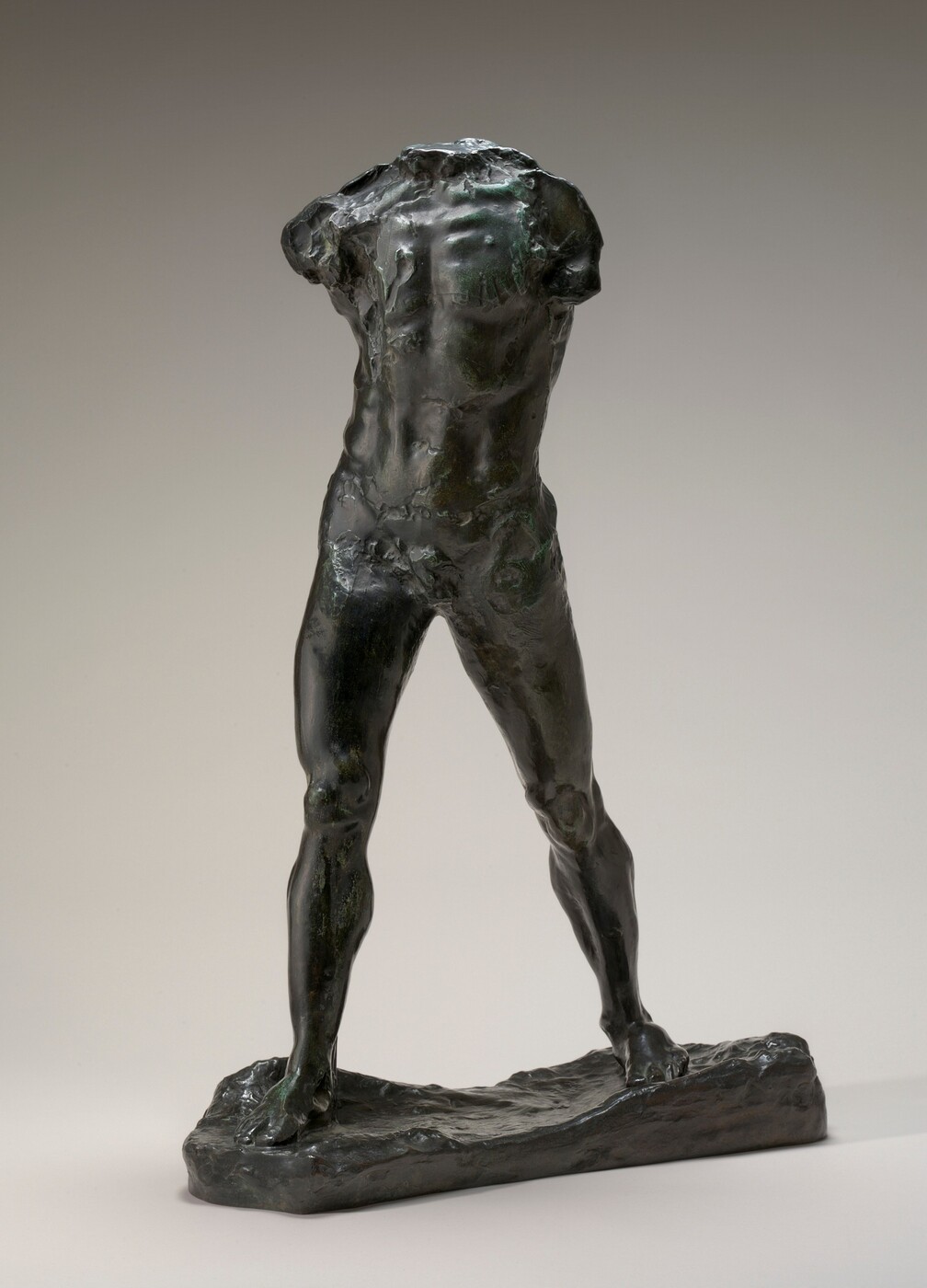
The feet are far apart, the torso gathers above them, and the next step seems overdue. Auguste Rodin’s The Walking Man has no face to announce an intention and no hands to point the way. Looking at the bronze, attention keeps returning to the distance between its feet. Something has begun that the object cannot physically finish.
The photograph shows the National Gallery of Art’s cast, a sculpture just over eighty-five centimeters high. The museum dates its model to 1878–1900 and the bronze probably to 1903.[1] That spread of dates is a clue to its construction. The figure developed through the reuse of earlier studies: a torso and legs associated with Rodin’s Saint John the Baptist became a new composition.[2]
Its incompleteness is deliberate. The Metropolitan Museum of Art, which owns another small cast, explains that Rodin regarded the composition as finished because it conveyed movement.[3] That judgment gives the viewer a useful task. Instead of mentally supplying the missing limbs, look at what the surviving forms already persuade the body to feel.
The join belongs to the movement
A smooth outline might let us take the figure’s unity for granted. Here, the upper body and legs seem to negotiate their connection. The broad stride gives the sculpture a firm spread at the bottom, while the torso rises with a slightly unsettled bearing. It is possible to see both a person moving and an object put together.
The Musée Rodin’s account makes that second impression literal. In the late 1890s Rodin combined an old, cracked torso study with a pair of legs, leaving evidence of the joining visible. The torso had spent years in the studio before its reuse. A plaster version appeared in his exhibition at the Pavillon de l’Alma in 1900.[2] The sculpture’s apparent bodily continuity grew out of separate working lives.
The museum at Meudon describes the assembled torso as leaning forward and turning slightly left. It connects the heightened sense of movement to the imperfect fit between the parts.[5] Alignment, in this reading, is expressive: the small discrepancy helps the upper body seem to be going somewhere.
I find that discrepancy more compelling than an immaculate demonstration of anatomy would be. The figure makes looking into a mild balancing exercise. The eye tries to settle the chest over the legs, then registers the direction in which it escapes that arrangement. Bronze holds the relation still; attention keeps adjusting it.
The roughness also asks to be read carefully. These surfaces belong to a sculpture’s making and remaking. A scarred appearance does not, by itself, establish a story about an injured person. The documented assembly supplies a material history before the viewer supplies a biography.
A stride takes time to see
Rodin offered a useful account of this problem in the conversations recorded by Paul Gsell and published in English as Art in 1912. In the chapter “Movement in Art,” he discusses how a static figure can lead the eye through successive phases of an action. The duration belongs partly to the act of looking.[4]
His example of walking concerns Saint John the Baptist, the composition behind the studies reused here. Gsell describes following the figure’s weight from one leg, through the body, toward the advancing foot. Rodin then contrasts that sequence with the arrested appearance he finds in instantaneous photographs. He acknowledges that his saint’s two grounded feet combine positions that a photograph of the same movement would separate.[4]
That is an artistic argument about how motion is perceived, rather than a general rule of gait. It also concerns Saint John directly; applying it to The Walking Man is a way of reading the related sculpture. With those limits in view, it explains why the bronze need not resemble a single sampled instant to suggest a convincing step.
Try letting your attention travel from one foot up into the torso and down the other leg. Then look at the entire silhouette. The first view unfolds; the second fixes. The sculpture accommodates both experiences, and their friction gives it much of its energy. Its broad stance can look almost stubbornly planted until the torso redirects the eye.
The absent arms make that redirection unusually exposed. There is no swinging hand to provide an easy sign of walking, and no face to turn locomotion into a recognizable person’s errand. The ordinary transfer of weight has to carry the encounter.
Enlarging the unfinished-looking body
The small bronze in the photograph belongs to an earlier scale of the composition. Henri Lebossé enlarged the figure in 1905–06; the Meudon museum records its presentation at the 1907 Salon under the title The Walking Man. Its large plaster model stands 214 centimeters high.[5] These dimensions belong to different objects and stages, rather than interchangeable labels for the pictured cast.
Enlargement changes the terms of looking. An eighty-five-centimeter sculpture allows the viewer to take in the body as a concentrated arrangement. A figure taller than many of its viewers can confront them with its stride. The same unresolved relation between torso and legs acquires a different physical insistence.
Yet scale does not complete the anatomy. The head and arms remain absent. As the Met’s account emphasizes, the work’s claim to completion rests on what it achieves with its assembled parts.[3] A viewer may continue to notice what is missing, but that notice need not become a request for repair.
Return to the feet. Their separation gives the eye somewhere to travel, and the torso gives that travel a direction. The bronze stays exactly where it is. The small anticipation it produces—the feeling that weight is about to pass onward—has already happened in the person looking.
Sources
- National Gallery of Art, “The Walking Man (L’Homme qui marche)” — record and source photograph for the bronze dated model 1878–1900, cast probably 1903; dimensions, provenance, and accession 1942.5.11.
- Musée Rodin, “Multiples, fragments, assemblages” — the reused torso and legs, visible joins, 1900 exhibition, and Rodin’s methods of recombination.
- The Metropolitan Museum of Art, “The Walking Man (L’homme qui marche)” — the composition’s assembly and Rodin’s acceptance of the partial figure as finished; separate cast, accession 40.12.4.
- Auguste Rodin and Paul Gsell, Art, translated by Mrs. Romilly Fedden, 1912, chapter IV, “Movement in Art,” especially pages 71–76 — the eye’s movement through a sculpture and the discussion of Saint John’s stride; digitized by Project Gutenberg.
- Musée Rodin Meudon, “The Walking Man, large model” — the torso’s alignment, Lebossé’s enlargement, the 1907 presentation, and the dimensions of plaster S.00164.