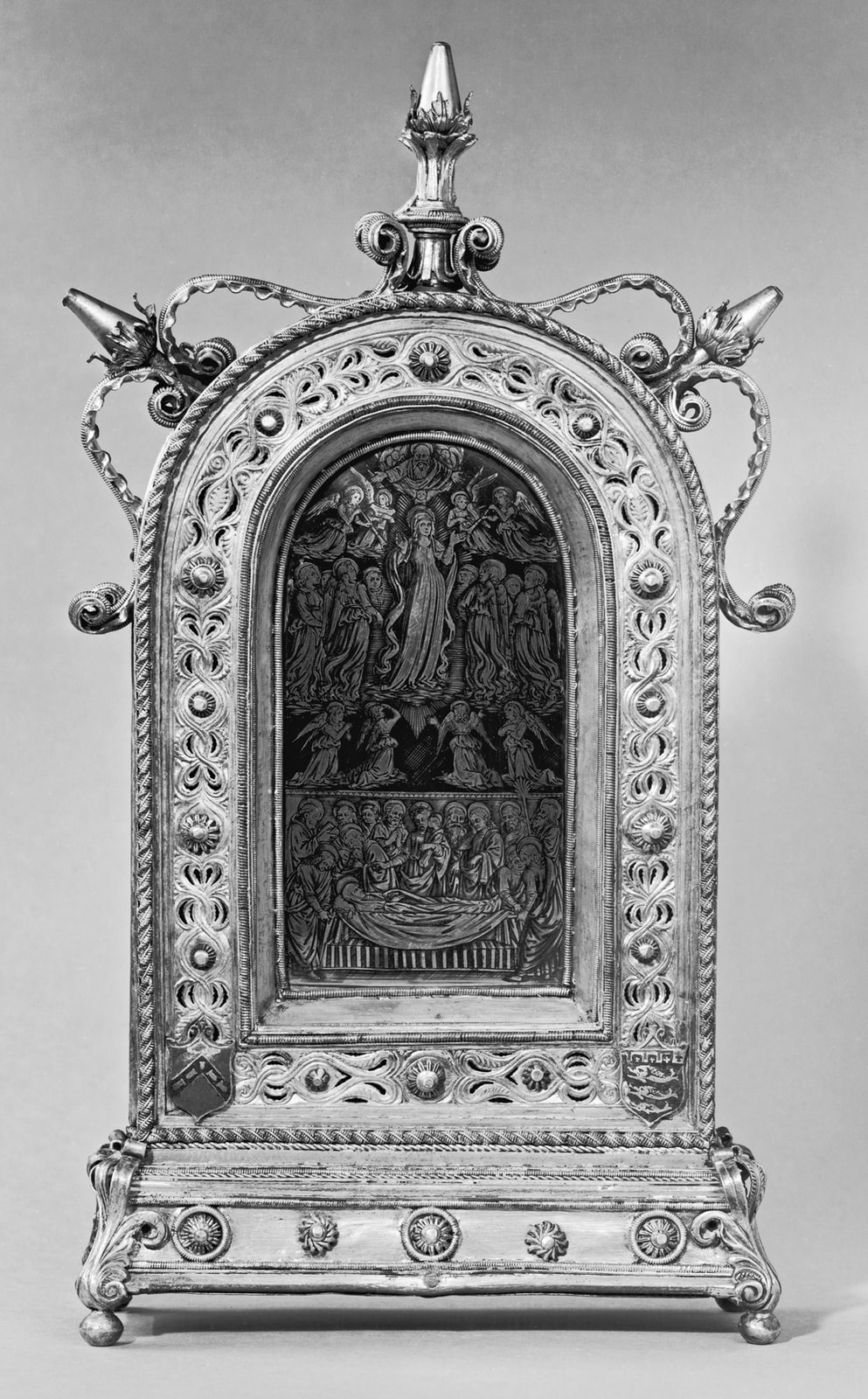
The small figures seem to belong to a drawing, until the gilded frame insists that this is an object. In the Walters Art Museum’s Pax with the Dormition and Assumption of the Virgin, a Florentine work of about 1440–1500, dark lines gather a religious scene onto silver.[1] The eye can follow the picture and almost forget the metal supporting it.
Niello makes that double attention possible. The black is material lodged in the worked surface. To understand its precision, imagine the image before the darkness arrived: an arrangement of incisions waiting to be filled. The finished object brings two crafts into such close agreement that their separate operations become difficult to see.
The cut gives the line a home
Engraving removes metal. A graver or burin cuts into the surface, establishing lines, lettering, or hatching. The V&A distinguishes this from chasing, in which tools displace metal through repeated pressure and tapping. Its account also emphasizes the engraver’s risk: a mistake can damage an object already far along in production.[2]
That distinction matters here because the cut does more than describe a figure. It creates room for another substance. Before the maker can obtain the final dark contour, the silver must already contain its path. The image is being designed both as something to look at and as a set of small recesses to receive material.
For the Walters pax, the museum describes niello powder spread over incisions, followed by heating and polishing until the filling was level with the surrounding metal.[1] The sequence proceeds through removal, addition, and finishing. Polishing belongs to the making of the picture: it brings the dark filling and exposed silver into a shared surface.
Consider what this means for a fold in a robe. Its contour can remain dark even when the neighboring silver catches light. A simple groove offers changing shadow and reflection; a filled groove adds the color of its contents. The line has acquired a material presence of its own.
Similar blacks, different workshop demands
Niello names a family of materials. In their technical study, conservators R. Newman, J. R. Dennis, and E. Farrell describe compounds of sulfur with silver, copper, or lead, alone or in combinations. They stress that different formulations can look much alike while behaving differently during application.[3]
Relatively pure silver or copper sulfide niello is packed into the prepared area, heated, and burnished into place. These materials decompose in air before melting. Some mixed formulations are fusible, allowing the maker to melt the filling into position. The study therefore distinguishes working methods that a finished black line can conceal.[3]
The Walters record describes this pax’s general sequence without publishing an analyzed recipe. We cannot assign it a particular mixture or temperature from the photograph. That limit leaves something valuable intact: the visible result is clear, while the precise workshop procedure remains only partly recoverable.[1][3]
This is also why blackness alone makes a poor identification test. The technical study distinguishes niello from dark lacquers, enamels, and chemical patinas that can resemble it.[3] A material label records knowledge beyond what a visitor can infer simply by looking.
From a ring to an approaching face
The contrast had a long life beyond Florentine silverwork. On an Anglo-Saxon gold ring bearing the name of King Æthelwulf, two birds flank a plant above the royal inscription. The British Museum explains that niello makes the ornament stand out. It interprets this and a related royal ring as probable gifts or symbols of office, rather than objects necessarily worn by the rulers whose names they carry.[4]
Gold changes the color surrounding the inlay, and the ring changes its scale and purpose. Yet the useful relationship remains: a dark material helps articulate ornament on reflective metal. This comparison shows how a technique can travel between kinds of objects without requiring their makers to share a recipe or a single visual ambition.
The Florentine pax brings the relationship close to the body in another way. A pax was presented to worshippers to kiss before Communion. Here the Virgin’s final sleep appears below her reception into heaven; Christ holds her soul in the form of an infant.[1] A compact surface carries a sequence of events for someone approaching it closely.
Seen with its making in mind, the picture invites a slower return. Follow one dark contour, then the silver beside it, then the frame. The line that first looked effortlessly drawn required a place cut for it, material worked into that place, and a surface finished around it. Niello gives the small image its composure by bringing those operations together.
Sources
- The Walters Art Museum, Pax with the Dormition and Assumption of the Virgin, accession 45.4 — museum-supplied object description and photograph, reproduced on Wikimedia Commons under CC BY-SA 3.0; photograph resized. Object and image record.
- Victoria and Albert Museum, “A guide to metalworking techniques,” March 12, 2026 — sections on engraving and chasing, their tools, and their different effects on metal.
- R. Newman, J. R. Dennis, and E. Farrell, “A Technical Note on Niello,” Journal of the American Institute for Conservation 21.2 (1982), pp. 80–85 — metal sulfides, variable recipes, burnishing, fusion, and limits of visual identification.
- British Museum, “Pair of royal finger rings,” Google Arts & Culture — gold and niello ornament, the Æthelwulf inscription, and the museum’s interpretation of the rings’ use.