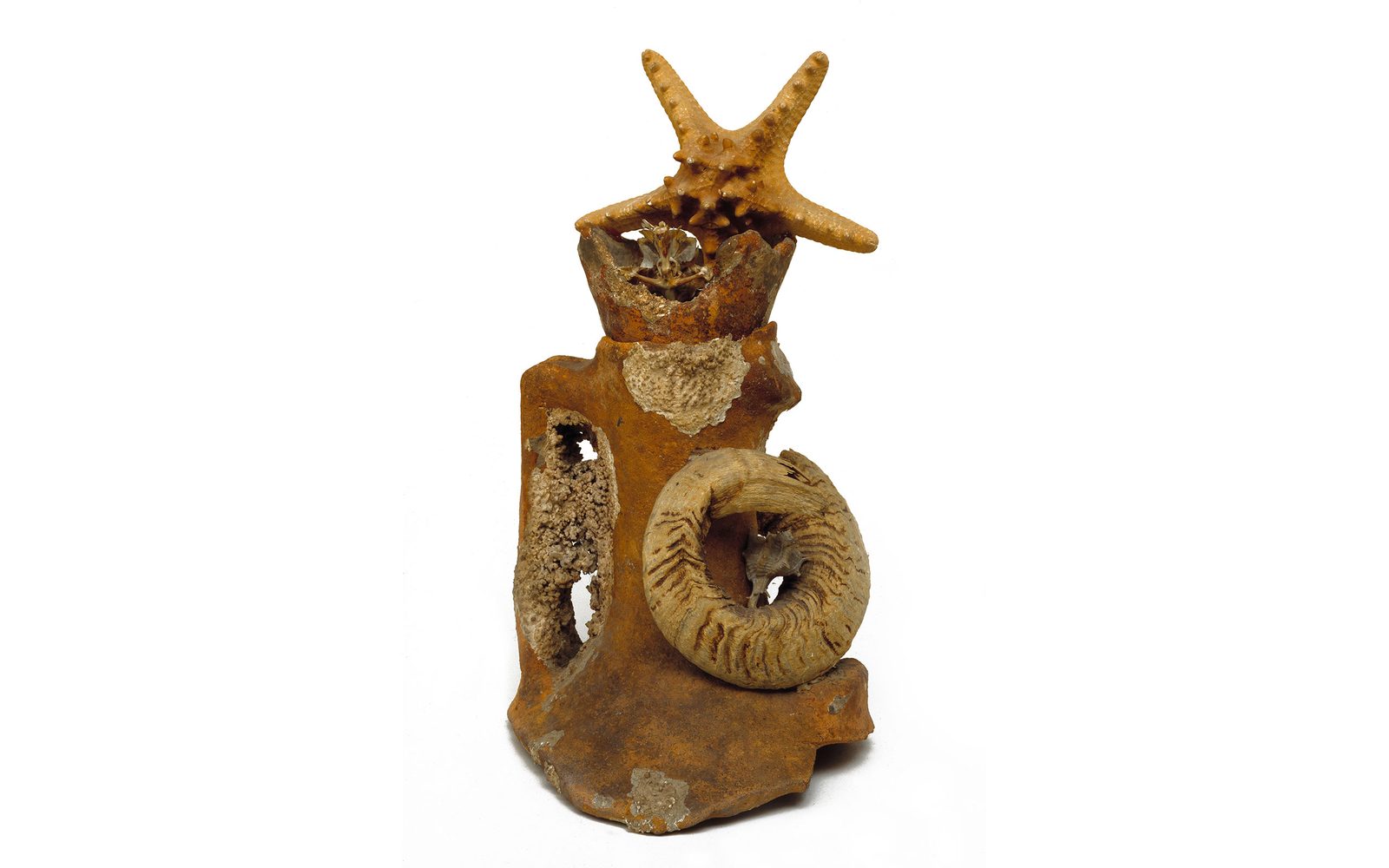
A fisherman’s net brought up part of the story. The rest had to travel. For Marine Object (1939), Eileen Agar combined a Greek amphora bought from a fisherman in Toulon with a ram’s horn collected in Cumbria, a starfish recovered from sea mud, and a marine skeleton. The Henry Moore Foundation’s account makes the sculpture sound, initially, like an inventory of unlikely luggage.[1]
Then the objects begin to belong together. A vessel offers a hollow, a horn supplies a curve, and the starfish spreads its arms across an unfamiliar support. Each part remains recognizable enough to bring its former life into the encounter. The pleasure lies in watching the assembly acquire a presence that none of its ingredients possessed alone.
Agar’s career rewards that double attention: to the thing discovered and the work done after discovery. Across sculpture, collage, photography, and painting, she kept finding ways to give an accidental encounter a durable form.
Choosing an artist’s life
Born near Buenos Aires into a wealthy family, Agar received her schooling in England. Curator Laura Smith’s account for Pallant House Gallery describes the early encouragement of painter Lucy Kemp-Welch and the growing conflict between Agar’s artistic ambitions and the social life expected of her. She entered the Slade School of Fine Art in 1921.[2]
Her education also included study with Leon Underwood and time in Paris. By the early 1930s she was exhibiting with the London Group; her first solo exhibition followed in 1933. This was an established working life before a famous movement supplied its label.[3]
In 1936, Roland Penrose and Herbert Read visited her studio while preparing London’s International Surrealist Exhibition. They selected three paintings and five objects. In the autobiographical recollection quoted by the V&A, Agar remembered being surprised to learn that her personal experiments qualified her as a Surrealist.[3]
The anecdote is funny because classification arrives late. She had already been making the connections that the exhibition would name. It also offers a useful way into her art: begin with her decisions about materials and forms, then consider how those decisions meet the movement’s interest in unexpected associations.
Giving surprise a shape
Smith describes Agar’s achievement as an exchange between Cubism’s analytical structures and Surrealism’s emotional and imaginative freedom. Agar could make a composition feel ordered while leaving its associations unsettled.[2] A strange object still needs somewhere to sit; a surprising fragment changes character when an edge, interval, or neighboring shape gives it emphasis.
Marine Object makes that relationship tangible. Its components came from different places, yet the completed sculpture invites us to imagine a single creature or recovered relic. That is my reading of the assembly, rather than an identification supplied by its title. Its worn materials make the fantasy persuasive because they retain the evidence of having existed elsewhere.
Working on paper gave Agar another way to negotiate that relationship. Pallant House’s Figures in a Forest (1954) brings gouache, ink, pastel, biro, and wax crayon together on one sheet. Smith points to its combination of organic forms and strongly contrasting abstraction.[2] The range of materials makes the studio sound less like a place devoted to one technique than a place where a developing picture could ask for another tool.
Leaves with something to remember
The gaiety has a darker register. In Woman reading (1936), now at Te Papa, a silhouette cut from blue card frames black and printed paper. Pressed foliage crosses the figure. The museum’s detailed description identifies the printed passages, following Agar’s own explanation, as material from The March of Time, concerning historical events and wars.[4]
The leaves carry an equally deliberate association. Agar linked their dryness to time passing, loss, and death. The figure therefore holds several kinds of duration together: the recorded past in the printed words, the arrested decay of the plant, and the reader’s present attention.[4]
That last connection is an interpretation, but it grows from unusually concrete choices. Paper can preserve words about a war; pressing can preserve a leaf while visibly changing it. Bringing the two into a human silhouette makes remembrance part of the body of the picture. Agar’s appetite for found material could accommodate grief as readily as delight.
A discovery could wait fifty years
Her camera extended the practice of collecting. On the Brittany coast in 1936, Agar photographed the rock formations around Ploumanac’h. The Henry Moore Foundation describes her response to these weathered forms as an encounter with sculpture already present in nature.[1] Photography let her carry away their appearance without carrying away the stone.
The photographs had a long working life. Whitechapel Gallery’s account of her career traces a return to them in paintings made in 1985, almost half a century later. Between those moments came wartime anxiety, difficulty concentrating on painting, and renewed experiments after the war with automatic painting and other Surrealist processes.[5]
That interval changes the meaning of spontaneity. An initial recognition could happen quickly, yet its consequences could unfold over decades. A photograph kept the encounter available for another medium and another stage of life. Agar’s curiosity included the patience to return.
She also let assemblage leave the studio on her own head. Her Ceremonial Hat for Eating Bouillabaisse used a cork bowl from St Tropez and marine finds, including shells, coral, and fishbone. The V&A records her wearing it on television in 1948 while walking through London.[3] The familiar act of getting dressed became another occasion for improbable materials to meet.
Return to Marine Object after that hat, those leaves, and the surviving photographs, and its unlikely luggage feels less eccentric. Agar was building a practice in which the world kept supplying possibilities. Keeping something was the beginning. Finding what it could become required an artist.
Sources
- Henry Moore Foundation, “Eileen Agar: Natural Ready-mades,” 2015 — Marine Object, the origins of its components, coastal photography, and image credit.
- Laura Smith, “Eileen Agar: Angel of Anarchy,” Pallant House Gallery, August 13, 2021 — education, Cubism and Surrealism, and Figures in a Forest.
- Rosalind McKever, “Introducing Eileen Agar: a pioneering surrealist artist,” Victoria and Albert Museum, June 4, 2026 — early exhibitions, the 1936 studio visit, and wearable assemblage.
- Museum of New Zealand Te Papa Tongarewa, “Audio description of Eileen Agar’s ‘Woman reading’, 1936” — written transcript describing the collage and recording Agar’s explanations of its materials.
- Whitechapel Gallery, “Whitechapel Gallery announces major Eileen Agar survey for May 2021” — wartime interruption, postwar experiments, and the 1985 paintings based on her Brittany photographs.