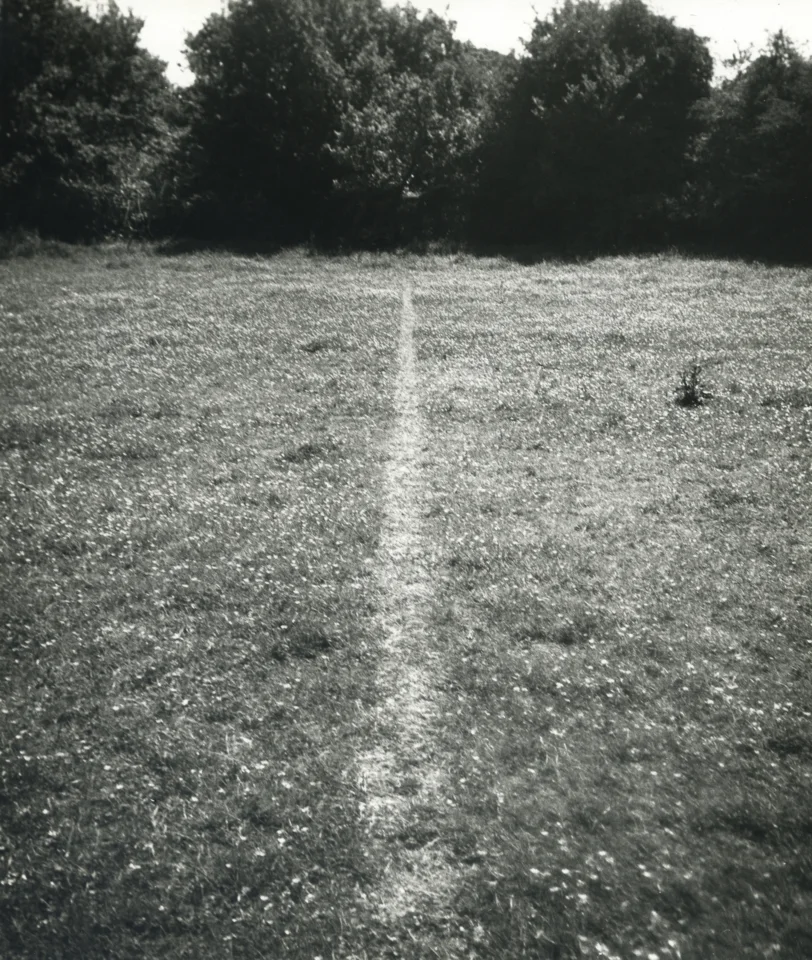
Richard Long's A Line Made by Walking is almost nothing, which is why it keeps working. A pale track runs through grass toward a low horizon. The photograph is quiet, frontal, and plain. There is no heroic body in the frame, no monumental object, no bulldozed earthwork, no dramatic wilderness. The mark could pass for a footpath, except it is too straight, too deliberate, and too recently made to feel anonymous.
Tate identifies the 1967 work as a photograph, a gelatin silver print on paper with graphite on board, now held in the ARTIST ROOMS collection and on display at Tate Modern.[1] That object data matters because the artwork is easy to misname. It is not only the field action. It is not only the walk. It is not only the print. Its force lies in the transfer among them: repeated steps press grass down, light catches the trace, the camera fixes what the field will erase, and the resulting image turns a temporary bodily act into a portable artwork.
Afterall's account gives the basic event: Long, then a student at St Martin's School of Art, walked back and forth along a straight line in the English countryside and photographed the track in black and white.[2] The spare action became a landmark because it made sculpture possible without mass. A line could be made by a body, in a place, over a short duration, and then survive as evidence rather than as a permanent structure. The work's radicalism is not that walking is strange. It is that Long made walking exact enough to count as form.
Image context: the lead image is a real archival photographic artwork sourced from DACS/Artimage, where the caption credits the photograph to Richard Long. This post uses no generated visuals, diagrams, or charts; the visual evidence is the work's own black-and-white record of the line in grass.[3]
A Line That Refuses Monument
Most sculpture asks the ground to hold something: stone, bronze, steel, clay, timber, a stacked weight, a cast body, a built form. Long asks the ground to register contact. The line in the photograph has no volume in the usual sculptural sense. It is made by subtraction and pressure: upright grass has been flattened, and the viewer reads that flattening as form.
That difference changes the artwork's ethics. A monument claims duration by resisting weather. A Line Made by Walking accepts that weather will win. Rain, growth, wind, and ordinary recovery will lift or blur the grass. The work's material life in the field is brief, but that brevity is not a failure. It is the point. Long makes sculpture without pretending that sculpture must dominate the site that receives it.
The photograph keeps the line from vanishing entirely, but it does not make the line heavy. The print preserves a fragile action as fragile. Its smallness and grayscale restraint keep the viewer close to the original fact: a person walked, repeatedly, until the landscape held a visible trace. The artwork is therefore not a conquest of land. It is a measurement of touch.
The Walk Is The Tool
Long's later reflection, published by DACS, sharpens how provisional the original journey was. He had the idea before arriving at the site, took a stopping train southwest out of London, left the train when the countryside appeared, and found a suitable field by chance.[3] That sequence is crucial. The idea was precise, but the place was not preloaded with myth. The field did not need to be famous. It needed to be receptive.
This is one reason the work resists romantic landscape reading. Long does not photograph an exceptional vista and ask the viewer to admire nature from a safe distance. The line is the event, and the landscape is both support and collaborator. The straightness of the mark is human; the grass, slope, horizon, and light keep it from becoming purely geometric. It is a drawing made with feet, but the paper pushes back.
Calling the walk a tool does not make the work mechanical. It makes it bodily. The line carries fatigue, rhythm, balance, and repetition, even though Long's body is absent from the image. Every step had to land close enough to the previous one to deepen the trace. The line is disciplined, but not machined. Its slight softness comes from grass yielding under human weight rather than from a ruler cutting across a surface.
Photography Does Not Merely Document
The photograph is sometimes treated as secondary evidence, as if the real artwork happened outside and the image merely reports it. That reading misses the intelligence of the piece. Without the photograph, the line would still have happened, but it would not have entered the circulation of art in the same way. The camera is not an afterthought. It is the hinge between action and afterlife.
At the same time, Long avoids the theatrical pose of performance documentation. He does not show himself walking the line. He does not ask the viewer to admire endurance or personality. The photograph records the result, not the performer. That decision keeps attention on relation: body to ground, line to horizon, act to record, disappearance to memory.
The image also creates a productive ambiguity of scale. A viewer can see the whole line at once, yet cannot know exactly how long the walk took or how many passes made the grass pale enough to photograph. The work feels both immediate and withheld. It offers just enough information to understand the action, then leaves the bodily duration inside the line rather than turning it into spectacle.
Why The Horizon Matters
The horizon is the photograph's quiet partner. It prevents the line from becoming a studio abstraction. If the line were cropped tightly, it might read like a mark on paper. With the horizon present, the mark becomes a path across a real field, and the viewer feels the body's orientation through space. The line points away, but not toward a destination. It measures direction without promising arrival.
That matters for Long's wider practice. The Guardian's 2022 profile presents his career as a sustained life of walks, local returns, routes, stones, rivers, and repeated encounters with landscape rather than as one youthful gesture frozen in 1967.[4] A Line Made by Walking already contains that future. The line is not a closed symbol. It is a first route, a proof that walking can be both ordinary movement and artistic structure.
The work also shifts the role of the viewer. We do not stand before it as we might stand before a statue. We mentally walk into it. The line invites projection: the repeated pacing, the stop to photograph, the field recovering afterward. The image is still, but it makes looking kinesthetic. The viewer sees with the body as much as with the eye.
A Small Work With A Large Consequence
Afterall describes the work as a landmark for a new kind of art emerging in Europe and the Americas.[2] The claim holds because Long's line changed the threshold for what could count as sculpture. The artwork does not abandon form; it strips form down to contact, direction, duration, and record. It does not abandon the object; it relocates objecthood into a photograph that carries the memory of a vanished mark.
That relocation still feels contemporary. So much current art depends on documentation, traces, instructions, walks, fieldwork, and temporary situations that Long's 1967 work can seem almost obvious in retrospect. It was not obvious. It required a precise refusal: no pedestal, no studio finish, no grand alteration of terrain, no heroic self-image. Just a body, a field, a line, and a photograph strong enough to keep absence visible.
The piece endures because it does not inflate itself. Its modesty is exacting. The line is narrow, but it holds an argument about sculpture's relation to time. The grass will rise; the photograph will remain; the walk will be gone and still legible. Long made a footpath become sculpture by showing that a line need not be built to be made, and a work need not last in the landscape to alter how we understand the landscape as a site of art.[1][2][3]
Sources
- Tate, "A Line Made by Walking" - collection record for Richard Long's 1967 work, including medium, ARTIST ROOMS context, and Tate Modern display note.
- Afterall, Dieter Roelstraete, Richard Long: A Line Made by Walking - One Work publication page summarizing the 1967 action, photograph, and land-art significance.
- DACS, "Richard Long describes 'A Line Made by Walking'" - artist reflection on the work's conception and DACS/Artimage source page for the photographic image.
- The Guardian, Mark Hudson, "'I've drunk from every river on Dartmoor': land artist Richard Long on changing the face of art" - 2022 profile of Long's walking practice and later career.