Mingei can look quiet enough to be mistaken for taste. A bowl with a combed surface, a straw rain cape, a textile with wear in it, a cupboard, a ladle, a basket, a piece of pottery meant to be held rather than displayed: none of these arrives with the theatrical self-importance of a manifesto object. That is exactly why the movement still matters. Mingei made ordinary usefulness carry an aesthetic argument.
The word itself is a compression. Mingei International Museum explains it as a term formed from "min," meaning people, and "gei," meaning art, and places the modern movement around the thinking of Soetsu Yanagi and the folk-craft value he saw in everyday objects.[1] The William Morris Gallery's exhibition framing is even sharper: Art Without Heroes treats Mingei as a challenge to art history's habit of chasing named geniuses while overlooking things made for use, often by unknown craftspeople, across Japan, Korea, and wider craft networks.[2]
That challenge did not appear in a vacuum. SFO Museum situates Mingei against the pressures of modernization after the Meiji period, when industrial production and imported standards threatened local craft systems; it also notes the 1934 founding of the Mingei Kyokai and the 1936 opening of the Japan Folk Crafts Museum in Tokyo.[4] Mingei was not nostalgia alone. It was a counter-institutional move: collect, name, exhibit, and defend humble objects before speed, novelty, and factory sameness made them invisible.
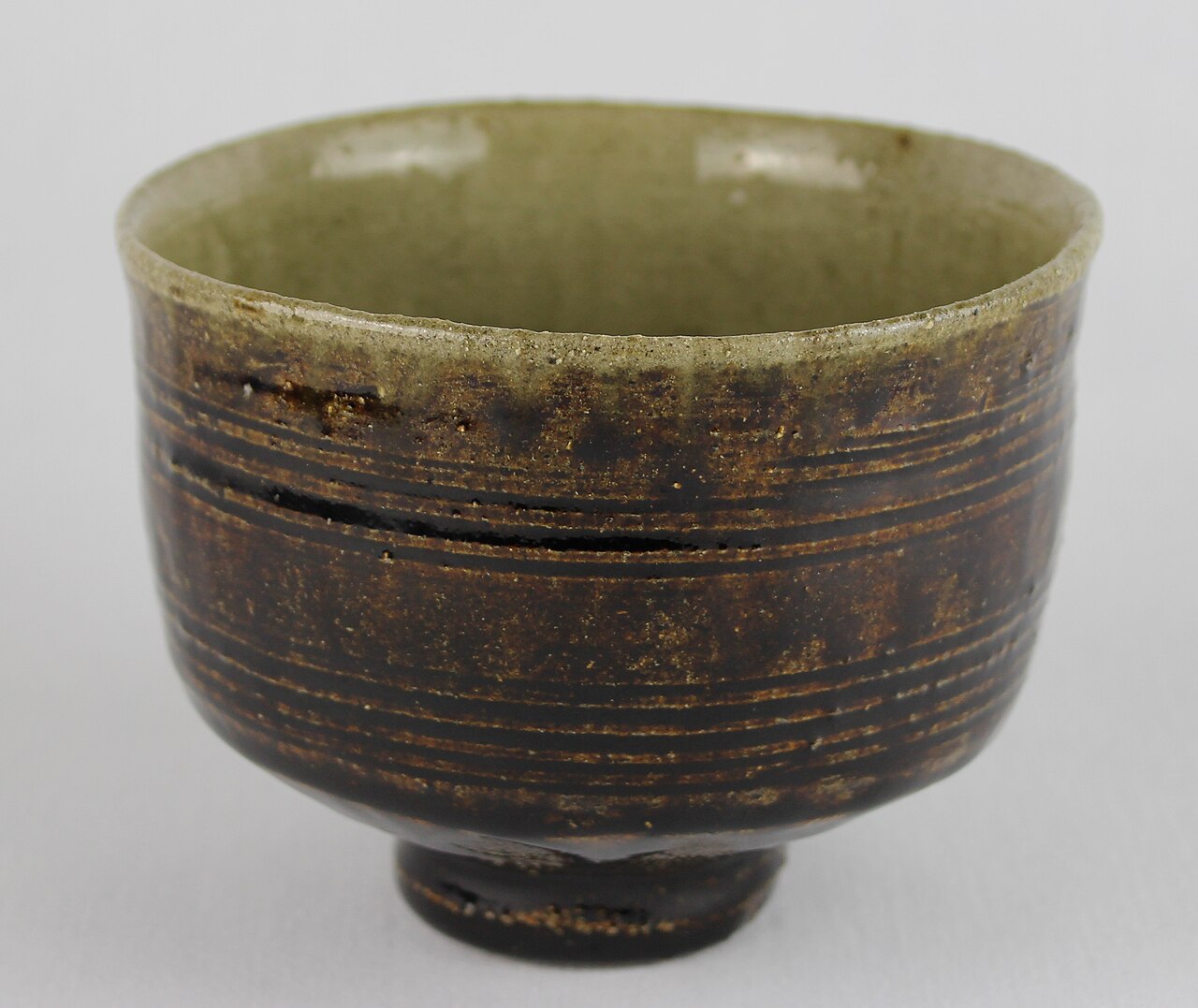
Image context: the lead image is a real photographic record of a Shoji Hamada tea bowl from Wikimedia Commons, not a generated visual, chart, or explanatory diagram. The object is a fitting visual anchor because the movement's claims live in material touch: thrown clay, combed marks, glaze variation, and a scale meant for use in the hand.[5]
Use Is Not A Small Detail
The easiest way to flatten Mingei is to call it "simple." Simplicity was present, but it was not the whole point. Use was the discipline. A bowl that must sit in the hand cannot indulge every sculptural fantasy. A cupboard that must hold things cannot perform pure abstraction. A basket that must carry weight has to make structure legible. In Mingei, use is not a reduction of art. It is a pressure that keeps form honest.
This is why Yanagi's circle cared so much about ordinary objects rather than elite studio statements. The V&A's account of the Arts and Crafts movement beyond Britain places Mingei in a broader international current, while identifying Yanagi, Hamada Shoji, Kawai Kanjiro, and Bernard Leach as key figures who valued direct perception and handmade daily objects.[3] "Direct perception" matters here. Mingei asks the viewer to look before ranking: shape, weight, surface, handle, firing mark, repair, repeated pattern, and the body's memory of use come first.
That order changes the politics of looking. A museum can turn any object into an untouchable specimen, but Mingei's argument begins before the vitrine. It begins with a hand reaching for a cup, a house relying on storage, a kitchen repeating gestures, a local kiln knowing its clay, a textile carrying seasons of wear. Beauty is not added after utility is solved. Beauty appears because utility has shaped the object over time.
Anonymous Does Not Mean Ownerless
The phrase "anonymous craft" is powerful, but it can also be dangerous if it becomes a romance of faceless labor. Mingei is strongest when anonymity is read as a correction to heroic authorship, not as permission to erase makers. The movement admired objects whose names were often unrecorded because their forms had been refined through communities of practice, local materials, inherited techniques, and repeated use. That is different from saying nobody made them.
The William Morris Gallery's "art without heroes" frame helps because it does not simply deny artistry. It shifts where artistry is located.[2] Instead of looking for a single signature, Mingei looks at a chain: the potter's hand, the kiln's heat, the clay's impurities, the household's needs, the market's habits, the region's vocabulary, and the passage of time. Authorship becomes distributed without becoming vague.
Hamada's bowl makes that distribution visible. It is not anonymous in the strict sense, since the object is attributed to him, but it helps explain why the movement respected non-heroic form. The bowl does not need an invented narrative to look alive. Its dark exterior bands, irregular combing, pale interior, and slightly breathing rim make finish feel inseparable from process. It is refined, but not polished into deadness.[5]
A Movement Against Two Kinds Of Forgetting
Mingei resisted industrial forgetting, the loss of local craft knowledge under mass manufacture. It also resisted art-historical forgetting, the habit of ignoring useful objects until a museum, market, or named modernist authorizes them. That double resistance explains why the movement still feels current. Contemporary design culture often claims to value materials, sustainability, repair, and local knowledge, yet it can still chase novelty with the old speed. Mingei slows that appetite down.
SFO Museum's historical account makes the institutional side visible: the movement built associations, collections, and museum settings to protect and interpret folk arts that might otherwise have been dismissed as backward or merely domestic.[4] The V&A's wider Arts and Crafts comparison also keeps Mingei from becoming a sealed Japanese episode. It belongs to a larger twentieth-century question: how should handmade knowledge survive when machines, empires, trade, and design education are reorganizing everyday life?[3]
The answer Mingei offered was not pure retreat. Hamada, Kawai, Leach, and Yanagi were modern figures, building arguments across exhibitions, publications, collections, travel, and institutions.[1][3][4] Their defense of folk craft was itself a modern act of framing. That tension is part of the movement's complexity. Mingei did not simply preserve a premodern world. It taught modern viewers how to see objects that modernity had trained them to overlook.
Why The Quiet Still Cuts
Mingei's quietness is easy to underestimate because it avoids spectacle. It does not ask useful things to become loud in order to matter. Instead, it asks the viewer to accept a harder standard: does the object reveal its making, serve the body, respect material limits, and hold beauty without demanding heroic exception?
That standard can still unsettle a room full of polished design. A perfectly branded object may have less life than a worn bowl. A limited-edition art object may be less intelligent about use than a regional tool refined by repetition. A named artist may matter less, in a particular case, than a form carried patiently through unknown hands.
Mingei made usefulness look radical because it changed where seriousness could be found. Not only in the studio, the signature, the avant-garde shock, or the museum label, but in the handled object whose beauty had been tested by life before theory caught up with it.[1][2][4]
Sources
- Mingei International Museum, "History of Mingei" - explanation of the term, Soetsu Yanagi's role, and the movement's folk-art principles.
- William Morris Gallery, "Art Without Heroes: Mingei" - exhibition page framing Mingei through anonymous craft, everyday objects, and the challenge to heroic art history.
- Victoria and Albert Museum, "The Arts and Crafts movement beyond Britain" - international Arts and Crafts context, including Mingei, Yanagi, Hamada, Kawai, Leach, and direct perception.
- SFO Museum, "Mingei: Traditional Japanese Arts" - historical context on modernization, the Mingei Kyokai, the Japan Folk Crafts Museum, and Japanese folk-art preservation.
- Wikimedia Commons, "Thrown, Combed tea bowl by Shoji Hamada" - source page for the real photographic image used as the cover.