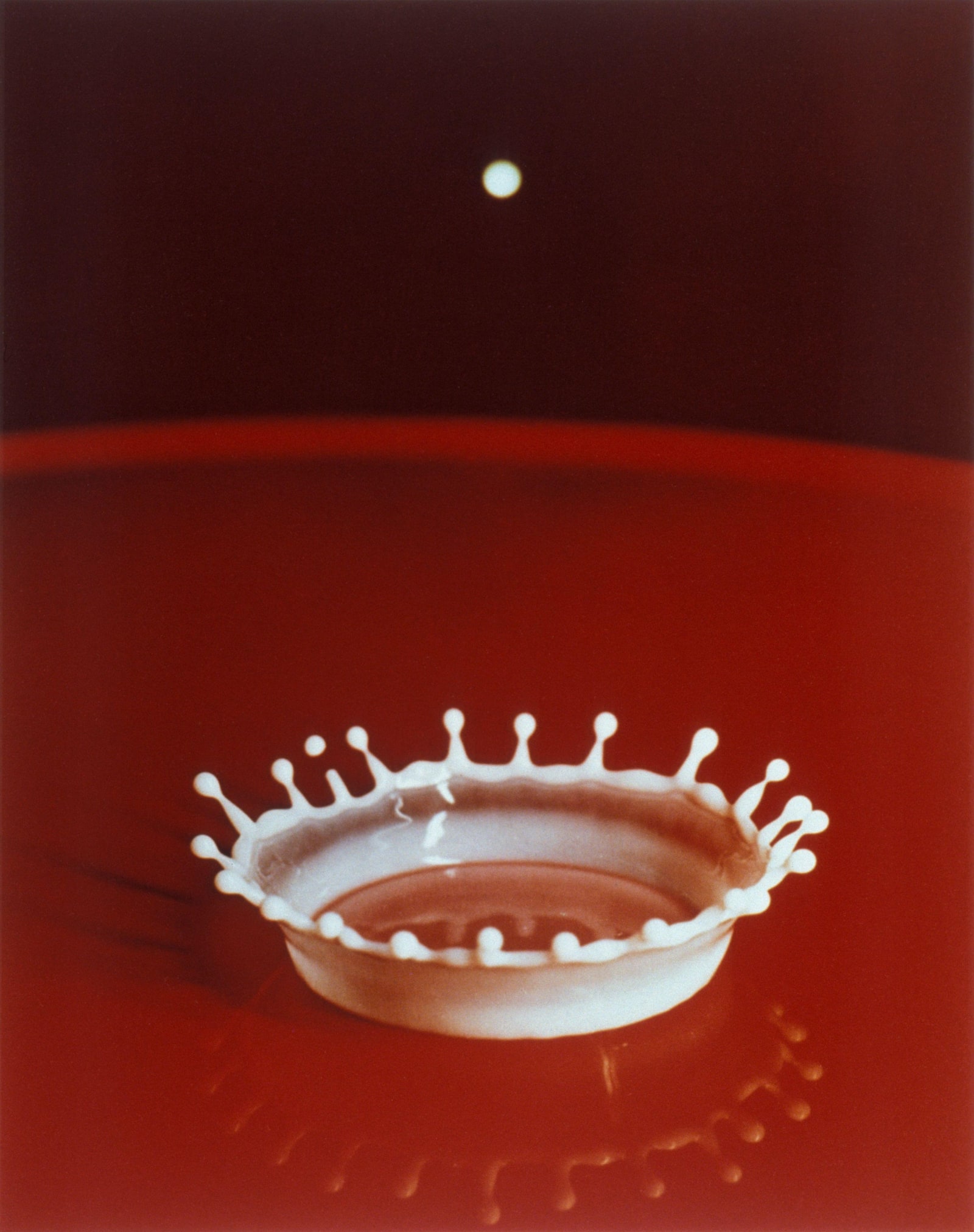
Harold Edgerton's Milk Drop Coronet looks at first like a small miracle of luck: a white liquid crown rises from a red field, its beads evenly spaced, while a second drop hangs above it like a punctuation mark. The picture's charm is immediate. It can be enjoyed before the viewer knows anything about engineering, strobe tubes, or MIT laboratories. But the deeper pleasure comes from realizing that the image is not a lucky splash caught by a quick finger. It is an apparatus made visible.
The Denver Art Museum identifies the work as a 1957 dye transfer print and places it inside a larger shift: before Edgerton, the strobe was specialized laboratory equipment; after his refinements, short, bright flash became a common photographic tool.[1] Science Friday's account sharpens the timing. The photograph captures roughly 1/10,000 of a second, after Edgerton had returned to the milk-drop problem for years, using flash technology precise enough to make events too fast for eyesight legible as images.[2] That is why Milk Drop Coronet still feels fresh. It does not merely show a beautiful thing. It manufactures a condition under which beauty can briefly appear.
Image context: the hero image uses the archival photographic file of Edgerton's Milk Drop Coronet from Wikimedia Commons, linked back to the MIT Museum object record. The image belongs here because the article depends on seeing the exact liquid form, suspended drop, red field, and high-speed photographic evidence rather than a diagram of the process.[5]
The splash is a system, not an accident
The word "coronet" matters because it turns physics into social form. A drop of milk hits a shallow pool, displacement drives liquid outward, surface tension pulls it into a rim, and instability lifts little beads along the edge. In ordinary seeing, that event is too quick and too small to settle into memory. Edgerton's picture makes the fleeting rim behave like an object with posture. The splash becomes architectural: base, wall, points, ornament, shadow.
That transformation depends on the camera's refusal to act like an ordinary camera. Science Friday explains the core trick in plain terms: Edgerton's flash was so brief that the light, rather than the camera shutter alone, decided the visible instant.[2] The frame is less a photograph of continuous time than a slice cut by illumination. Darkness does much of the editing. The event exists before and after the frame, but the viewer receives only the instant the system has selected.
This is why the suspended drop above the crown is so important. Without it, the photograph might become decorative, a pleasing white ring on red. With it, the image keeps the sequence alive. The upper bead is a timer. It tells us that another impact is coming, that the crown below is not a finished sculpture but one frame in a chain of collisions. Edgerton makes time stop, but he also leaves enough evidence that stopping time is a controlled fiction.
The machine has an aesthetic
Edgerton was trained as an electrical engineer, and the International Center of Photography's biography gives the scale of that technical life: Nebraska-born, MIT-trained, on the MIT faculty, holder of numerous patents for strobe and electrical engineering devices between the 1930s and 1960s.[3] Those facts matter because Milk Drop Coronet is not art that borrows science as a theme. It is art made from the operating logic of a scientific instrument.
The old MIT demonstration film preserved on Infinite MIT makes the public claim behind the device wonderfully clear. A synchronized strobe can make a fan seem still, reveal effects visible only while machinery is moving, and turn bullets or shattering objects into analyzable motion.[4] That industrial usefulness is still present in Milk Drop Coronet. The image is beautiful because it is diagnostic. It lets the viewer inspect a fluid event as if the splash were a mechanical assembly with parts.
The aesthetic is therefore not softness, accident, or expression. It is control with room for surprise. Edgerton does not paint the milk into a crown. He builds a situation where liquid physics can draw itself for one instant, then gives that instant enough light, color, and exposure to become visible. The artist's gesture is displaced into setup: timing, trigger, flash duration, drop height, surface, color field, print process. The hand is hidden, but decision is everywhere.
Red makes the experiment theatrical
The photograph's red background is more than a contrast device. It pushes the milk crown toward stage presence. White against red reads cleanly at a distance, but the color also warms the laboratory event, moving it away from sterile demonstration and toward something almost ceremonial. The dye transfer print listed by Denver matters here because the color is part of the final work's persuasion, not just a documentary byproduct.[1]
Look at the lower shadow and the faint reflection around the crown. They keep the splash from floating in pure abstraction. The event happens on a surface. Gravity still applies. The milk has weight, thickness, and a messy future outside the perfect instant. That material grounding prevents the image from becoming a mere technical stunt. It remains a photograph of matter behaving, not a graphic symbol of speed.
At the same time, the composition is startlingly spare. There is no lab bench, no technician, no measuring grid, no explanatory label in the frame. Edgerton removes nearly everything that would make the apparatus visible, then leaves the result of the apparatus as the subject. The viewer is caught between two readings: a crown that seems almost designed and a splash that could never have been designed by hand.
Why this still feels modern
In a culture used to slow-motion video, computational image stacking, and synthetic visual effects, Edgerton's photograph could seem quaint. It does not. Its power comes from the clarity of the bargain. The image says: if you want to see what the world is doing, you may need to build a new way of seeing. That claim remains contemporary because cameras have only become more instrumental, more algorithmic, and more involved in deciding what counts as visible evidence.
But Milk Drop Coronet also resists the coldness of pure instrumentation. Denver's object text emphasizes Edgerton's sense of beauty and drama, and the print justifies that claim.[1] The crown is not important only because it proves a flash tube worked. It is important because the instrument revealed a form that human vision could not have invented on its own. Technology here does not replace wonder. It gives wonder a sharper edge.
That is the enduring lesson of the photograph. Edgerton did not make time stand still in any literal sense. He made timing into an artistic material. He turned flash duration, trigger control, and liquid motion into a visual event that still reads instantly, even before its mechanics are explained. Milk Drop Coronet remains one of the great images of art and technology because it refuses to separate evidence from delight. The picture is proof, performance, and crown at once.
Sources
- Denver Art Museum, "Milk Drop Coronet" - collection record for Harold Eugene Edgerton's 1957 dye transfer print and museum note on the strobe light, invisible motion, beauty, and drama.
- Science Friday, Emma Bryce, "The Story Behind That Iconic Milk Drop Picture" - account of the 1/10,000-second exposure, Edgerton's long milk-drop work, xenon flash, and short-duration light.
- International Center of Photography, "Harold Eugene Edgerton" - biographical archive note on Edgerton's MIT career, electrical engineering background, patents, and stroboscope work.
- Infinite MIT, "How Fast Is Fast? - Harold 'Doc' Edgerton" - interactive transcript showing the stroboscope's machine-diagnostic and ultra-slow-motion demonstrations.
- Wikimedia Commons, "File:Milk Drop Coronet, 1957.jpg" - archival photographic file page used for the article image, with date, description, dimensions, and MIT Museum credit link.