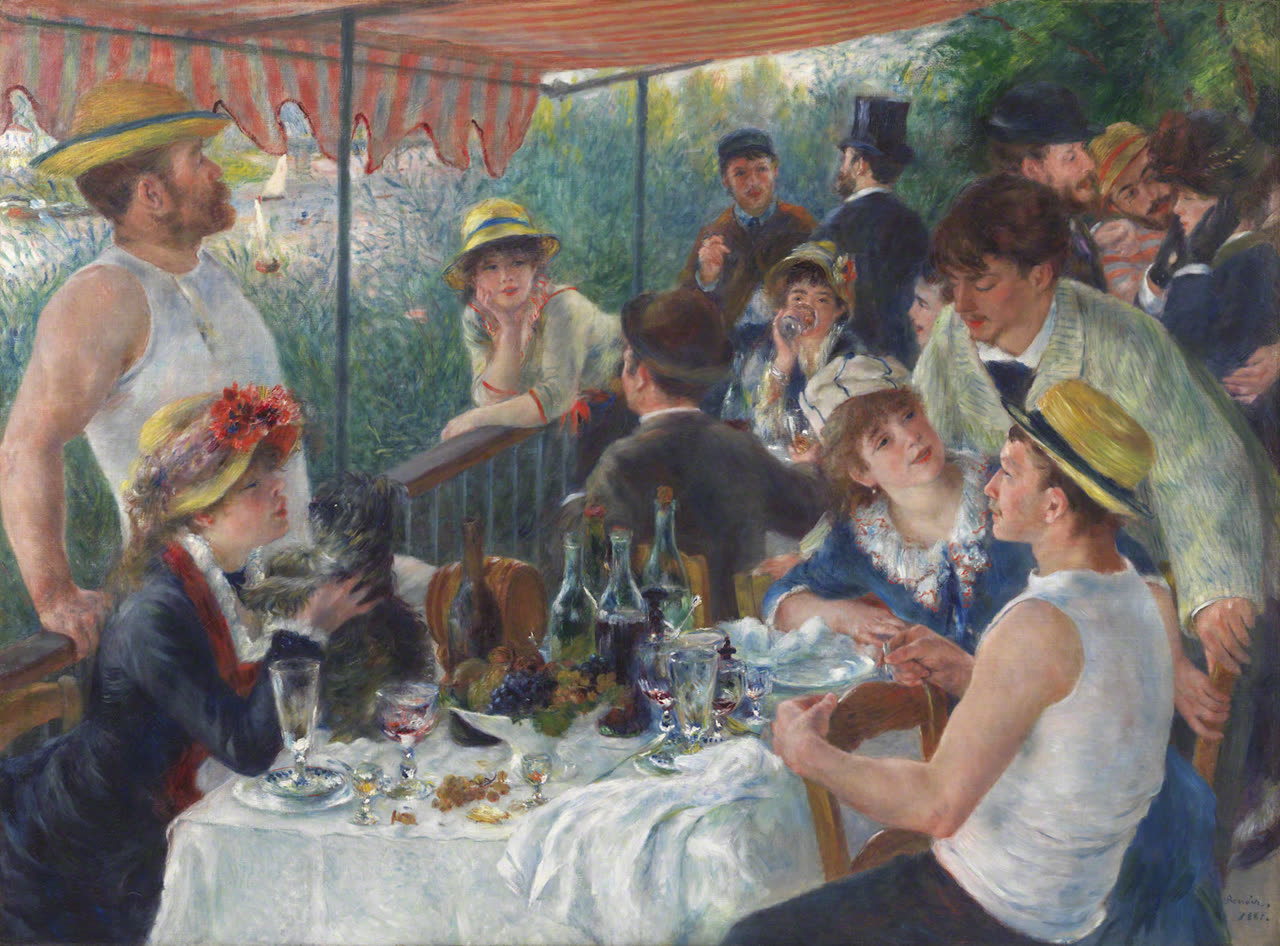
Pierre-Auguste Renoir's Luncheon of the Boating Party is usually remembered as one of painting's happiest crowds.[1][3] The memory is understandable. Straw hats tilt, glasses catch the light, a little dog lifts the mood in the foreground, and the whole terrace seems to vibrate with late-afternoon sociability. Yet the painting lasts for a harder reason. Its pleasure is built, not merely felt. Renoir turns what could have been a loose anecdote of friends at lunch into a remarkably exact system of intervals: between one face and the next, between table and railing, between the balcony's shallow enclosure and the river air beyond it.[1][2][4]
That difference matters because crowds in painting often collapse into either confusion or theater. Renoir avoids both. He gives the scene enough movement to feel casual, but he also keeps every figure legible inside a larger compositional order. The result is why this picture still feels abundant without becoming noisy. Leisure here is not emptiness. It is a social arrangement.
Image context: the lead image uses the full painting because this close reading depends on Renoir's spatial braid. Crop to the lower right and you keep Aline Charigot with the dog but lose the balcony's outward pull; crop to the upper half and you lose the tablecloth, fruit, glassware, and the bodily compression that make the scene feel inhabited. The work's meaning sits in the traffic between those zones.[1][2]
The balcony is a stage that still breathes
The first thing Renoir gets right is the setting. The Phillips Collection's exhibition page is precise on this point: the picture was mostly painted on the balcony of the Fournaise restaurant in Chatou, and that location is more than scenery.[3] It gives Renoir a shallow terrace where bodies can be packed tightly without suffocating the image. The balcony rail runs almost horizontally across the middle distance, holding the crowd in place while still allowing patches of river and sky to leak through.[1][3]
That matters because the painting is neither fully interior nor fully outdoors. The striped awning above acts like a ceiling, turning open air into a temporary room, while the railing prevents the river from dissolving the group into pure landscape.[1][3] Renoir therefore gets two kinds of atmosphere at once. He has enclosure enough for intimacy and openness enough for light. The painting feels social because it understands that parties need architecture, even improvised architecture, to keep bodies in relation.
This is where the scene's famous ease starts to sharpen. A picnic on open grass would disperse the figures. A dining room wall would flatten them. The balcony allows compression with ventilation. Renoir can crowd the foreground and still keep the upper half luminous. Joy arrives through that calibration.
Renoir organizes the crowd in clusters, not in a blur
The Phillips object page identifies most of the sitters, and its inventory is useful because it shows how deliberately Renoir arranges them.[1] In the right foreground, Aline Charigot bends toward the little dog, making one of the softest passages in the whole picture.[1] Across from her sits Gustave Caillebotte, turned backward in his chair, more upright and angular.[1] At the railing stands Alphonse Fournaise Jr., leaning into the scene but not fully absorbed by it.[1] Elsewhere, heads pair off, glasses lift, elbows rest, and conversations overlap in twos and threes.[1]
That grouping principle is the core of the composition. Renoir does not paint a single crowd mass. He paints local knots of attention. One person listens while another turns away. One pair occupies the rail while another occupies the table edge. The eye can therefore travel without getting lost. It moves from Aline and the dog to Caillebotte, from the central white tablecloth to the standing figures, from the upper-right laughter to the river glimpsed behind the railing.[1][2]
The technical study at the Phillips makes this feel even more impressive because it argues that much of the painting's success lies in the convincing interaction Renoir creates among his models, and that their arrangement in twos and threes is what leads the eye through the composition.[2] That sentence gets to the painting's real feat. Renoir is not simply recording sociability. He is engineering circulation. The crowd feels natural because the picture has been carefully designed to meter attention.
The table is the painting's pressure zone
Many viewers remember the faces first, but the white tablecloth does just as much structural work.[1][2] It is the broadest light shape in the lower half of the painting, and it gathers bottles, glasses, fruit, hands, and folded fabric into one common field. Without it, the figures would break into separate portraits. With it, they become participants in one event.
The table is also where Renoir solves a major problem of social painting. He needs enough still-life density to make the lunch feel real, but not so much that objects overpower the people. The answer is distribution. The fruit bowl, wine bottles, and glassware give the foreground weight, yet none of them becomes a showpiece. They hold the lower edge of the image so that the faces can stay mobile above.[1] In practical terms, the tablecloth behaves like a visual floor for the crowd.
This is one reason the painting feels both intimate and monumental. Monumentality here does not come from heroic gesture. It comes from giving ordinary lunch objects enough pictorial authority to stabilize a many-figure scene. The meal is not a prop. It is the white plane on which Renoir can rest the whole composition.
The spontaneity is real, but it was revised into place
The Phillips technical study is indispensable because it prevents the painting's ease from being mistaken for improvisation.[2] Infrared images, X-radiography, and paint cross-sections show that Renoir reached this result only after multiple revisions.[2] The study notes that no preparatory drawings are known, that little underdrawing appears in infrared, and that the work seems to have been developed directly on the canvas as the composition evolved.[2] Renoir himself complained in a letter that friends were coming and going and that the picture had become difficult to finish.[2]
That evidence changes the emotional reading of the painting. The scene is cheerful, but the making was laborious. Renoir had to remove figures, reposition relationships, and repaint passages before the crowd would hold.[2] Drying cracks and buried brushwork testify to that reworking process.[2] This is not bad news for the painting. It is the reason the pleasure feels durable. What reads as unforced sociability is the result of repeated decisions about spacing, overlap, and emphasis.
Seen that way, Luncheon of the Boating Party becomes more than an Impressionist snapshot. The Met's Renoir essay describes the picture as showing a new solidity and clarity in the depiction of figures and their placement within space.[4] That is exactly the point. Renoir keeps the broken light and lived immediacy associated with Impressionism, but he binds them to a firmer architecture of bodies. The painting smiles, yet it never slumps.
Why the painting still holds
The strongest crowds in art do not merely show many people. They create readable relations among them. Renoir's balcony lunch still works because every local pleasure answers to a larger order: the rail behind the figures, the awning above, the white table below, the clustered conversations inside, and the river's looseness outside.[1][2][3] Each element keeps the others from drifting. Air meets structure. Friendship meets pictorial discipline.
That is why the image remains so memorable. It offers one of modern art's most persuasive fantasies of collective ease, but it does so without pretending that ease comes naturally. Renoir had to build the afternoon carefully enough that it could look as though it had simply happened.[2][4] The painting's joy survives because its intervals do.
60-second viewing drill
- Start at the lower right with Aline Charigot and the dog, and notice how softly the picture opens.
- Move across the white tablecloth and track how bottles, fruit, and glasses hold the whole lower field together.
- Lift your eye to the railing and ask how the balcony both encloses the group and lets river light escape through it.
- Finish with the clusters of faces in twos and threes, and test whether the scene would still feel effortless if even one of those intervals were badly placed.[1][2]
Sources
- The Phillips Collection, Luncheon of the Boating Party - collection page with figure identifications, acquisition history, and the museum's reading of the painting's monumentality.
- The Phillips Collection, "Luncheon of the Boating Party" technical study - infrared, X-radiographic, and paint-layer analysis showing Renoir's multiple revisions and compositional reworking.
- The Phillips Collection, Renoir and Friends: Luncheon of the Boating Party - exhibition page on the work's creation, the circle of friends who modeled for it, and the Fournaise balcony setting.
- Cindy Kang, "Auguste Renoir (1841-1919)," The Metropolitan Museum of Art, Heilbrunn Timeline of Art History - artist essay locating Luncheon of the Boating Party within Renoir's move toward greater solidity and spatial clarity.