Precisionism is often introduced as the American art movement that loved factories.[1] That description gets the subject right and the mood wrong. The movement's real achievement was not simple machine worship. It invented a new emotional temperature for American modernity: hard edges, scrubbed surfaces, abrupt crops, and a calm so controlled it starts to feel strange.[1][2][3] In Precisionist painting, a grain elevator can look like a cathedral, a bridge like a theorem, and a steel mill like a devotional image that has mislaid its congregation.
That is why the style still matters. Precisionism gave the United States an art of industrial distance. Its painters absorbed Cubist geometry, Purist clarity, and the era's fascination with technology, but they translated those influences into something less European and more regionally specific: elevators in Lancaster, Ford plants in Dearborn, smokestacks in Pittsburgh, bridges, barns, water towers, and machine rooms that seemed to summarize a national temperament.[1][3][5] The pictures are highly ordered, yet the order is never innocent. Their stillness can feel proud, lonely, and faintly inhuman at the same time.
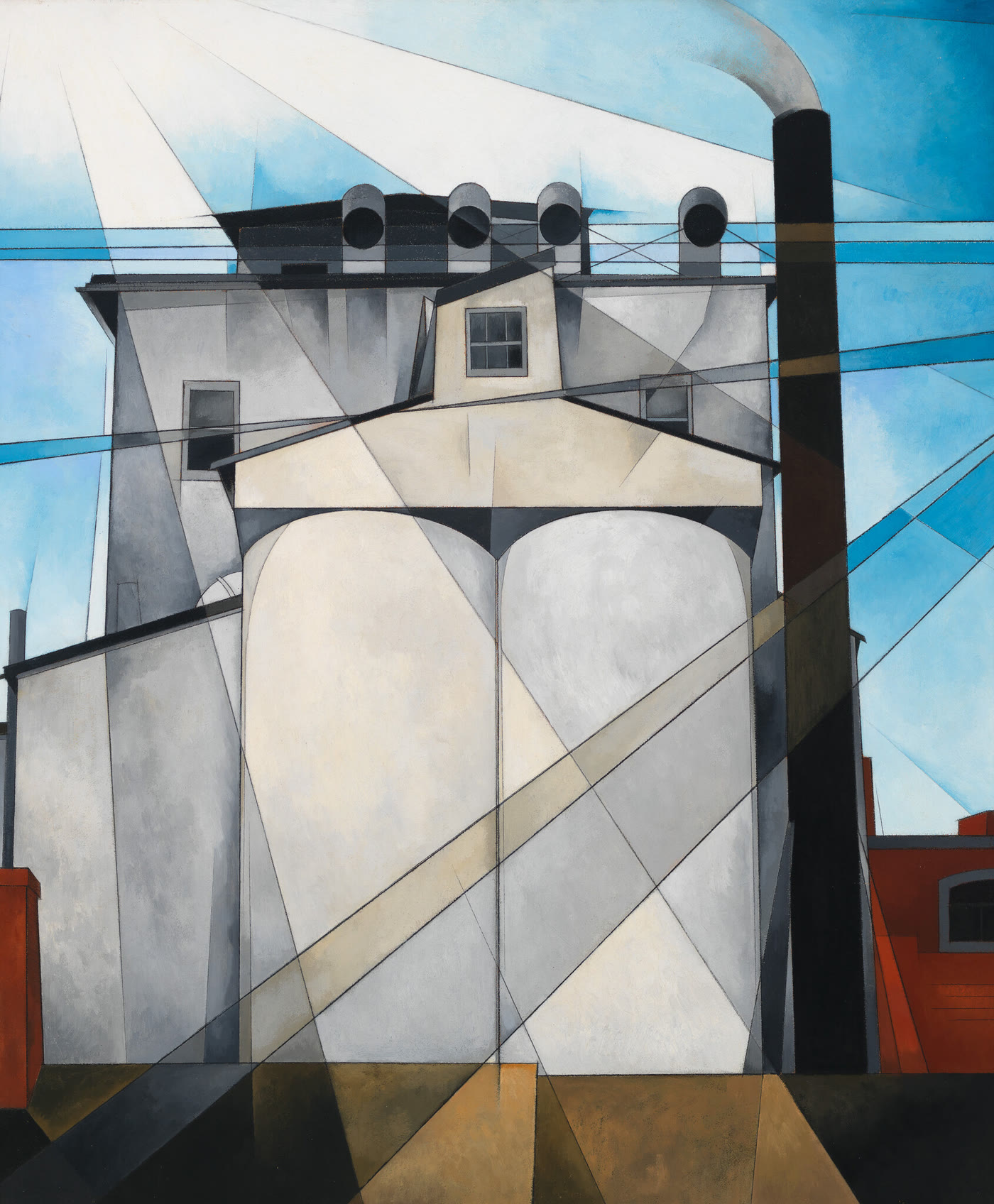
Image context: this article uses Charles Demuth's My Egypt because the painting compresses the movement's whole argument into one vertical form. The building is made monumental by low vantage and sharp geometry, but the polished surface and hard light prevent the monument from becoming uncomplicated praise.[2]
Precisionism was a style of control before it was a style of praise
The Met's overview remains the clearest starting point because it defines the style formally before it turns to ideology.[1] Precisionist artists reduced scenes to simple shapes and geometric structures, favored clear outlines and smooth handling, and borrowed from European movements such as Cubism, Purism, and Futurism.[1] But in American hands those formal habits were attached less to avant-garde manifesto culture than to the built landscape of new industry. Grain elevators, barns, office towers, machine parts, and bridges became the movement's favored subjects because they already looked like abstraction trying to pass as infrastructure.[1][3]
This is also why the style can be misread as naive optimism. The surfaces are so clean that viewers sometimes treat them as advertisements for progress. Yet Precisionism is usually more withholding than celebratory. Its paintings are notably depopulated. Workers vanish. Smoke becomes pattern. Architecture stands in for labor, capital, and public desire all at once.[1][3][5] The machine age arrives, but it arrives after people have stepped out of frame.
That distance is not a bug in the movement. It is the movement's signature. Precisionism turns modern life into a question of viewpoint: from what angle, and at what emotional altitude, can a new industrial nation picture itself without collapsing into propaganda or panic? Demuth, Sheeler, and Driggs answer differently, but each of them uses visual control as the way to stage ambivalence.
Demuth made the industrial monument both sacred and unsettling
Demuth's My Egypt is one of the movement's anchor works because it shows how much psychological pressure Precisionism could hold inside a nearly airless surface.[2] The Whitney identifies the subject as the John W. Eshelman & Sons grain elevator in Lancaster, Pennsylvania, painted from a low vantage so the structure swells into a monumental equivalent of an ancient pyramid.[2] That alone would make the picture a machine-age hymn. Yet the same object page notes a darker undercurrent: the title may invoke slave labor and the dehumanizing force of industry, while the pyramid's associations with death and afterlife mattered to Demuth during a period of severe illness.[2]
That double charge is the key to Precisionism as a whole. The painting looks immaculate, almost machine-made. Diagonal planes of light sharpen the elevator into an emblem, and the brushwork retreats so far that the surface verges on impersonal finish.[2] But the more controlled the image becomes, the more pressure builds underneath it. Demuth is not simply saying that American industry has achieved monumentality. He is asking what kind of spiritual life such monumentality permits. The answer is not stable triumph. It is reverence edged with confinement.
The wider Precisionist field helps explain why Demuth's painting mattered so much. The Met places the movement in the 1920s and 1930s moment when American painters sought a native modernism without abandoning representation.[1] My Egypt solves that problem by making industrial architecture do the work of both subject and symbol. It is fully recognizable as a grain elevator, yet it behaves compositionally like an abstract construction and emotionally like a modern ruin seen in advance.[1][2]
Sheeler gave the movement its coldest syntax
If Demuth supplied the movement's private intensity, Charles Sheeler supplied its system logic. The Smithsonian American Art Museum's artist biography emphasizes that Sheeler moved between painting and commercial photography, and that his Precisionist works were marked by sharply defined geometric forms shaped by industrialization and modernization.[5] That cross-media traffic matters because Sheeler's paintings rarely feel hand-spontaneous. They look filtered through the camera first, then rebuilt into a stricter visual order.
The National Gallery's essay on Classic Landscape makes that method explicit.[3] The painting grows out of Sheeler's engagement with the Ford River Rouge plant, and the NGA describes it as a culminating example of his effort to fuse abstraction's structural design with wholly realistic presentation.[3] That phrase gets to the heart of Precisionism's paradox. Sheeler is not abstracting away from the factory. He is using realism to prove how abstract the factory already is. Pipes, stacks, conveyors, and walls enter the frame as relations of interval, angle, and mass before they settle back into industrial subject matter.[3][5]
The emotional result is extraordinary and a little chilling. Sheeler's spaces are often silent, lucid, and emptied to the point of estrangement.[3][5] The plant becomes a landscape, but only after landscape has been rebuilt as a system of engineered volumes. Nature is not quite gone; rather, it has been disciplined into line, plane, and managed light. Precisionism at its coolest therefore does not celebrate motion. It celebrates stoppage, the moment when technology can be seen as pure arrangement.
Driggs proved the movement could carry doubt
Elsie Driggs is essential because she keeps the movement from reading as an all-male hymn to industrial mastery.[4][6] The Whitney's artist page identifies her as one of the few women to achieve real visibility in the 1920s and notes her association with Precisionism's geometric treatment of the industrial landscape.[6] Her 1927 painting Pittsburgh pushes that language toward a darker register. On the object page, the Whitney explains that Driggs returned to Pittsburgh to pursue a remembered vision of steel mills and later described the painting as her "Piero della Francesca," invoking structure, order, simplicity, and strength.[4]
That Renaissance comparison is revealing. Driggs did not paint the mill as a burst of speed or smoke. She painted it as a severe architecture of faith.[4] Yet the same Whitney text notes how ominous the result can feel, with gray smokestacks rising through haze in a way that suggests not only belief in technology but also a question about it.[4] Precisionism here becomes devotional and skeptical in one motion. The industrial plant is composed like a monument, but the monument does not fully trust its own god.
Driggs also exposes one of the movement's social limits. The Whitney notes that when she sought access to the mills, she was told it was no place for a woman.[4] That detail matters because it clarifies how often Precisionist vision is constructed from thresholds: from outside the plant, from the train window, from the overlook, from the photographer's chosen angle. The movement's distance is never purely optical. It is also institutional and social.
Why the movement still reads as American
Precisionism now looks less like a unified school than like a shared answer to a national problem.[1][5][6] How do you make modern art in the United States without merely importing Europe whole? One answer was to take new formal discipline and aim it at American infrastructure. Another was to discover that bridges, mills, grain elevators, and machine rooms were already generating a native iconography.[1][5] Precisionism helped invent that iconography, but it did so by emptying it of noise. Its America is legible, ordered, and newly monumental, though rarely comfortable.
That discomfort is part of the movement's continuing force. The Met notes that a second generation of Precisionists in the 1930s moved closer to abstraction and Surrealism, and that the confidence underlying the style was weakened by the political and technological violence surrounding World War II.[1] In hindsight that arc makes sense. Precisionism was strongest when American industry could still be pictured as both commanding and coherent. Once the machine lost its innocence, the style's frozen confidence became harder to sustain.
Yet the best Precisionist paintings still hold because they never relied on innocence alone. They knew that control has a cost. They knew that clarity can produce estrangement. Most of all, they knew that modern life often appears first not as speed, but as a strange calm after systems have taken command of the visible world.
60-second viewing drill
Try this on My Egypt, Classic Landscape, or Pittsburgh:
- Look for the first place where a real building starts behaving like a geometric sign.
- Check how much evidence of labor or human presence has been removed from the scene.
- Follow the light: does it warm the structure, or does it make the surface feel harder and more remote?
- End by asking whether the painting feels celebratory, devotional, anxious, or split between those moods.[1][2][3][4]
Sources
- Jessica Murphy, "Precisionism." The Metropolitan Museum of Art, Heilbrunn Timeline of Art History (June 2007).
- Whitney Museum of American Art, "Charles Demuth, My Egypt" (collection page).
- National Gallery of Art, "American Paintings, 1900-1945: Classic Landscape, 1931" (scholarly collection essay).
- Whitney Museum of American Art, "Elsie Driggs, Pittsburgh" (collection page).
- Smithsonian American Art Museum, "Charles Sheeler" (artist biography).
- Whitney Museum of American Art, "Elsie Driggs" (artist page).