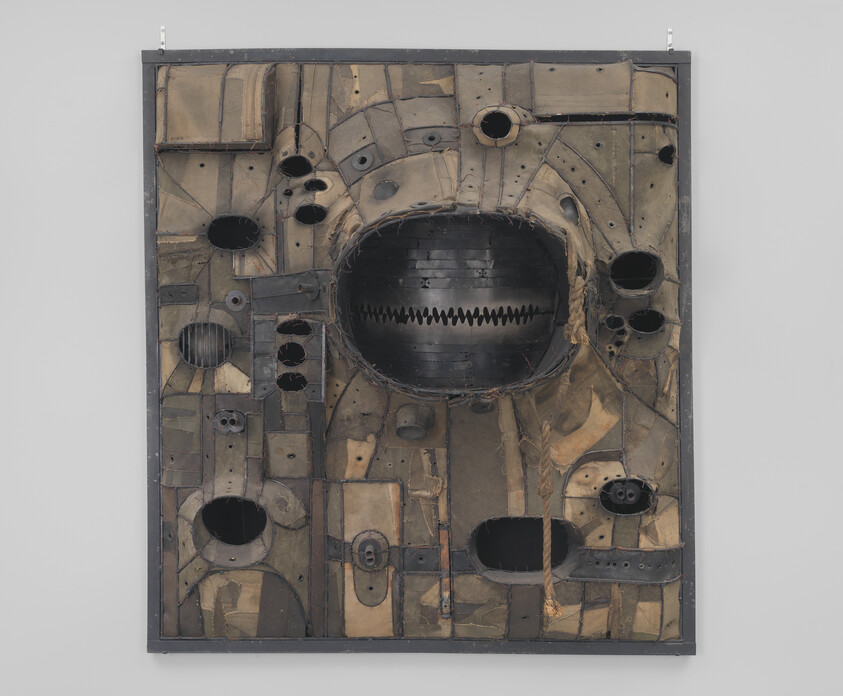
Lee Bontecou is often remembered through one immediate sensation: a dark opening in the wall, edged with stitched canvas and metal, looking half like an engine intake and half like a wound.[1][2] The sensation is real, but it can make her work seem narrower than it is, as though she were simply a sculptor of menace. Her stronger achievement was broader and stranger. Bontecou built a visual language in which machine parts, animal structures, geological cavities, and outer-space imagery could occupy the same object without settling into one stable meaning.[1][2][3]
That instability is exactly why the work still holds. In Bontecou's reliefs, fear is never merely symbolic. It is constructed. Steel is welded into armature, canvas is stitched like skin, found industrial fragments harden into teeth or vents, and a black interior recess keeps refusing to declare whether it is opening outward or sucking inward.[1][2] Her art does not just depict postwar anxiety. It gives anxiety a body.
Image context: the cover uses the Whitney's image of Untitled, 1961 because this single work shows how Bontecou's objects stay suspended between categories. The stitched canvas still remembers fabric, the steel frame still remembers industrial construction, and the dark center remains legible as both cosmic distance and immediate threat.[1][2]
1) Bontecou's art began where war memory met material intelligence
The biographical frame matters because Bontecou's forms did not come from abstraction in the purely formal sense.[5] The Smithsonian American Art Museum notes that she was deeply affected by World War II and remembered her mother wiring submarine parts in a factory.[5] That detail helps explain why machinery in her work never feels neutral. Metal arrives already charged with labor, conflict, and mass production. Even before viewers begin naming shapes, Bontecou's materials carry the twentieth century inside them.[5]
Her training widened that charge rather than smoothing it out. After studying with William Zorach at the Art Students League, Bontecou traveled to Rome in 1957.[5] SAAM says she became interested there in the "inartistic" objects she found in streets and machinery, while the Menil Collection's Drawn Worlds page emphasizes how she used welding torch and soot in drawings made during her Fulbright period.[4][5] That pairing is important. Rome did not turn Bontecou toward classical finish. It sharpened her attraction to residue, scorch, scrap, and improvised structure. The drawings and the reliefs belong to the same problem: how to make a surface feel as though it has survived heat, pressure, and collision.[4][5]
This is also why her work never reads like cleanly utopian space-age design. The Menil describes the postwar decades as a period when space exploration unfolded in the shadow of the Bomb, the Holocaust, and environmental anxiety.[4] Bontecou belongs exactly to that contradiction. She is fascinated by flight, distance, and the unknown, but she never treats technological progress as innocent. Her imagery keeps wonder and dread bolted together.
2) The wall reliefs matter because they behave like organisms built from industry
The Whitney's collection pages are the clearest evidence of how radical the wall pieces were.[1][2] Between 1959 and the mid-1960s, Bontecou made large reliefs by welding steel armatures and stitching salvaged canvas from the conveyor belts of the laundry below her Lower East Side studio.[1][2] She added rope, grommets, washers, and saw blades, producing objects that hang like paintings but project forcefully into the viewer's space.[1][2]
That technical description is already an artistic argument. Bontecou does not disguise construction. The stitches remain visible. The surface keeps the memory of having been fastened together. The relief is neither a polished shell nor a seamless sculpture. It looks assembled under pressure, which is why the finished work feels both physical and unsettled. A viewer registers the object first as a body, but an unstable one: half armored, half vulnerable.
Whitney's reading of Untitled, 1961 gets to the center of the matter. The museum notes that viewers can see camera lenses, engines, gun barrels, volcanoes, human orifices, insect shells, and celestial black holes in the same work.[1][2] That range is not decorative ambiguity. It is Bontecou's core syntax. She makes the industrial world feel biological and the biological world feel engineered. A saw blade can read like teeth; a stitched opening can read like a wound; a black recess can read like both a gun barrel and a cosmic abyss.[1][2]
Once that syntax clicks, Bontecou stops looking like an artist of one shocking motif. The voids in her reliefs are powerful not because they are simply dark, but because they keep changing scale. At one moment the opening feels bodily and intimate; at another it feels planetary, as if the object has folded an impossible distance into a wall-mounted surface. That ability to collapse scales is one reason the work still feels contemporary.
3) Cold War fear and space-age wonder occupy the same chamber
Bontecou herself was unusually explicit about wanting the work to belong to her moment.[2] The Whitney quotes her saying that she wanted her art to be "things and facts inside us, from war to the wonders of the space age."[2] That sentence is more useful than many later interpretations because it refuses the easy split between political reading and formal reading. For Bontecou, the form already carried the historical weather. War and wonder were not separate subjects waiting to be illustrated one after the other. They were simultaneous conditions inside the same structure.[2][4]
Glenstone's description of its 1962 Untitled helps make that visible from another angle. The museum describes a work that pushes outward from the wall while recoiling inward into three black holes, linking those voids to the 1960s fascination with the cosmos, the moon race, and space travel.[3] The outward-and-inward motion matters. Bontecou's objects do not merely confront the viewer. They also retreat into depths that cannot be fully entered. This recoil is what keeps the work from hardening into propaganda. If the reliefs only attacked, they would become illustrative. Because they also withdraw, they remain mysterious.
That mystery is one reason critics and viewers have kept returning to the same vocabulary of engines, mouths, wounds, shells, and craters.[1][2][3] Bontecou's objects invite those analogies and then outrun them. They are not metaphors pinned to a stable target. They are pressure chambers where the human body, military machinery, and cosmic imagination keep colliding. The work feels historical because it is saturated with Cold War tension, but it never becomes reducible to one news cycle or one policy fear.
4) Her later trajectory proves the achievement was not one decade of aggression
A weaker account of Bontecou would leave her in the early 1960s forever. The institutional record does not.[1][4][5] Whitney notes that she was the only woman represented by Leo Castelli in that celebrated male-heavy circle, then withdrew from the New York art world in the early 1970s and moved to rural Pennsylvania.[1] SAAM adds that the withdrawal was tied to disillusionment with the art world and to a desire to focus on motherhood.[5]
What matters is what happened after the withdrawal. The Menil's Drawn Worlds exhibition shows that drawing remained central across decades and that Bontecou's imagery kept extending beyond menace into what the museum calls mixtures of menace, strangeness, and marvel.[4] Seashells, birds, flowers, waves, imprisoning bars, black holes, and guns all move through the drawings.[4] That breadth clarifies the earlier sculptures. The dark openings were never the whole story. They were one part of a much larger attempt to think about how living and built systems occupy the same world.
Seen this way, Bontecou's importance lies beyond the famous black mouths of the 1960s.[1][2][3][4][5] She made postwar sculpture capable of holding incompatible pressures without resolving them: industry and anatomy, violence and curiosity, the factory and the cosmos, threat and wonder. Her work still feels severe because it never asks to be comfortingly decoded. It asks to be faced.
Sources
- Whitney Museum of American Art, "Lee Bontecou" - artist page on her wall-mounted reliefs, Castelli years, industrial materials, and later withdrawal to rural Pennsylvania.
- Whitney Museum of American Art, "Lee Bontecou, Untitled, 1961" - collection page describing the welded armature, salvaged canvas, found materials, and Bontecou's own "war to the wonders of the space age" statement.
- Glenstone, "Lee Bontecou" - artist page connecting the reliefs' black holes and voids to 1960s space-race culture while stressing the works' pull between abstraction and figuration.
- The Menil Collection, "Lee Bontecou: Drawn Worlds" - exhibition page on Bontecou's Rome Fulbright period, soot drawings, and the postwar mix of technological anxiety, natural imagery, and spatial invention.
- Smithsonian American Art Museum, "Lee Bontecou" - artist biography covering her World War II memory, her mother's submarine-factory work, Rome, and her early-1970s move to rural Pennsylvania.