Robert Rauschenberg's Open Score begins with a joke that is also an engineering problem. At the 69th Regiment Armory in New York, two players take up tennis rackets, strike a ball, and make the room respond. The sound of contact is not just amplified. It becomes a command. Each hit helps extinguish part of the lighting system until the performance space falls into darkness; then infrared television reveals a large group of people gathered where ordinary sight can no longer work.[2][3]
That sequence is why Open Score remains one of the clearest early tests of art as a live technical system. The performance, presented on October 14 and 23, 1966 as part of 9 Evenings: Theatre & Engineering, is often remembered as a landmark in artist-engineer collaboration.[2][4] But its force is more specific than the general phrase "art and technology" suggests. Rauschenberg did not bring machinery onto the stage as futuristic decoration. He made a sports gesture operate like a control surface: a bodily action triggered sound, sound drove darkness, and darkness made electronic vision necessary.
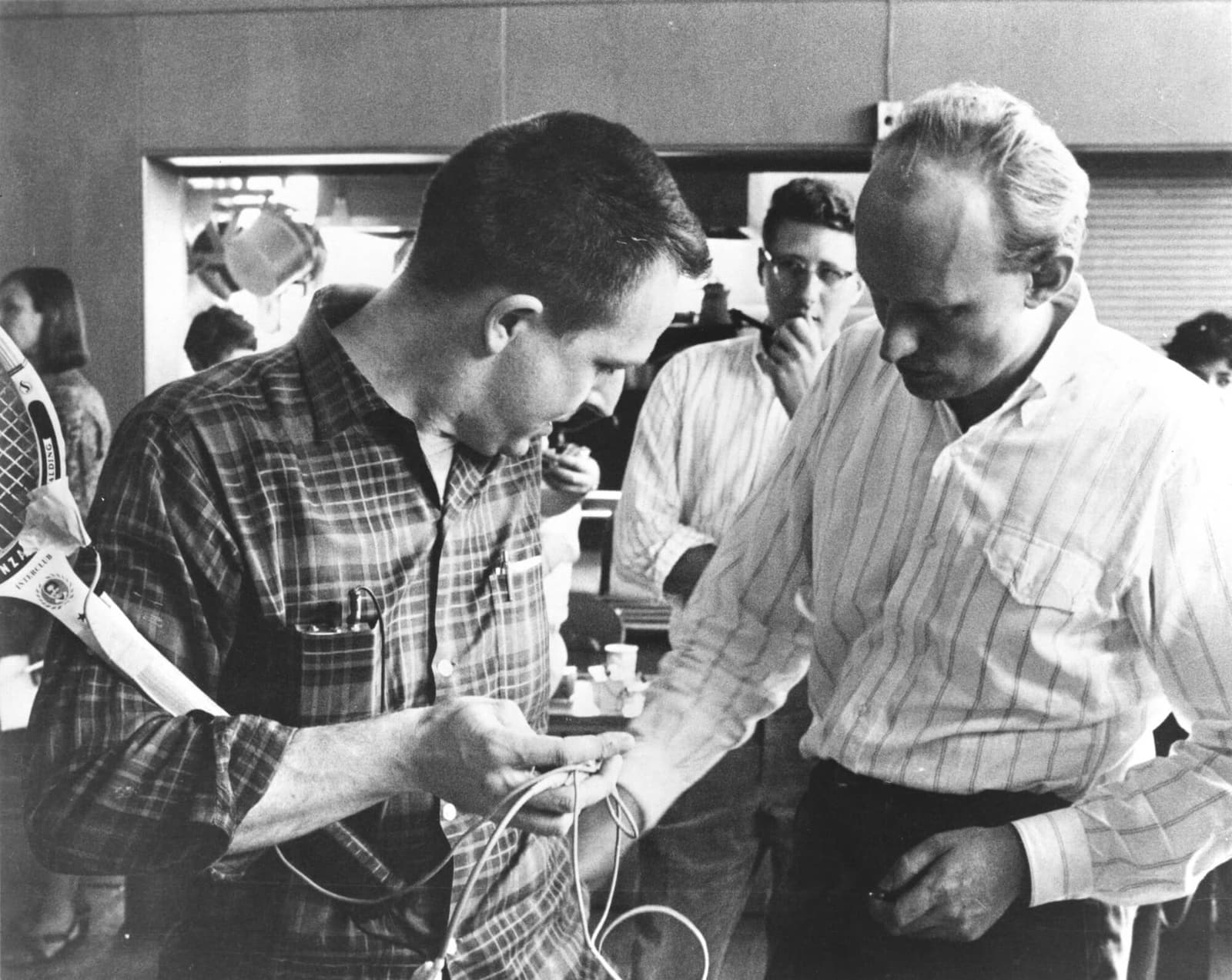
Image context: the lead image is a real archival photograph, not a diagram, chart, or generated visual. It shows the backstage premise of the work: Cecil Coker and Billy Kluver preparing electronically wired tennis rackets for a technical rehearsal at the Berkeley School Gymnasium in September 1966. The photograph is not merely contextual; it shows the exact kind of object that let the performance convert a familiar racket swing into a signal-bearing event.[1]
The Armory was not neutral space
The best clue to Open Score is the venue. Vivid Projects notes that Rauschenberg derived the performance from the characteristics of the space, where tennis was also played.[3] This matters because the tennis court was not imported as a quirky prop. It was a way of reading the building. The Armory already held military scale, public spectacle, and recreational use in tension. Rauschenberg turned that existing ambiguity into a score.
That score joined ten artists with engineers from Bell Laboratories across the larger 9 Evenings program.[4][5] Museo Reina Sofia's collection page emphasizes the interdisciplinary frame: artists linked to performance, music, and dance made original works for a project that mixed avant-garde theater with new technologies at the 69th Regiment Armory.[4] Open Score belongs squarely inside that experiment, but it is also unusually legible. You do not need to understand an entire control rack to grasp the piece. A racket hits a ball; the room changes.
That clarity is deceptive. The work makes causality feel simple while hiding a dense chain of mediation. LABoral describes the rackets as carrying FM radio transmitters in their handles, while the Rauschenberg Foundation's performance history credits radio-transmitting rackets to Bill Kaminski and the infrared-television system to Bill Hartig, Larry Heilos, and Jim McGee.[2][5] The names matter because Open Score was not a magic trick by a lone artist. It was a temporary infrastructure built by performers, engineers, volunteers, and a large room.
A racket becomes an interface
The wired racket is the work's central invention because it changes what a gesture is allowed to do. In ordinary tennis, a hit has athletic consequences: placement, speed, angle, error, score. In Open Score, the same hit acquires theatrical consequences. LABoral describes two participants playing tennis with transmitter-equipped rackets, while Vivid Projects gives the performance logic: every racket hit dimmed the venue lighting.[3][5]
This is not interactivity in the later museum-demo sense, where a visitor presses a button and receives an effect. The system is more unstable and more interesting. A competitive or semi-competitive action is routed into the building's sensory field. The players do not simply perform for the audience; they operate the audience's conditions of seeing. Each stroke changes the room's available perception.
That is why the piece feels closer to an interface than to a theatrical scene. The racket is not just a prop with electronics attached. It is an input device whose user is also a performer, whose output is distributed across speakers, lighting, and audience attention. Rauschenberg's title becomes exact. The score is "open" because it is not a closed image or a fixed object. It is a procedure through which ordinary actions can produce variable technical consequences.
Darkness is the second medium
The lights going out can sound like a stunt. In the piece, darkness is more disciplined than that. It removes the audience's default visual contract and replaces it with a technological one. Vivid Projects describes a second part in which a crowd assembled on stage in darkness and was filmed by infrared cameras; the Foundation's performance history records around 500 volunteers.[2][3]
The number is important because the crowd is not an incidental surprise. Rauschenberg scales the piece from two visible players to a mass that can only be seen through mediated vision. The first half of Open Score is built around measurable contact: ball, racket, transmitter, sound, light cue. The second half asks what remains of performance after ordinary visibility fails. Infrared television does not restore a normal view. It produces a different image regime, one in which bodies appear because a machine can see where the audience cannot.
This is the point at which Open Score becomes more than an elegant artist-engineer anecdote. It asks whether technology expands perception or reorganizes authority over perception. The audience sees because the system permits seeing. The performers appear as a crowd because the system translates them into an electronic image. The work's theatrical drama sits inside that dependency.
Collaboration is the form, not the backstory
Rauschenberg's later reputation can make the engineering collaboration seem like a footnote to an artist's idea. The sources push against that. The Rauschenberg Foundation's art-and-technology overview places 9 Evenings in a longer chain running from Rauschenberg's work with Billy Kluver on Jean Tinguely's Homage to New York through Oracle, then into Experiments in Art and Technology and later works such as Soundings and Mud Muse.[6] In that history, collaboration is not a service layer. It is one of the media.
The same page is useful because it does not romanticize the event as a smooth triumph. It notes that the performances premiered with trials and errors of new technology and that some reviews were hostile, even as later assessments found durable propositions inside the experiments.[6] That tension is exactly right. Open Score mattered not because the machinery disappeared into flawless illusion, but because the machinery became visible as a condition of the artwork.
New-media art often inherits this problem. If the technology works too invisibly, it risks becoming spectacle without thought. If it fails too loudly, the piece collapses into demonstration. Open Score sits in the productive middle. It lets the viewer feel the chain from hit to signal to darkness to infrared image. The work is not about gadgetry; it is about what happens when a live room is wired so that gesture, sound, light, and image are no longer separate categories.
Why it still reads as contemporary
The contemporary afterlife of Open Score is not that tennis rackets can be sensors. That lesson is now trivial. The lasting point is compositional: Rauschenberg understood that a performance could be structured as a responsive system before "responsive" became a default cultural word. He treated the room as a network of inputs and outputs, but kept the inputs stubbornly human: a swing, a sound, a gathering crowd, a body seen only after the lights fail.
That is why the archival rehearsal photograph is so compelling. It shows engineers handling rackets before the event has become art history.[1] The objects look practical, not mythic. Their significance lies in the connection they are about to make possible. Once the rackets enter the Armory, they do not represent technology. They route action through it.
For art-and-tech work now, Open Score remains a useful standard because it refuses both easy novelty and easy nostalgia. The piece is not impressive merely because electronics were hard in 1966. It is impressive because the electronics served a precise perceptual argument. Rauschenberg made a familiar game expose the hidden systems that decide what an audience can hear, when it can see, and how a live body becomes an image. The racket was only the handle. The real artwork was the room becoming controllable, and then becoming strange.[2][3][5][6]
Sources
- Robert Rauschenberg Foundation, "9 Evenings technical rehearsal" - archival photograph record identifying Cecil Coker and Billy Kluver preparing electronically wired tennis rackets for Open Score at a September 1966 technical rehearsal.
- Robert Rauschenberg Foundation, "Performance History" - official chronology entry for Open Score, including October 14 and 23 performances, radio-transmitting rackets, infrared-television system credits, performers, volunteers, and review bibliography.
- Vivid Projects, "9 EVENINGS: Open Score" - project page summarizing Rauschenberg's use of the venue, the racket-triggered dimming of lights, and the infrared-filmed crowd in darkness.
- Museo Nacional Centro de Arte Reina Sofia, "9 Evenings: Theatre & Engineering. Open Score" - collection page for the film documentation, situating 9 Evenings at the 69th Regiment Armory and identifying the participating artists and technological frame.
- LABoral Centro de Arte y Creacion Industrial, "Open Score" - artwork page summarizing the E.A.T. context, the two tennis participants, FM radio transmitters, gong sounds, lights going out, and infrared cameras.
- Robert Rauschenberg Foundation, "Creative Synergy: Art and Technology" - foundation overview connecting Rauschenberg's Kluver collaboration, 9 Evenings, E.A.T., and later technology works including Soundings and Mud Muse.